


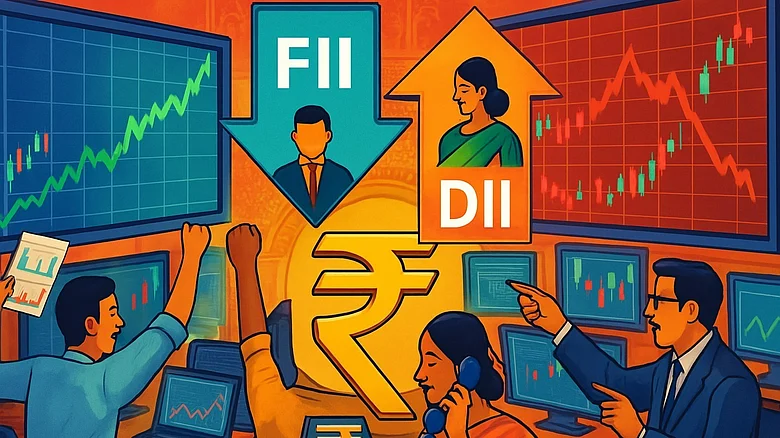

Foreign portfolio investors poured a record ₹949.6 billion into Indian equities, reversing earlier heavy outflows.
Crude oil volatility, sticky inflation above the RBI band, and global AI trade jitters threaten a quick market reversal.
Resilient corporate earnings support valuations, but future market gains depend heavily on actual corporate delivery.
Foreign portfolio investors poured a record amount into Indian equities in November in a bid to diversify from the crowded artificial intelligence trade abroad and to own a part of companies that showed resilient balance sheets in the September quarter. This buying frenzy helped the Nifty 50 index reclaim a nine-month high on Tuesday, erasing all losses since the war in West Asia started.
After selling roughly ₹350 billion in September and October each, foreign institutional investors have bought a net ₹949 billion worth of equities in November so far. This marked the highest single-month foreign equity investment.

1 November 2026
Get the latest issue of Outlook Business

However, a sudden gush of liquidity has raised questions over whether this marks the beginning of a return of foreign investors, or whether India is just a tactical hedge against AI-related jitters in foreign markets. Inflows driven by tactical bets rather than a structural allocation are often made for short-term gains and can quickly reverse.




"This is a tactical re-entry, not yet a structural reallocation"Nikunj Saraf, Chief Executive Officer of Choice Wealth, told Outlook Business
Advertisement
Unlike a few months ago, the AI trade may not be firing on all cylinders, but it still has supporters among large brokerages. Meanwhile, the war in West Asia is still ongoing, posing a risk that oil prices may whipsaw again and put further pressure on the macroeconomic health of the country and corporate profitability.
“This is a tactical re-entry, not yet a structural reallocation,” Nikunj Saraf, Chief Executive Officer of Choice Wealth, told Outlook Business. “The triggers are cyclical: Brent crude oil cooling from about $118 to the low-$90s, a firmer rupee, and India as a relative safe haven while the global AI trade wobbles. With FIIs still net sellers of around ₹2.1 trillion in 2026, I’d treat this as a defensive hedge that only becomes structural if earnings and the currency hold.”
Advertisement
Whether Indian companies are able to carry the strong earnings momentum of the two trailing quarters into the current quarter will be the key to determining the domestic market’s attractiveness to foreign investors. A tighter monetary policy and rising yields on US bonds will also test the resolve of foreign investors.
Some of these concerns are already reflected in the market, where foreign investors are re-entering long positions selectively, rather than engaging in a broad-based buying spree. The Nifty 50 – which houses all the large-cap players – has risen 10.1%, while the Nifty Smallcap 250 and the Nifty Midcap 150 indices have risen 5.9% and 7.6%, respectively, so far in November. Meanwhile, bank stocks, where FIIs have the most exposure among other sectors, have risen sharply, pushing the Nifty Bank index to a record high of 62,436.70 points on Tuesday.
“The durability of FII (Foreign Institutional Investors) inflows depends on strong domestic earnings growth for Q3 of the current fiscal year and valuations; the Nifty 50 PE ratio of 20.5 is neither low relative to other emerging and Asian markets nor to India’s own history,” said Apoorva Javadekar, Chief Economist, Shriram Group. “Earnings have been resilient, but the EPS (earnings per share) forecast at 14.5% for FY27 trails 19% EPS growth projections for emerging markets.”

The Democratic Party’s victory in the US midterm elections has lowered the risk of extreme oil prices, and investors will continue diversifying away from AI and the US. Foreign investors are realising that they are heavily exposed to both themes, with roughly 70% of cross-border equity flows in 2026 ending up in the US, Javadekar said.
Foreign investors rotated out of Indian equities for the majority of 2026 as two key issues brought down the bull case. First, the artificial intelligence trade – a term for investments across the AI value chain – sparked a gold rush in several global markets. Investors pumped money into markets with direct exposure to the theme and reduced their positions in India, where financial services and software companies sway headline indices more than other sectors.
Second, the US and Israel’s strikes on Iran led to an effective closure of the Strait of Hormuz – a critical chokepoint through which 20–25% of global seaborne oil flows were transported before the war in West Asia. As the war took its toll on the production capacity of several key crude oil refiners, the supply squeeze sent the price of the commodity soaring. High oil prices are a key negative for India, which imports nearly 90% of its annual crude oil demand. A sustained rise in oil prices also increased India’s import bill, put pressure on the rupee, and added to inflationary pressures.
The inflection point in foreign funds flow came in November, when the Democratic Party swept the US Congress, which increased odds of tougher regulation on AI infrastructure build-out. Investors were already eager to diversify away from crowded AI bets, which have been under scrutiny over high debt and low profitability of companies in the sector.
US President Donald Trump losing control of Congress, coupled with shipments from West Asia touching pre-war levels, has also eased some supply concerns in the energy market. The front-month futures contract of Brent crude oil declined nearly 19% in November, partly alleviating another overhang from Indian equities.
Warning signs
Despite positive developments, many analysts warn against reading the November inflows as a durable structural reallocation by foreign investors.
“November’s inflows are real, but they are not sticky enough to withstand sustained $100-plus crude and a roaring Nasdaq together,” said Saraf of Choice Wealth. “High crude oil prices are the single clearest reversal risk… every $10 increase in Brent simultaneously lifts bond yields, pressures the rupee, and squeezes corporate margins – the exact inputs that pulled FIIs out earlier this year.”
Several global brokerages still see a large upside to AI-related names, such as Morgan Stanley, which is “max overweight” on global equities. The brokerage said an intact artificial intelligence capital expenditure cycle should carry resilient economic and earnings growth into next year. A correction in AI names, therefore, could spark a “buy on dips” trading approach when valuations of these companies become attractive once again. AI giant Anthropic’s Nasdaq debut on 19 November will test the demand for AI names.
Apart from oil and the AI trade, foreign fund inflows also depend on domestic earnings growth and the macroeconomic health of the country. Indian companies have reported resilient earnings despite an increase in input costs over the last few quarters. However, this growth has lagged the profitability increase in other markets, where AI supply chain players reported record profits.
December quarter earnings will likely show some margin moderation as those input costs flow through and the festive demand base normalises, Saraf said. The structural allocation narrative “survives if companies defend margins and inflation eases toward 5% by Q4 – at which point FIIs have a reason to stay. It frays if crude stays high and earnings momentum stalls,” added Saraf.
Echoing this view, Pabitro Mukherjee, Deputy Vice President–Research at Bajaj Broking, said the impact of the earlier rise in crude oil and other commodity prices may become more visible in upcoming quarters as higher input, transportation, logistics, and energy costs gradually feed into corporate results. This could put pressure on margins, particularly for companies that have limited pricing power or depend heavily on imported raw materials. If this is accompanied by slower revenue growth or earnings downgrades, it could make Indian equities less attractive at current valuations and weigh on foreign investor sentiment, Mukherjee added.
However, as June and September quarter results show, not all looks grim on the earnings front. The 2,979 companies that declared numbers in the September quarter reported a 22.3% sales growth and an impressive 29.2% earnings growth, V.K. Vijayakumar, Chief Investment Strategist at Geojit Financial Services, noted. This appears to be a sustainable capital inflow from foreign portfolio investors, Vijayakumar said, adding that if demand in the economy sustains, many companies can fund their investments from internal accruals, offsetting the impact of a high-interest-rate environment.
Following strong September quarter results, brokerage Motilal Oswal Financial Services raised its earnings-per-share estimate for Nifty 50 companies in FY27 by 0.9% to ₹1,243. It raised its FY28 EPS estimate by 1.4% to ₹1,427. Saraf of Choice Wealth said forward multiples have eased and Indian equities now look reasonable, although they are still not cheap. “From here, re-rating has to be earned by delivery, not driven by liquidity – so the valuation cushion is real but not unlimited,” said Saraf.
Long-term inflationary pressure
The effects of high crude oil prices will linger long after prices normalise, analysts said. The consumer price index rose to 6.09% in October, up from 5.54% in September and breaching the Reserve Bank of India’s upper tolerance band. The wholesale price index also jumped 90 basis points month-on-month to 12.3%. Taken together, the two readings pose a risk to consumer demand and highlight input cost pressures for manufacturers.
The RBI ended its easing cycle and raised the benchmark repo rate by 25 basis points to 5.5% in October, noting broad-based inflationary pressure. Saraf identified a 10-year G-Sec yield sustainably above 7.5%, paired with a 6.25% repo rate, as the pain threshold where incremental project internal rates of return and corporate credit demand begin to stall.
Javadekar, however, said that rate hikes will choke private capital expenditure plans not through corporate borrowing costs, but by squeezing household discretionary spending. Indian household debt sits near 50% of GDP, up from 35% pre-COVID, and is largely tied to floating rates. Hence, rising monthly repayments, along with negative real wage growth and deteriorating consumer sentiment since February, threaten to pull back consumption, which in turn will stall corporate capex plans, Javadekar said.
Currency risk is another factor that will determine FII flows going forward. The rupee has appreciated 1.3% against the dollar so far in November, buoyed by a fall in crude oil prices. However, analysts noted that a wider trade deficit, coupled with high foreign exchange hedging costs due to the RBI’s measures to support the domestic currency, has added to the risk of depreciation. Ultimately, until crude oil volatility subsides, US bond yields stabilise, and Indian corporate earnings deliver a sustained beat, foreign inflows will remain a tactical balancing act rather than a permanent structural shift.