



Goldman Sachs has upgraded Indian equities to ‘overweight’ and projects the Nifty 50 to hit 28,500 by end-2027.
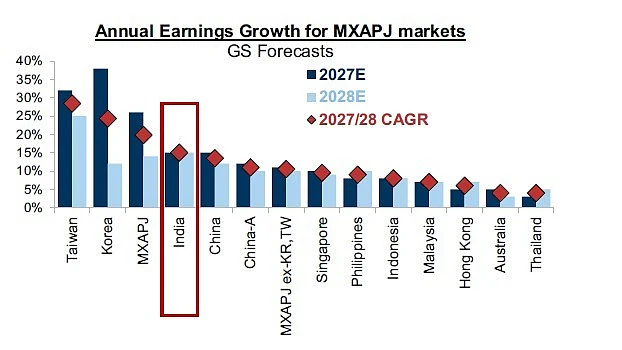
MSCI India profits are forecast to grow 11% in 2026 and 15% annually over the next two years, outpacing most regional peers.
Real GDP growth is seen moderating to 7.2% in 2027 and expected RBI rate hikes to 6.25%.
Global brokerage Goldman Sachs has upgraded Indian equities to ‘overweight’ and expects the benchmark Nifty 50 index to rise to 28,500 points by the end of 2027. Against the Nifty 50’s 18 November close of 25,227.95 points, this implies around 13% price upside.
Better-than-expected earnings, strong domestic demand and the lowest foreign ownership in more than a decade position India as an attractive destination for investors looking to diversify away from the artificial intelligence trade, the brokerage argued.

1 November 2026
Get the latest issue of Outlook Business

Indian equities have underperformed markets emerging markets in Asia-Pacific for two years, which has happened only twice in the last three decades. Both instances were followed by a 38 percentage point rebound, Goldman Sachs noted. India’s returns have lagged other emerging markets due to a slowdown in domestic growth, an oil price shock, weaker rupee, and investor preference for AI names.
However, with the domestic market’s relative returns now significantly below historical trends, a mean reversion is likely.
Goldman Sachs expects the Nifty 50’s upside to be driven by earnings momentum, with no valuation expansion factored into its target for the headline index. In fact, the brokerage’s valuation model suggests that the forward price-to-earnings (P/E) ratio will decline by 2–3% over the next 12 months, as foreign inflows will likely be offset by selling from domestic funds sitting on very low cash levels.
Advertisement
The forward price-to-earnings (P/E) multiples have come down from their 2024 peak of around 25 times and are now close to their 10-year average, which lowers the risk of investment the brokerage said. In the bull case, valuations could rise by 7–8%, while the bear case would see a de-rating of 10–12%.
Strong Earnings Drive Optimism
Corporate earnings have been higher than expected for five quarters in a row due to resilient domestic demand, which is likely to remain strong, Goldman Sachs said. Easing monetary measures in 2025 and a limited oil-price pass-through to end-consumers this year supported demand.



September-quarter earnings reflect that demand has broadened out from downstream consumer-sensitive names to midstream and upstream capital expenditure-sensitive layers of the economy, Goldman Sachs said. It is also positive on corporate commentary highlighting exceptionally strong demand that outweighs rising input-cost concerns. A strong September quarter has led to an upward revision in earnings per share for the first time in two years, with consensus projections rising 1% quarter-to-date, the brokerage noted.
Advertisement
Goldman Sachs expects MSCI India profits to grow 11% in 2026 and 15% in each of the two successive years. This is slightly below consensus expectations as the brokerage has pencilled in the impact of higher cost inflation. “We expect earnings growth to be above consensus in financials, but below consensus in exporters [IT] and consumer-sensitive [companies],” Goldman Sachs said in a report.
Despite expecting slower-than-consensus net profit growth, the brokerage said India’s growth appeal will come back into focus as earnings growth in tech-heavy markets moderates. Barring South Korea and Taiwan, India will likely see the strongest earnings growth in the region over the next two years, according to the report.
“The AI capex cycle [is] slowing down, which means it actually has a more disproportionate impact on earnings and markets than on growth,” said Sunil Koul, global emerging markets equity strategist at Goldman Sachs. This will likely improve risk appetite among investors, encouraging them to build positions in non-tech pockets of emerging markets, he said.
Slower, But Resilient GDP Growth
Goldman Sachs expects India’s real GDP growth to moderate to 7.2% in 2027, compared with a projected 7.9% in 2026. Tighter financial conditions and the fading effects of Goods and Services Tax (GST) cuts will likely drive this slowdown.
Additionally, the brokerage expects headline inflation of 5.7% year on year in 2027, amid El Niño-related weather disruptions and high input costs, which supports the argument for further monetary tightening. The Reserve Bank of India’s Monetary Policy Committee will likely raise the repo rate to 6.25%, implementing three more 25-basis-point hikes, Santanu Sengupta, chief India economist at Goldman Sachs, said.
However, this GDP growth is still “remarkably resilient”, the brokerage said. US tariffs on India, equity portfolio outflows and the energy shock due to the war in West Asia have failed to deter the country’s growth, thanks to timely fiscal support, earlier monetary easing and strong credit growth.
A nascent recovery in the private capital expenditure cycle is also expected to support India’s growth. In 2026, capex growth for companies in the NSE 500 index accelerated to 17% year on year—the second-highest level in a decade—driven by utilities, energy, automobiles, capital goods and materials.
Goldman Sachs also believes the worst is over for the rupee due to robust services exports, high remittances and improved capital flows. Over the next 12 months, the currency is expected to stabilise around 96 per US dollar. The brokerage expects India’s current account deficit to remain at around 1% of GDP over 2026 and 2027.
Top Sector And Theme Recommendations
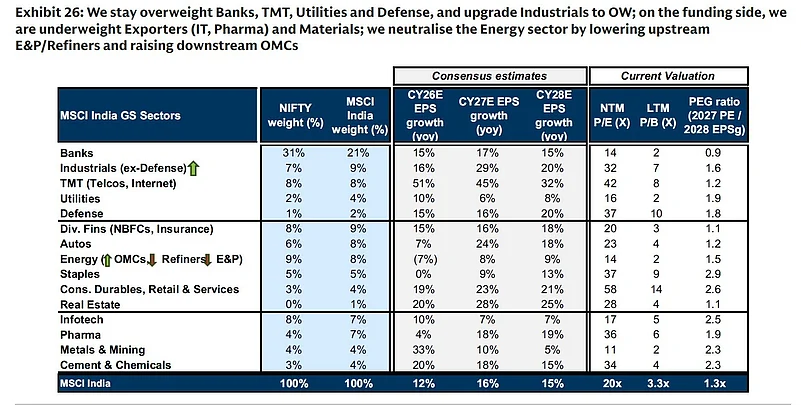
The brokerage is ‘overweight’ on banks due to expectations of further rate hikes, low valuations and light positioning. It upgraded industrials to the ‘overweight’ category on the back of stronger earnings growth projections, and is also ‘overweight’ on defence, utilities, telecommunications and internet stocks.
Meanwhile, Goldman Sachs has maintained an ‘underweight’ position on information technology, healthcare, metals, cement and chemicals, while remaining ‘neutral’ on energy stocks. Investment cyclicals such as energy security, defence, AI enablers, premium consumption, internet and new-age companies, and private banks were the brokerage’s recommended themes.
The table below shows the brokerage’s upgrades and downgrades: