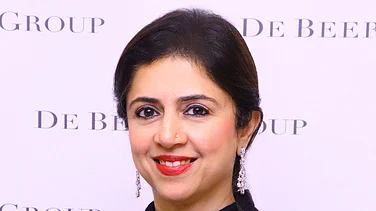
Whenever companies led by women receive public visibility, the framing is often “woman founder” first, says Neha Juneja, co-founder of IndiaP2P and EquiRize. According to her, this approach does more harm than good.
“If I get an opportunity to speak at an event, which start-up founders value because it is a great way to promote and talk about our businesses, the focus is always on the ‘woman’ part. I barely get to talk about what we actually do. I am interested in telling people about our business, not about who I am personally or how I manage things,” she says.
Speaking about the funding gap between men and women founders, Juneja adds that one practical solution would be for venture funds to internally track how much capital is allocated to men versus women founders.

4 July 2026
Get the latest issue of Outlook Business

In an interaction with Outlook Business, she talks about how to mitigate the gap between men and women founders, whether women founders should have separate funds, and the need to give more funding to women.
Edited Excerpts
Despite the rapid growth and global recognition of India’s start-up ecosystem, women remain significantly underrepresented among founders. From your perspective, what explains this persistent disparity?
I don’t think we lack women founders. We have plenty of women running and scaling businesses. That said, it is unrealistic to expect the number to be 50–50. Nowhere in the world is it truly 50–50 for various reasons.
However, while there may not be a shortage of women founders, there is definitely a gap in how much funding they receive. That gap is very real. This is also why most funds do not present gender-disaggregated data. They may share how many women co-founders or founders they have backed, if at all, but they rarely disclose how much capital actually goes to those companies.
Even if 20% of founders are women and 80% are men, the funding split is not 80–20. It is often closer to 96–4, or sometimes even 99–1. That is where the real disparity lies.
I don’t think there is a dearth of educated or ambitious women in India. But there is definitely some form of bias that still exists among those who control capital.

In your journey as a founder, did you ever feel that when you were going for funding sessions, when you were talking to VCs, did you ever feel that you were first addressed as a woman and then as a founder?
Not so much in front of serious VCs. I wouldn’t say being a woman has been either an advantage or a disadvantage in that context. Fortunately, we have VCs on our cap table where there has been no problem or bias whatsoever. But by and large, whenever we get any kind of public visibility as a company or as a founder, the framing is “woman founder” first. That is not helpful at all.
If I get an opportunity to speak at an event, which start-up founders like to do because it is a great way to promote and talk about our businesses, the focus is always on the “woman” part. I barely get to talk about what we actually do. I am interested in telling people about our business, not about who I am personally or how I manage things. That is irrelevant.
It may seem like a small thing, but it is actually a big problem. It is frustrating and it puts us at a disadvantage. Public exposure and networking become automatically harder for women because the attention shifts away from the business and onto the fact that the founder is a woman.
Even in something as basic as Google searches, when people look up a woman founder’s name, one of the first autocomplete suggestions is often “husband.” There is an underlying assumption that some man in her life must be helping her. If you take any well-known woman founder and type her name into a search bar, you will likely see “husband” among the top suggestions. This does not happen with men.
There is still an emphasis on creating “women founders” panels. But that often becomes a token exercise. I want to be on a panel with my peers — people running similar businesses or operating in the same industry. I do not want to be featured in a separate category called “women’s success.” That framing reduces it to a subset of success rather than success itself. It feels like a perpetual silver medal — never the gold. And that is what needs to change.
There seems to be a debate around whether dedicated women-focused funds are the solution, or whether they inadvertently reinforce segregation in the ecosystem. In your view, what is the most effective way to close the funding gap for women founders?
I don’t believe we need separate women’s funds. Those funds tend to be small, and they will never truly solve the problem. More importantly, the message that women-only VC funds send is that other funds do not need to back women because this one fund is addressing the issue. That is not the case.
Women need equal opportunity, which means equal access to the entire pool of available capital. However, I think the problem must be addressed from both sides. First, while India does have many women entrepreneurs, we still need more. We need to encourage women to start businesses from a young age. Within our social structure, there is still some discouragement when it comes to women pursuing independent careers or building businesses.
If you look at the data since around 2015, women’s participation in India’s labour force has declined over the past decade. That should not be happening. I initially wondered whether this was because men’s participation had increased significantly, but that argument does not hold. We have highly educated women dropping out of the workforce.
Part of the reason is that while women have become more independent, many men have not. There is still a structural imbalance in expectations at home. Women are often expected to manage both careers and domestic responsibilities. We need more independent men who do not rely on women to take care of their lives. Addressing this social imbalance is critical.
On the funding side, many funds may not even realize that they have fewer women founders in their pipeline. They may be unintentionally overlooking strong women entrepreneurs. One simple step would be to encourage capital providers, not through regulation but through internal accountability, to track gender-disaggregated data. Funds should at least examine how much capital they allocate to women versus men.
Once that data is visible, investors may realize that funding women is not just a matter of fairness. It is also a missed economic opportunity. Currently, only around 2.5 per cent of VC funding goes to women founders. When faced with that reality, perhaps the imbalance, whether it is 95–5 or 97.5–2.5, will begin to shift.

How does not having women in the economy harm us?
If you look at other peer economies, whether it is China, Vietnam, Indonesia, or any comparable country, their female labour force participation rates are at least double ours. There are enough economic studies to show that India cannot significantly increase its per capita income, meaning we cannot become richer as a country or as individual citizens, unless more women participate in the workforce. Yet that has not been happening. Over the last ten years, the number has remained stagnant or even slightly declined, which is deeply concerning.
The past decade has been a technology decade. We have seen the widespread adoption of mobile phones, the rise of work from home, digital platforms, and massive technological transformation. And yet, women in India have not been able to capitalize on these changes to increase their workforce participation. That is a serious concern because increasing women’s participation is perhaps the fastest and most effective lever for raising per capita income.
Coming to casual discrimination, it can take many forms. It may be a question someone asks that they would never ask a man. It could be the way someone looks at you or speaks to you simply because you are a woman. Is that something that you faced?
In my previous venture, we had a factory. I am an industrial engineer by training and have spent a great deal of time in factories. At our own factory, if I touched a machine, some workers would perform a cleansing ritual afterwards because a woman had touched it. This was in my own company.
When this first happened, we addressed it and corrected it. At Greenway now, we have a high proportion of women staff, and such practices are not tolerated. But similar experiences go back to my college days. There were about 1,500 students in my department, and only five were women. During a visit to a railway yard in Delhi, the foreman initially refused to let us enter the workshop area. Our professor intervened and insisted that we be allowed in. After we completed our survey, there was an attempt to make us perform a ritual for “cleansing” the machines. Our professor firmly refused and said that none of the girls would participate in such nonsense, and neither would the boys condone it. That kind of support made a difference.
Now, whenever someone makes a discriminatory remark, whether politely or otherwise, I respond.
Around occasions like Women’s Day, tokenism becomes visible again. Whether it is being labelled a “woman founder” or being limited to symbolic discussions, bias persists both at home and at work. The real question is where the gap should be addressed.
From my experience, both of my ventures have focused on women consumers. For many Indian women, the workplace expects you to operate in the 21st century, while the home expects you to remain in the 19th century. There is a two-century gap.
Workplaces are gradually becoming more supportive. We see more women participating, and there is growing awareness about bias. But change at home has been much slower. In our portfolio, many borrowers are women who run rural or semi-urban businesses that are small but scaling. These women have no difficulty learning how to improve their businesses. They learn how to sell on Amazon, how to market digitally, how to network with larger buyers. They are good at delegation, budgeting, and scaling operations.
However, many are still uncomfortable delegating responsibilities at home because of social expectations and stigma. That is where the deeper challenge lies. Cultural norms make change difficult.
We may need a broader social campaign that encourages men to become more independent. We need more independent men who share domestic responsibilities and do not assume that women will manage everything at home.
How can we make the start-up ecosystem more equal?
In the start-up ecosystem specifically, I do not believe that venture capitalists or private equity investors deliberately avoid funding women. They are in the business of generating returns. However, some form of filtration bias may creep into the system.
One practical solution would be for funds to internally track how much capital goes to men versus women founders. This is not about mandating quotas or special treatment. Business cannot run on preferential treatment. But funds may realize that they are not meeting enough women founders, or that their pipeline is too narrow at the top of the funnel.
If investors begin systematically recording, and perhaps even reporting, gender-disaggregated funding data, that awareness alone could start correcting the imbalance.