


From a distance, the Defence Research and Development Organisation (DRDO) booth looks promising with a sizeable figurine of a soldier wearing an electronic headgear. The other stalls around it are mostly of state government departments and bereft of any significant footfall. Of course, they can’t compete with the unmistakable lure of the national defence lab’s exhibits.
But visitors to the DRDO booth don’t maintain their excitement for long. The headband is fitted with sensors that can create a map of the surroundings—and is useful in areas where the global positioning system doesn’t work. However, it is emblazoned with the logo of ZED—a brand of camera manufactured by a US-based company called Stereolabs.
Another exhibit in the stall is a sturdy box that translates Mandarin to Hindi, but there’s no large lang-uage model (LLM) inside. What’s worse is that it works on a central processing unit, not even a graphics processing unit. Maybe it will be useful on the border to eavesdrop on the Chinese? No, its efficacy drops fast beyond a few metres. The excitement fades as visitors learn about this.

1 October 2026
Get the latest issue of Outlook Business

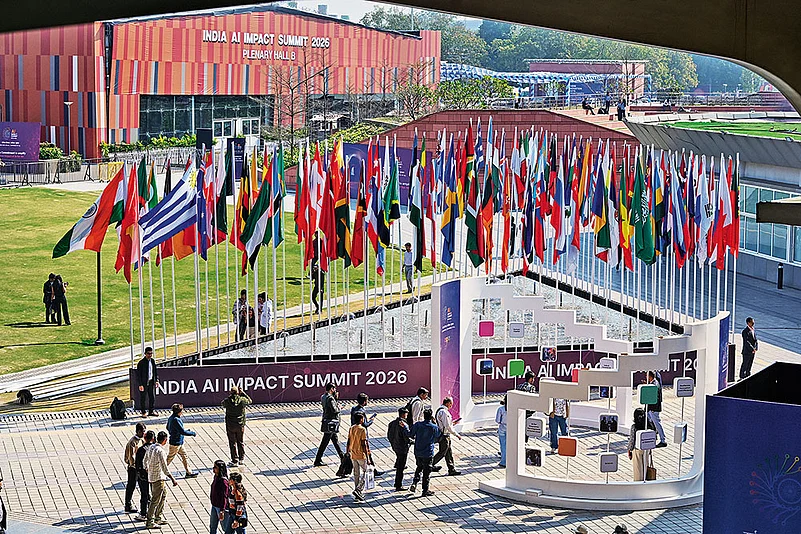
As this theatre of technology plays out inside a gargantuan exhibition hall in the heart of Delhi, a senior minister takes to the podium a few hundred feet away. He tells the global audience that India has achieved a world record for the number of pledges taken by people to use artificial intelligence (AI) responsibly.
While India tried to put its best foot forward in a week-long conference last month to show its progress in AI technology, the country unwittingly laid bare to the world its challenges.
There were pockets of spark. Three Indian start-ups unveiled their homegrown AI models. A bevy of commitments to invest billions of dollars in local data centres was made. Heads of state and czars of the technology world graced the carnival. But there were no technological breakthroughs that could create ripples globally.
“The summit was good for optics and undergraduate students, not for the rest,” said a tech founder who did not wish to be named. “None of the start-ups looked exceptional. Many seemed just a few GPT or Claude updates away from going out of business,” he added.
He was pointing to a structural problem in today’s AI ecosystem. Many early-stage companies are building applications on top of LLMs such as OpenAI’s GPT or Anthropic’s Claude. These are powerful, rapidly improving foundation models.
If a start-up’s core value lies in prompt engineering, user interface layering or narrow workflow integration, then its moat is thin. When OpenAI or Anthropic release a major update—features that once differentiated a start-up can become commoditised overnight.


Fight for Sovereignty
One of the great episodes of the Middle Ages was the fall of Constantinople when the Ottomans took control of the last remaining vestiges of the Roman Empire in 1453. The victory was sealed mainly by the infantry drawn from Europe’s own Christian households. Called the Janissaries, they were recruited from the Balkan region, converted to Islam and formed the core assault force.
Something similar is happening in India, where techies are becoming the Janissaries of Silicon Valley.
Many pointed this out when Sriram Krishnan, a Silicon Valley star who was born, brought up, studied in India, and now is an adviser in the White House, took the stage at the event to say that India should bank on American AI infrastructure. It was one of the things that created a furore on social media.
However, it was surprising that while India’s top policymakers held up sovereignty as a key theme for the summit, a disproportionate space was given to foreign voices that seek the opposite.
Today India is one of the largest consumer markets for the American AI majors—be it OpenAI, Google, Meta or Anthropic.
A Bank of America Global Research report shows that India now leads all markets in active users across major LLM platforms, driven by cheap data, a 700mn-plus mobile base and aggressive bundling by telecom operators.
ChatGPT is the clear market leader in India with around 145mn monthly active users. Google Gemini follows closely with about 105mn, while Perplexity has crossed 20mn.
But that scale comes with consequences. The report warns that India’s domestic AI start-up ecosystem could feel the pressure from the network effects enjoyed by global LLMs.
“This is like how US tech platforms like Meta [parent company of Facebook, Instagram and WhatsApp] and Google have dominated the Indian market. The network effect of global LLMs would make them better placed to meet local consumer demand via agentic AI wrappers than Indian start-ups,” said a Bank of America report.
Instead of becoming a core innovation hub for foundational AI, India risks emerging as a consumption and testing market, where global models are stress tested at population scale before being deployed elsewhere.
Silver Linings
Not all is bleak. The summit did live up to some of its hype when it saw Reliance Industries pledging $109.8bn in investments over the next seven years and the Adani group unveiling plans for a $100bn AI data centre expansion over the coming decade.
Experts say the summit has brought India into the global AI conversation. “Just pulling the greatest minds of AI to India and giving access to Indian AI builders is a big fillip. This has woken up Indian entrepreneurs, global technologists and even families watching from afar,” wrote Amrish Rau, founder of fintech platform Pine Labs, on X.
Moreover, three sovereign models were launched by the country’s home-grown start-ups—Sarvam AI, Gnani AI and BharatGen.
Sarvam AI, which launched two models with 30bn and 105bn parameters, aims to achieve proficiency in 22 Indian languages. “We want to be able to show that we can build world-class models from India. That is the goal. We want to inspire not just people at Sarvam, but the whole ecosystem that tomorrow many developers and many start-ups can also do things that show we can build from India,” said Vivek Raghavan, co-founder of Sarvam.
Sarvam claims its models perform better on Indian languages than OpenAI and Gemini in certain benchmarks.
Instead of becoming a core innovation hub for foundational AI, India risks emerging as a consumption and testing market for global models
However, experts point out that language is not typically a strong moat in software platforms. For instance, players like homegrown microblogging platform Koo and short-video platform Moj had used the plank of Indian languages and set out to disrupt the grip of Meta and Twitter in India. But the foreign giants quickly amped up their penetration into Tier-II and -III segments by investing in the vernacular. In the end, the domestic players lost out in the battle of capital.
India must find more resources to invest in R&D and tech start-up ecosystem. For context, India’s R&D intensity, at 0.64% of GDP in 2020–21, remains low compared to developed nations such as the US at 3.5% and China at 2.4%.
“The key thing to do after this summit is to put money to work. We need ₹30,000-40,000 crore to be invested in AI every year. We need to fund companies like Sarvam,” said Mohandas Pai, founder of venture-capital firm Aarin Capital.
Future Tense
The summit attempted many things at once: a place for serious discussions among investors and founders, a platform to nudge the government toward policy action, a forum to push back against nations with overwhelming control over technology, a stage for influencers showcasing the crowd to their followers, a space for 10-year-old children to demonstrate their tech projects. It was also a hunting ground for anxious final-year BTech students searching for jobs as entry-level roles shrink due to AI.
“One major achievement is that the summit created a global platform. It is not a small matter for Prime Minister [Narendra] Modi to host world leaders and top technology executives who are shaping the future of AI,” said Mitali Nikore, founder of economics-research group Nikore Associates.
However, the country still has zero growth-stage AI start-ups headquartered in India that have reached Series B funding.
But all is not lost. Several scholars argue that excellence in LLMs, the technology that has led to the creation of ChatGPT and China’s Deepseek, is not the endgame of AI.
For instance, Yann LeCun, former Meta chief AI scientist and Turing Award winner, believes that LLMs have been overhyped by Silicon Valley and that a new technology would need to be invented to create AI that would reach human-level cognitive powers.
Speaking at the summit, LeCun said, “India should invest more in research, incentivise more students to pursue advanced degrees and PhDs, and encourage them to stay in India.”
“Given the changing geopolitical situation, developing local expertise is important. Being a leader in technology requires vibrant research activity, which can only happen with strong funding for academic research and PhD programmes,” he added.
The IndiaAI summit lived up to its hype. It brought together leaders who rarely share a stage, including OpenAI chief excutive Sam Altman and his Anthropic counterpart Dario Amodei. Despite the first-day mismanagement, the event saw steady attendance each day, more than 5 lakh people in total.
What is needed now is investment and execution. It will be a difficult journey, but one that must be undertaken.



