





China's 15th Five-Year Plan bets big on clean energy, driven more by energy security than climate goals.
The plan shifts focus from building renewable capacity to integrating it into industry, grids, and manufacturing.
India risks swapping oil import dependency for cleantech import dependency, with China as the dominant supplier.
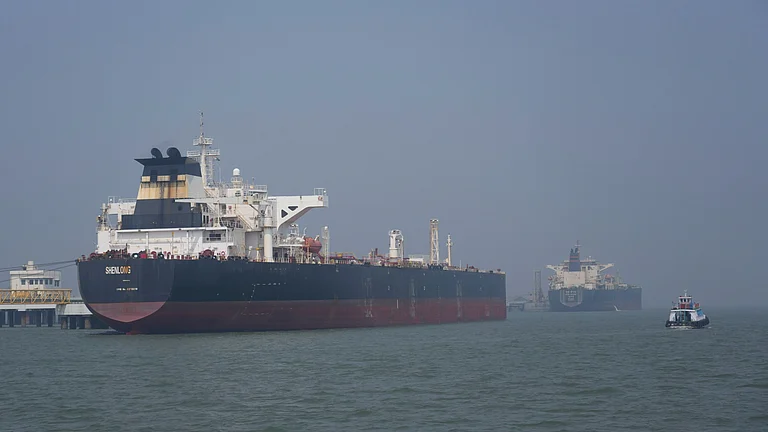
Recent strikes on the Gulf energy infrastructure, oil prices pushing past $100 a barrel, and tankers rerouting away from the Strait of Hormuz have served as a sharp reminder of how structurally exposed the world's energy system remains. Against this backdrop, China released its 15th Five-Year Plan in March 2026. The timing was coincidental. The contrast was instructive.
The plan is not a masterpiece of strategic foresight. But it reflects a consistent logic that China has been applying for more than a decade, and the current disruption in energy markets makes that logic easier to read. A few observations follow, with particular attention to what the plan might mean for India's cleantech ambitions.

1 September 2026
Get the latest issue of Outlook Business

Energy Security, Not Climate, Is The Organizing Principle
The 15th Five-Year Plan covers 2026 to 2030. It sets a 17 per cent reduction in carbon intensity, commits to raising non-fossil energy to 25 per cent of primary consumption, and signals continued support for solar, wind, batteries, nuclear, and green hydrogen. On the headline numbers, it is broadly consistent with China's clean energy buildout but stops short of an absolute emissions cap. The 17 per cent intensity target is, in fact, weaker than the 18% set in the previous cycle, which China itself missed.


Advertisement
The more revealing part of the plan is not the climate numbers but how officially it is framed. China's National Energy Administration, in its commentary on the plan, positions the entire clean energy push as a response to import vulnerability. China imports roughly 75 per cent of its oil and over 60 per cent of its natural gas. The plan's emphasis on domestic renewable capacity, grid investment and green hydrogen reads, in that framing, as a structural effort to reduce exposure to exactly the kind of supply disruption now playing out in the Gulf.
The clean energy trajectory serves both climate and security goals. Domestically, the security framing carries more political weight, which is probably why the commitments are more likely to be sustained. Industrial competitiveness, discussed below, reinforces the same direction.
Advertisement

From Building Capacity to Building Systems
The 14th Five-Year Plan was largely about deploying clean energy hardware at speed. China reached its 2030 wind and solar installation target six years early.
The 15th plan reads differently. The emphasis has shifted to system integration: ultra-high-voltage transmission, grid flexibility, pumped-hydro storage, smart grids, and vehicle-to-grid infrastructure. This reflects a real operational problem. Solar generation accounts for over 30 per cent of China's installed power capacity, but a much smaller share of actual electricity output in some western provinces. The hardware is there. The grid and market architecture to absorb it is not.
The plan's response is partly infrastructure and partly industrial geography. It announces roughly 100 national zero-carbon industrial parks and more than 10,000 kilometres of zero-carbon transport corridors. These are clusters designed to co-locate renewable generation, industrial load, storage and logistics. Inner Mongolia, where large solar farms are being built alongside battery manufacturing and data centres, illustrates what this looks like in practice. The logic is that abundant, cheap, renewable electricity becomes a production cost advantage for energy-intensive industries, not just a way to decarbonize the power sector. State Grid's announced investment of roughly $25 billion over this five-year period is inseparable from that industrial argument.

Carbon Accounting as Trade Preparation
One element of the plan has received less attention than it warrants. China's NDRC briefing commits to building product-level carbon-footprint standards for batteries, solar panels, EVs, steel, cement, chemicals, and hydrogen.
The EU's Carbon Border Adjustment Mechanism entered its definitive phase on January 1, 2026. It applies a carbon cost to imports based on embedded emissions. Exporters without verified carbon data face default emission factors that significantly raise their effective cost in European markets. China cannot avoid this in its largest export destination, so it is building the compliance infrastructure systematically and early.
India knows this challenge directly. The EU-India Free Trade Agreement, concluded in January 2026, did not resolve CBAM. Indian steel, aluminium and cement exporters face the mechanism in full, with no exemptions. For Indian cleantech manufacturers with European market ambitions, carbon certification is work that needs to happen alongside manufacturing capacity, not after it.
What This Means for India
India shares enough structural features with China that the plan rewards careful reading on its own terms.
China is using its clean energy build to reduce dependence on imported fossil fuels. India is pursuing the same transition, but with a different vulnerability embedded in it. As India scales up renewable energy, it is increasingly dependent on cleantech components, with import dependencies as high as 80 to 90 per cent in some value chains, with China as the dominant supplier.
Research from the Bharat Climate Forum projects that India's annual cleantech import bill could reach $65 to $97 billion by 2030 if domestic manufacturing does not improve. In practical terms, India risks exchanging one import dependency for another. The Strait of Hormuz is the current chokepoint. A concentrated cleantech supply chain is the emerging one.
India’s National Manufacturing Mission, announced in 2025, targets six key value chains: solar, wind, electric vehicles, batteries, green hydrogen, and high-voltage transmission equipment. Its objective is to boost domestic value addition by improving the ease of doing business, strengthening manufacturing clusters, and fostering a comprehensive supporting ecosystem. Importantly, the drive for energy security through these initiatives is compelling in its own right and does not rely solely on climate-related justifications.

China's experience also carries a forward-looking signal for India. When renewable capacity is added quickly, a second challenge tends to follow: the grid, the market design and the industrial location of demand all need to be reconfigured to absorb that power. China is dealing with this now. In some western provinces, solar panels generate electricity that the grid cannot fully carry to where it is needed, so a significant share goes unused. India is still largely in the phase of building renewable capacity. But that integration challenge tends to arrive faster than planners expect once deployment picks up pace. The time to think about grid architecture, storage and industrial clustering is before the problem appears, not after.
The Chinese model is not straightforward to transfer. The state capacity, financing mechanisms and policy coordination behind it are specific to that system. The plan has drawn genuine criticism for walking back earlier coal-reduction commitments, revising carbon accounting methodologies in ways that flatter past performance, and setting targets that allow absolute emissions to continue rising. Those are real constraints on what the plan delivers in terms of climate.
Geopolitical disruption to fossil fuel supply is a recurring feature of the global energy system. Countries that import most of their energy face this as a structural condition. China's 15th Five-Year Plan is an imperfect but serious attempt to reduce that vulnerability over time, by embedding clean energy into industrial and export strategy rather than treating it as a separate environmental agenda.
For India, the plan is worth studying not as a blueprint to copy but as evidence of what sustained alignment between energy policy, industrial and export strategy, and long-horizon planning can produce. The National Manufacturing Mission is attempting something analogous. The decisions made over the next three to five years on manufacturing investment, grid architecture and carbon compliance infrastructure will shape what options India has for the two decades that follow.









