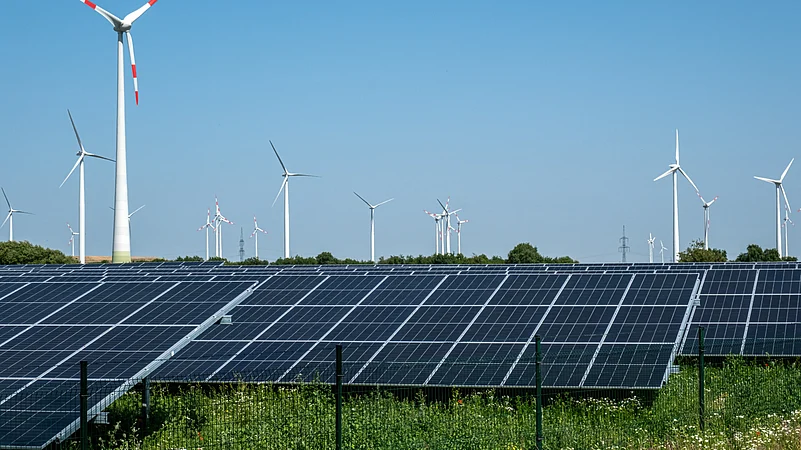

China invests in renewable-powered green hydrogen projects for industrial applications.
India targets major hydrogen output by 2030 with strong subsidy support.
Western countries slow ambitions as China and India accelerate clean energy push.
China is part of a $2bn project, that harnesses renewable energy to run banks of electrolysers that produce molecules needed for fertiliser, marine fuel and low-emission steelmaking.
India also has been investing heavily in green hydrogen while Western countries are slowing down their plans. India is targeting 5mn metric tonnes of green hydrogen annually by 2030 backed by subsidies worth $2.1bn – five times the current size of the global market and about double China’s projected output by then, according to Reuters.

1 September 2026
Get the latest issue of Outlook Business


This move comes at a time when the West is moving away from its green hydrogen goals from the start of this decade after cost constraints appeared greater than anticipated. On the other hand, China and India are doubling down and using strong government support to move the sector forward. Even though they have different reasons for doing so, both countries can create a market by supporting projects, guiding demand, and lowering costs through scale.
India's main goal is energy security. The government offers subsidies and guaranteed buyers like refineries, fertiliser plants, and steelmakers to encourage private investment. China, on the other hand, wants to stay on top of the hydrogen market as it moves to cleaner energy. Beijing has made green hydrogen a frontier industry in its most recent five-year plan, along with advanced technologies. This means that there will be more investment and a long-term commitment.
Advertisement
China has invested $3.7bn in green hydrogen production last year, more than double US levels, Rystad Energy’s head of hydrogen, Minh Khoi Le told Reuters.
Citing Rystad projections, Reuters reported that China will have some 2.6mn tonnes per year online, representing $26bn in investment by 2031.

Global Hydrogen Momentum
According to the 2024 report by the International Energy Agency, global low-emission hydrogen production could reach up to 49 million tonnes (mtpa) annually by 2030 based on announced projects, up from less than 1 Mt in 2023. However, this optimistic projection faces hurdles, with the 2025 review noting that while expansion is strong, technical, financial and regulatory barriers may affect final output.
Advertisement
The International Renewable Energy Agency (IRENA) noted that falling renewable power costs are key to making green hydrogen viable. However, high electrolyser costs and infrastructure gaps remain major barriers, slowing deployment in several regions even as Asia accelerates investment and project pipelines.