

The Finance Ministry has flagged concentration and over-leveraging risks in India’s aviation sector
It prompted the Civil Aviation Ministry to propose a cap on the number of airport bundles a single bidder can win
Discussions took place during the PPPAC meeting on Aug 4. It has given in-principle approval to 11 airports in 5 bundles
The Finance Ministry has raised concerns over the "oligopolistic nature" of India’s aviation sector as the government prepares to put 11 airports on the block through a new bundling model, with the Civil Aviation Ministry proposing a cap on the number of airport bundles that a single private operator can win.
The issue was discussed at the 149th meeting of the Public Private Partnership Appraisal Committee (PPPAC) held on August 4, according to the Record of Discussion issued by the Department of Economic Affairs on August 20.

1 October 2026
Get the latest issue of Outlook Business

The PPPAC subsequently granted in-principle approval to the proposed privatisation of the 11 airports through five bundles.



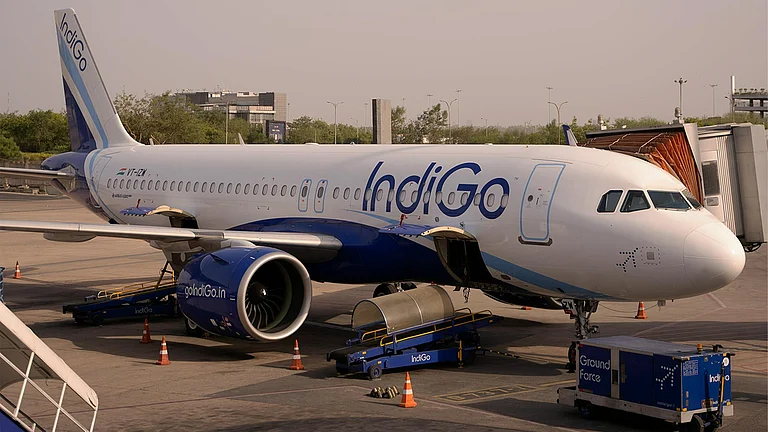
During the meeting, the Chair asked: "Given the oligopolistic nature of the aviation sector, what measures have been envisaged to ensure that the risks related to concentration and over-leveraging are minimised, considering these risks can have a cascading effect across all the projects?”"
The Ministry of Civil Aviation responded: "The number of airport bundles that may be awarded to a single bidder would be capped to mitigate the risks arising from market concentration and potential over-leveraging, including their possible cascading impact across projects. The modalities of such capping are being finalised and would be submitted as part of the proposal seeking final recommendation by the PPPAC."
Advertisement

The Finance Ministry record did not specify how many bundles an individual bidder would eventually be allowed to secure.
The concerns are raised at a time when the airport market is already concentrated among a handful of private operators.
According to a report by Business Standard (BS), Adani Airport Holdings operates eight airports and accounts for about 24-25% of passenger traffic and 33% of air cargo, while GMR Airports has about 27.5% of passenger traffic.
Together, the two private operators account for more than half of India’s air passengers.
Advertisement
Five Airport Bundles Approved
According to the Finance Ministry record, the government plans to group larger airports with smaller ones to improve the financial viability of the latter through cross-subsidisation.
The five proposed bundles are Amritsar-Kangra, Varanasi-Gaya-Kushinagar, Bhubaneswar-Hubballi, Raipur-Aurangabad, and Tiruchirappalli-Tirupati. Each bundle will be awarded to a single concessionaire for 50 years.
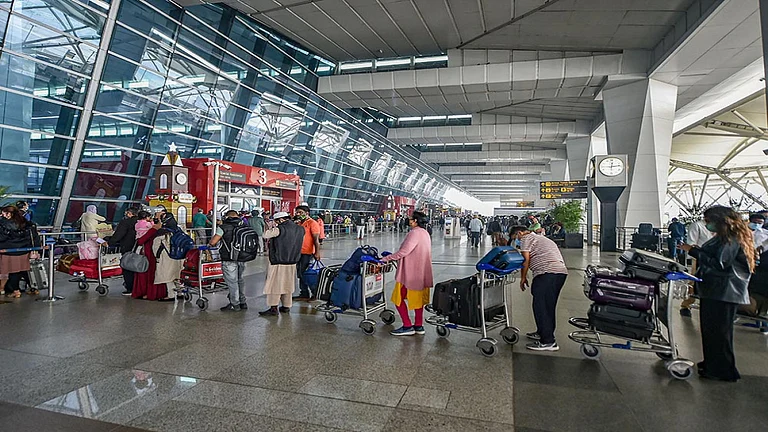
The bundling proposal was developed by the Airports Authority of India (AAI) after assessing major and smaller airports on passenger traffic, land availability, commercial potential, financial performance, capital expenditure requirements, geographical proximity and city-side development potential, the PPPAC record said.
The bidding process will use per-passenger fee for domestic passenger throughput as the bidding parameter, with international passenger fees set at twice the domestic passenger fee.
The latest proposal follows the first major round of airport privatisation, when six airports — Lucknow, Ahmedabad, Jaipur, Mangaluru, Thiruvananthapuram and Guwahati — were awarded to a private operator for 50 years in 2019.
The Adani Group won all six airports in that round and took them over between October 2020 and November 2021.
The new structure therefore seeks to combine the financial benefits of airport privatisation with safeguards against excessive concentration, while using larger airports to support the development of smaller ones.
What Private Operators Will Have To Do
The proposed concession will cover the operation, management and development of the airports, including passenger terminals and city-side infrastructure.
AAI will continue to handle air traffic control and communication, navigation and surveillance services, while AAI Cargo Logistics and Allied Services Company Ltd will continue cargo operations.

The concessionaire will have to undertake AAI-sanctioned capital expenditure, including committed works, as well as additional capacity-augmentation expenditure anticipated during the first seven years, subject to traffic or capacity thresholds and Airports Economic Regulatory Authority (AERA) norms.
The PPPAC record said expansion will be triggered by objective traffic or capacity thresholds rather than rigid timelines, reducing the risk of creating infrastructure ahead of actual demand.
Market Sounding Before Final Structure
The government has not yet finalised the complete bidding framework. Following the in-principle approval, the Civil Aviation Ministry plans to conduct a fresh market-sounding exercise to assess interest from infrastructure companies and gather feedback on the proposed bundling structure.
The ministry told the PPPAC that bundling is being attempted for the first time in the airport sector. Feedback from prospective private players will be considered before the proposal is submitted for the PPPAC's final recommendation.
The government will also specify the technical eligibility requirements, city-side land available for development and capacity-expansion obligations in the draft concession agreement.

Employee Protection Also Into Proposal
The proposed transaction provides for a one-year joint management period involving existing AAI employees.
After that, the concessionaire will be required to retain 60% of AAI employees for up to three years, according to the PPPAC record.
The government is also considering lessons from the previous airport PPP round and subsequent infrastructure-sector transactions, including highways, before finalising the bidding documents and concession agreement.