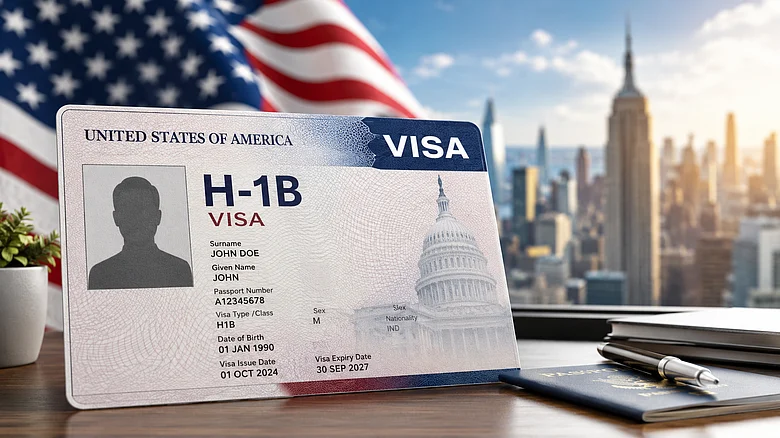

The US has proposed a $103,265 fee on cap-subject H-1B petitions
Large Indian IT companies may be able to absorb much of the cost, but smaller firms could face margin and investment pressure
The fee could accelerate a shift in India's IT business model, with more work moving to offshore centres in India and greater use of local US hiring
The US administration has proposed a $103,265 fee on new H-1B petitions subject to the annual visa cap, a move that could significantly raise the cost of deploying foreign professionals in the US and put further pressure on the traditional delivery model of Indian IT companies.
The Department of Homeland Security (DHS) published the proposal in the Federal Register on August 24, as per a report by Reuters.

1 October 2026
Get the latest issue of Outlook Business

It will undergo a 30-day public comment period and could be finalised later this year. The proposal is not yet in force and could also face legal challenges.




What Is The New $103,265 H-1B Fee?
Under the proposal, employers sponsoring cap-subject H-1B workers would pay $103,265 in addition to existing visa-related charges.
The fee would cover petitions under the annual cap, including those eligible for the 20,000 advanced-degree exemption, according to DHS, as per a report by the New York Times (NYT).
Advertisement
The US issues 85,000 new cap-subject H-1B visas annually — 65,000 under the regular quota and 20,000 for advanced-degree holders.
Certain cap-exempt employers, including qualifying universities and research organisations, would not be covered.
The proposal is broader than last year's $100,000 measure because it is tied to cap-subject petitions rather than simply whether the worker is outside the US.
How Much Will It Increase Hiring Costs?
Before the latest proposal, H-1B-related costs generally ranged from about $2,000 to $5,000 in basic government fees, as per Reuters, although employers can incur additional immigration and compliance expenses.
Advertisement
The proposed $103,265 charge would therefore represent a substantial increase in the direct cost of sponsoring a new worker.
In February, Moody's Ratings had estimated that the earlier $100,000 fee regime could increase annual operating expenses for large Indian IT companies by $100 million-$250 million.
This was around 1% of revenue, with an estimated impact of about 100 basis points on EBITA margins, as per a report by The Economic Times (ET).
Why Are TCS, Infosys, Others Reducing H-1B Dependence?
Indian IT companies have historically used H-1B visas to place specialised employees at US client locations while delivering a larger portion of work from India.
The higher visa cost strengthens the economic incentive to move work offshore, use subcontractors or rely more heavily on local US employees.
As per an ET report from September 2025, analysts expected the fee increase to accelerate offshore delivery, remote contracting and alternative talent models.

Moody's also said in February that Indian IT firms were increasing investments in AI and automation, which could reduce the need for employees in on-site customer locations over time.
Will Indian IT Cos Hire In US?
Local hiring is likely to become more attractive for roles that can be filled within the US, although it is not a complete substitute for H-1B workers.
Indian nationals accounted for about 70% of H-1B beneficiaries in fiscal 2025, as per ET. That makes the policy particularly relevant to India's technology sector.
Companies could reportedly respond through greater US hiring and subcontracting, but these options can also raise costs and put pressure on margins.
The impact could be sharper for smaller companies. Moody's said small and mid-sized firms may struggle to absorb higher visa costs because of lower margins and more limited liquidity.

Can Work Shift From US To India?
Yes, where projects do not require employees to be physically present with clients.
The earlier $100,000 fee had already prompted expectations of greater offshore delivery. Indian IT firms are relatively well placed to expand this model because offshore delivery and subcontracting are already established parts of their operations.
However, specialised assignments, client-facing roles and projects requiring an on-site presence may continue to require US-based staff, as per ET.
What Does This Mean For India's IT Services Industry?
The proposed fee adds another cost and uncertainty for an industry heavily dependent on the US market.
The US contributes as much as 85% of revenue for some Indian IT companies, as per ET.
Moody's said the largest firms could absorb higher costs because of strong margins and cash positions, but smaller players could face greater pressure.
The broader outsourcing industry, valued at about $283 billion, could therefore see greater differentiation between financially stronger firms and smaller providers.
Is H-1B Model Of Indian IT Changing?
The model is changing gradually rather than disappearing. The latest proposal adds to a series of measures making overseas deployment more expensive and uncertain.
At the same time, Indian IT companies are expanding localisation, offshore delivery, automation and AI-led productivity.
The key shift is likely to be in where work is performed, rather than simply whether Indian IT companies continue serving US clients.
More work could be delivered from India, while US-based employees are increasingly reserved for roles where physical presence is essential.