India–US reach interim trade framework with reciprocal 18% tariff structure.
India to cut tariffs on wide US farm and industrial goods; US to ease duties on Indian tech, pharma, gems and aircraft parts.
India signals $500bn purchase plan over five years, including energy and tech.
Both sides to address long-standing non-tariff barriers in medical devices, ICT and agriculture.
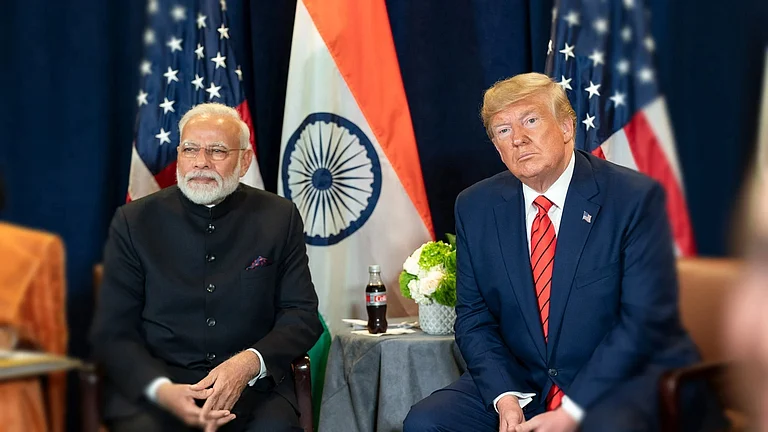
India and the United States today announced that they have reached a framework for an Interim Agreement on reciprocal and mutually beneficial trade, marking a significant step forward in the broader US–India Bilateral Trade Agreement (BTA) negotiations launched by President Donald Trump and Prime Minister Narendra Modi on 13 February 2025.
According to the joint statement, the interim pact will include additional market-access commitments and support the development of more resilient supply chains.

1 September 2026
Get the latest issue of Outlook Business

“India will eliminate or reduce tariffs on all US industrial goods and a wide range of US food and agricultural products, including dried distillers’ grains (DDGs), red sorghum for animal feed, tree nuts, fresh and processed fruit, soybean oil, wine and spirits, and additional products,” the statement said.
In return, the United States will apply a reciprocal tariff rate of 18% on originating goods from India, including textiles and apparel, leather and footwear, plastics and rubber, organic chemicals, home décor, artisanal products and certain machinery.
Advertisement
Subject to the successful conclusion of the Interim Agreement, Washington will also remove reciprocal tariffs on categories such as generic pharmaceuticals, gems and diamonds, and aircraft parts.
The US further agreed to lift tariffs on certain aircraft and aircraft components imported from India that had been imposed under national-security provisions. India will additionally receive a preferential tariff-rate quota for automotive parts, subject to similar national-security-linked tariff rules.
India indicated its intention to purchase $500bn worth of US goods over the next five years — including energy products, aircraft and aircraft parts, precious metals, technology products and coking coal.
"India and the United States will significantly increase trade in technology products, including Graphics Processing Units (GPUs) and other goods used in data centers, and expand joint technology cooperation," the statement said.
Advertisement

Both sides have reserved the right to modify their commitments if either country makes changes to its agreed tariff structures.
Addressing Non-Tariff Barriers
Both countries also committed to tackling non-tariff barriers that have affected bilateral trade.
“India agrees to address long-standing barriers to the trade in US medical devices; eliminate restrictive import-licensing procedures that delay market access for, or impose quantitative restrictions on, US Information and Communication Technology (ICT) goods,” the statement noted.
It added that India also agreed to address long-standing non-tariff barriers to the trade in US food and agricultural products. However, Commerce and Industry Minister Piyush Goyal said in a tweet that no concessions have been extended to sensitive agricultural sector produce in grains, fruits, vegetables, spices, oilseeds, dairy, poultry, & meat amongst many others.