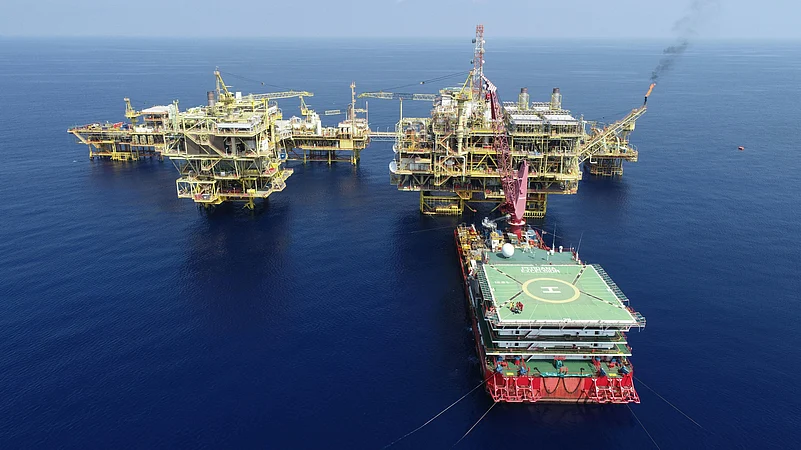

ONGC is planning a $20 billion deepwater drilling programme under the Samudra Manthan Mission to boost domestic oil and gas exploration.
The move comes as geopolitical tensions in West Asia and supply disruptions highlight India’s vulnerability to import dependence.
Offshore exploration could strengthen long-term energy security and access to critical minerals, though environmental risks remain a concern.
India’s state-owned oil major Oil and Natural Gas Corp is preparing to spend as much as $20 billion to hire deep-water drilling rigs. The company issued a tender for rigs last month in an effort to enhance domestic hydrocarbon exploration as part of the government’s Samudra Manthan Mission. For years, India has been relying heavily on energy imports and ‘just-in-time’ supplies, which has put New Delhi in vulnerable positions in times of geopolitical disruptions and global energy market volatility.
What Is the Samudra Manthan Mission?
In 2025, Prime Minister Narendra Modi announced the launch of the mission in a move which could get India closer toward the Atmanirbhar Bharat 2047 vision. The goal of the mission primarily remains to explore oil and gas reserves located in the country’s offshore energy resources. Despite being one of the largest consumers of crude and natural gas, India imports nearly 90% of its daily crude needs and around 50% of its LNG and LPG requirements. For a country whose energy requirements sit at the top of its national interest, reducing energy import dependency is critical.

1 September 2026
Get the latest issue of Outlook Business

Advertisement
Geopolitics Strengthens Case for Domestic Output
Until early February, New Delhi was facing mounting pressure from the US and the West to reduce its crude imports from Russia. India emerged as one of the two top buyers of Russian oil, and the West alleged that India’s purchases were indeed fuelling the Russia-Ukraine war.
In August 2025, US President Donald Trump even imposed a punitive tariff of 25% on top of reciprocal tariffs in a move to pressurise India to halt its Russian imports. Over the last few months, India reduced its imports from Moscow and was pivoting back to its West Asian suppliers to meet its energy needs.
Advertisement
However, in an unexpected escalation of tensions between Iran, Israel, and the US, Tehran shut down the Strait of Hormuz, through which crude and fuel needs for most Asian economies transit.
The situation also compelled several oil-producing economies, including Saudi Arabia and Qatar, to slash their production and exports, exposing India to energy vulnerabilities. Benchmark crude prices surged to multi-year highs, with Brent hovering near $150 per barrel, the rupee breaching the psychologically crucial level of 94 per dollar, leaving India with one of the worst LPG crises in recent decades.

State of India’s Domestic Gas Output
With a coastline of over 11,000 kilometres, India’s offshore gas production contributes mainly towards its domestic output, with nearly 67% of natural gas stemming from offshore fields since 2019, and the latest data indicating roughly 25,709 million metric standard cubic metres produced offshore. As per reports, India has more than 170 hydrocarbon discoveries, including over 60 in offshore areas. Petroleum reserves are estimated at around 2 billion tonnes of oil equivalent.
Currently, India’s total net gas production is projected at 35 bcm, driven primarily by the deepwater fields in the Krishna-Godavari basin, and accounts for nearly 25% of the total production. Northeast basins, including Assam and Tripura, have recently started contributing nearly 47% of India’s onshore production and 13% of total gas supply.
Deepwater Exploration as an Energy Security Buffer
The mission paves the way for India to find ways to create safety buffers in times of global crisis by identifying natural energy reserves that the country currently lacks. The Centre has been working on several steps, including identifying and allocating reserves, drilling wells, and conducting seismic surveys under the National Seismic Programme. The Ministry of Petroleum and Natural Gas has also allocated ₹3,200 crore to begin work on four stratigraphic wells, reports said.


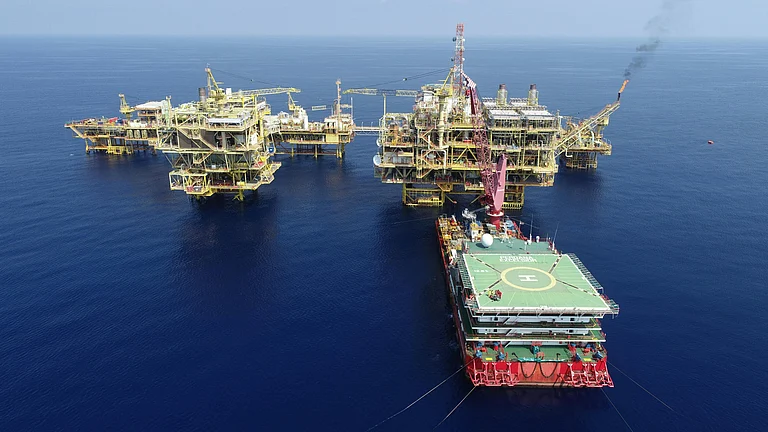
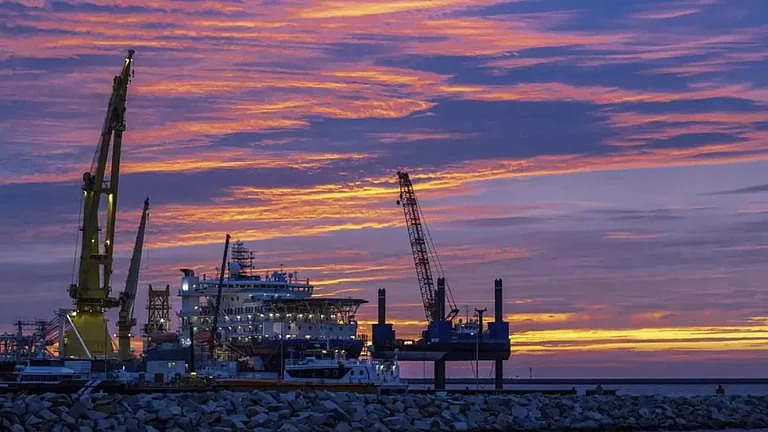
The initiatives are currently exploring four basins, including the Andaman and Nicobar Basin, the Mahanadi Basin, the Bengal Basin, and the Saurashtra Basin. Last month, Oil India began offshore drilling in the Kerala-Konkan Basin, hinting at active efforts from the government to tap high-potential regions despite the lack of cutting-edge technology.
Besides oil, deep-sea exploration will also give India leverage of critical minerals. In 2024, scientists from the National Institute of Ocean Technology discovered minerals including nickel, cobalt, and manganese in the Indian Ocean.
Can Offshore Drilling Cut Import Dependence?
Accelerating offshore oil and gas production will take decades before it materialises to provide a substantial reduction in imports. Offshore gas production can especially reduce import dependence on LPG imports. As per reports citing experts, India’s production boost positions India in better negotiating power on the global stage.
Environmental Risks and Concerns
Despite the ambitious vision, the project points towards the contrast between development and environmental protection. Deep-sea mining involves the extraction of mineral deposits, which poses the risk of exploitation of natural resources.
Without strict environmental policies, policymakers and conservationists argue that apart from exploitation, deep-sea exploration could also create noise and light pollution, as well as spillage of fuels and other chemicals used in the mining process into the oceans.
Further, sediment plumes are also a major concern flagged by experts. Once the required minerals are extracted, the rest of the sediments are released back into the sea, which can harm ocean species such as corals, sponges, and other creatures.