India and the United States are moving swiftly toward finalising the first tranche of a bilateral trade agreement, which could be concluded by mid-July, Commerce and Industry Minister Piyush Goyal said on Friday, as per inputs from PTI.
"It is only the first tranche of our bilateral trade agreement, which will give preferential access to India over our competitors," Goyal said, adding that both sides were "fast moving towards closing all the open ends" of the proposed deal. He described the first phase of the pact as "very, very vibrant," the report added.
A US negotiating team was in New Delhi from June 2–4 for discussions with the Indian side on finalising the interim trade agreement. The US team was led by its chief negotiator Brendan Lynch, while India's chief negotiator is Darpan Jain, additional secretary in the Department of Commerce.

1 October 2026
Get the latest issue of Outlook Business

During the talks, the two teams held discussions across a wide range of issues, covering trade in goods, non-tariff measures, customs and trade facilitation, economic security alignment and other areas of mutual interest, the commerce ministry reportedly said.


A high-level US team, likely to be led by US Trade Representative Jamieson Greer, is expected to visit India toward the end of this month, Goyal said.
Path to This Point
India and the US reached an initial understanding on a trade deal in February, when both sides issued a joint statement finalising the framework for the first phase of the bilateral trade agreement. Under the agreed framework, the US had agreed to reduce tariffs on Indian goods to 18% from 26%, including cutting the 25% tariff imposed for buying Russian oil.
Advertisement
However, on February 20, the US Supreme Court ruled against President Donald Trump's sweeping reciprocal tariffs imposed under the 1977 International Emergency Economic Powers Act. Following the ruling, Trump announced a uniform 10% tariff on all countries for 150 days starting February 24, set to end on July 24. Negotiations, which had slowed after the court ruling, gathered pace again during this week's talks in New Delhi.
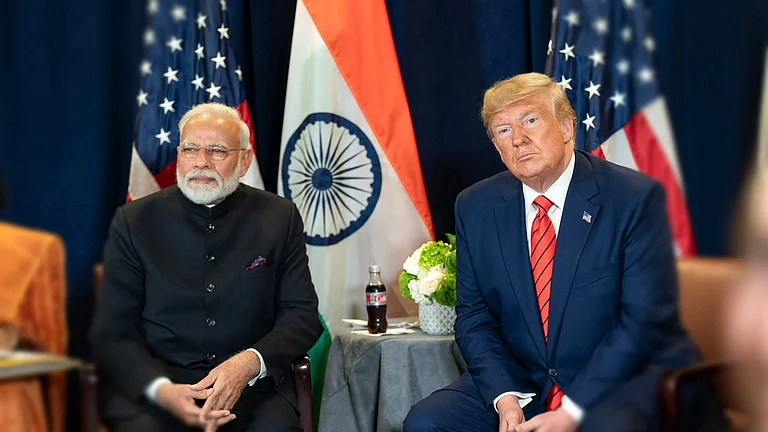
Separately, on Wednesday, the US proposed an additional tariff of 12.5% on imports from India, citing it as among 60 economies that had failed to curb imports made with forced labour.
Advertisement
In light of the changed tariff landscape, the two sides met in Washington in April, when the Indian team visited the US from April 20–23. The latest round of talks in New Delhi was a follow-up to those discussions.
With US trading partners now facing a uniform 10% tariff, the February framework may require recalibration. When the framework was agreed, India had a comparative advantage over competitor countries such as Sri Lanka, Pakistan, and Bangladesh. The joint statement includes a clause stating that if either country changes its agreed tariffs, the other may modify its commitments accordingly.
After finalising the first phase, both countries intend to take forward negotiations for the broader bilateral trade agreement, according to the report.
Under the proposed framework, India has offered to eliminate or reduce tariffs on all US industrial goods and a range of food and agricultural products, including dried distillers' grains, red sorghum for animal feed, tree nuts, fresh and processed fruit, soybean oil, wine and spirits. New Delhi has also expressed its intention to purchase $500 billion worth of US energy products, aircraft and aircraft parts, precious metals, technology products, and coking coal over the next five years.