India’s merchandise trade deficit fell to $27.1 billion in February, lower than January’s $34.68 billion as imports eased.
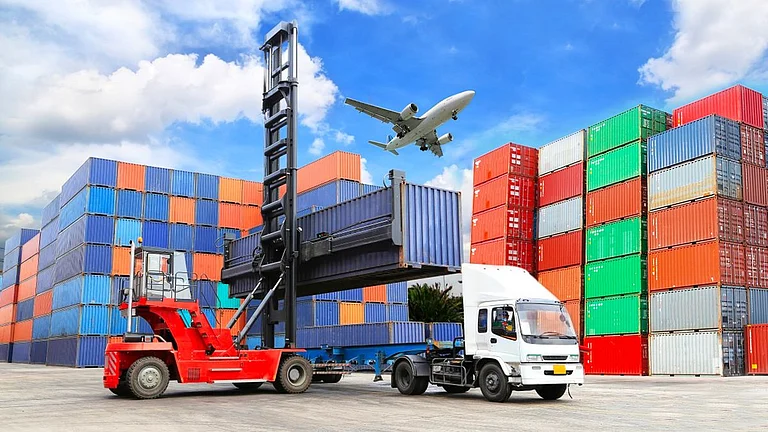
Exports rose marginally to $36.61 billion, while imports dropped to $63.71 billion month-on-month.
The West Asia conflict and disruption in the Strait of Hormuz could affect shipments, push crude prices higher and strain India’s energy imports.
India’s merchandise trade deficit narrowed to $27.1 billion in February following an easing in imports compared to the previous month, official data from the Ministry of Commerce and Industry said on Monday. Officials have warned that the escalating geopolitical situation in West Asia and the near-complete closure of the Strait of Hormuz could further stall key shipments.
Market participants are also bracing for the impact of higher crude prices and energy imports. According to a Reuters poll, economists had expected the trade deficit in February at $28.8 billion, compared to $34.68 billion in the month prior.

1 September 2026
Get the latest issue of Outlook Business

Indian exports rose marginally to $36.61 billion from $36.56 billion in January. During April–February, exports stood at $402.9 billion compared to $395 billion during the same period a year earlier.
Meanwhile, imports fell to $63.71 billion from $71.24 billion in January. However, imports rose sharply to $80.09 billion compared to $65.84 billion a year ago. Gold imports rose to $61.46 billion during April–January compared to $51.19 billion a year earlier. Silver imports surged 128.54% to $9.78 billion from a year ago.
Advertisement
“This year has been challenging for Indian exports, and there are logistical challenges being faced due to the West Asia crisis,” Commerce Secretary Rajesh Agrawal told reporters.
India imports nearly 90% of its crude oil for energy needs and has been grappling with extreme volatility and surging crude prices. US oil executives have already warned that they expect crude prices to remain higher for a prolonged period, which could have adverse effects on the global economy.
Economists and analysts have warned that crude prices above $100 per barrel for a prolonged period could even trigger a global recession. The situation in West Asia currently shows no signs of easing, with US President Donald Trump signalling more attacks on Iran over the weekend.
Advertisement
India is also currently facing a cooking gas crisis, with 60% of its liquefied petroleum gas (LPG) imported from West Asia. Owing to the slashing of output, closure of the strait, and shipment risks, the Indian government has been compelled to prioritise gas supply for domestic households while reducing commercial and industrial supply of the fuel.


The government has also issued notices to consumers asking them to avoid panic buying of LPG cylinders and has proposed an “economic stabilisation fund” to provide fiscal headroom to respond to global volatility.