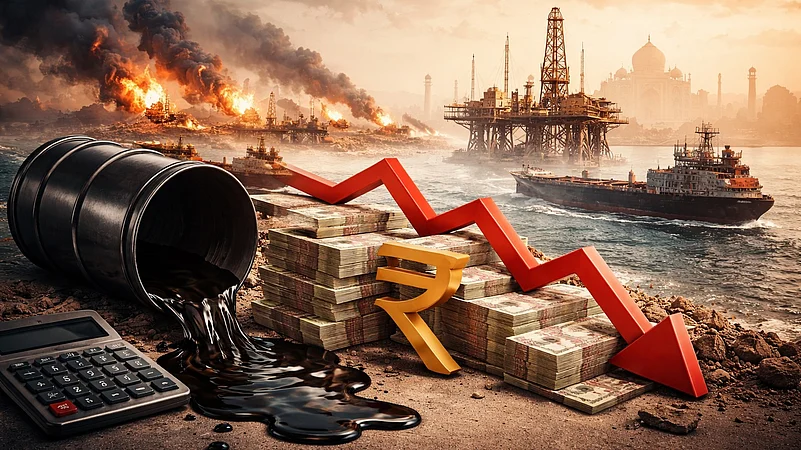

Escalating tensions in West Asia have pushed crude prices sharply higher, sending the rupee to a record low and raising concerns over India’s import bill.
Sustained crude above $90–$100 per barrel could widen the current account deficit, weaken the rupee and strain government finances through higher subsidies.
Persistently high oil prices may slow economic growth and push inflation higher due to imported price pressures.
The rupee recorded its lifetime low of 92.35 against the dollar on Thursday as crude prices surged following the latest attacks on oil and transport facilities in West Asia. Brent futures rose to a high of $101.6 per barrel during the day, with the rupee posting one of its worst recorded losses against the dollar since the start of the war.
The US and Israel launched a combined military strike against Iran, compelling Tehran to retaliate and shut the Strait of Hormuz. The attacks on shipments and blockades at the Strait have sent jitters across markets, with benchmark crude prices — Brent and West Texas Intermediate (WTI) — posting multi-year highs since 2022. Brent rose as high as $119.50 before paring gains. However, owing to no signs of de-escalation and uncertainty in global trade, oil prices have been on a roller coaster during the week.

1 September 2026
Get the latest issue of Outlook Business

With India importing nearly 90% of its energy needs and being one of the largest consumers of energy, this comes with a huge cost. Rising crude prices put heavy pressure on India’s import bill alongside pressure on the domestic currency.
Advertisement
Analysts and industry experts have warned that even if crude prices stabilise at $90 per barrel, it does not become sustainable for India. Analysts say that even in the event of conflict resolution, crude prices are expected to remain on the higher side due to disrupted logistics, shipment risks and damage to oil infrastructure in West Asia. If crude prices remain high, New Delhi’s economy will face significant impact, exposing its vulnerability as an import-dependent country for energy.
1. Widening of Current Account Deficit
The immediate impact of higher crude and a depreciating rupee will be felt in India’s current account deficit. Before the war, the outlook on global oil prices was sanguine, with economists and analysts projecting prices to remain benign. Brent crude was trading near $65–$70 per barrel.
Advertisement
As per a note by IDFC Bank dated March 2, a sustained $10 per barrel increase in crude oil prices could widen India’s current account deficit (CAD) by around 0.4 percentage points of GDP if it persists for a year.
However, the impact remains manageable as India’s current CAD levels are relatively low, providing a buffer against higher import costs. If crude prices average $80 per barrel in FY27, the CAD could rise to around 2% of GDP, whereas under the base-case scenario of $70 per barrel, the CAD is expected to remain contained at about 1.6% of GDP. An average of $100 per barrel would further widen the deficit to 2.2%.
2. Depreciation of Rupee
The rupee was already under pressure, emerging as the worst-performing Asian currency in 2025. While the downward pressure on the rupee last year was primarily due to hot money flight from the exodus of foreign investors from the domestic market, sustained higher crude prices could further depreciate the currency.
Currently, forex traders and economists expect the rupee to average around 92.50 against the greenback in the near term before reversing losses. However, some analysts note that without intervention from the Reserve Bank of India in the domestic spot market and the non-deliverable forwards market, volatility in the rupee market could become extreme.

3. Strain on Fiscal Math
The impact of higher crude prices is not limited to the widening of the current account deficit and volatility in the forex market; it also extends to strain on the Centre’s fiscal math.
Higher crude would affect government finances through higher subsidy bills. The government’s LPG subsidy currently accounts for 0.04% of GDP, while the fertiliser subsidy accounts for 0.45% of GDP.
To put this in context, during the Russia–Ukraine war, India’s fertiliser subsidy exceeded budget estimates by 0.6% of GDP.




According to the IDFC First Bank note, higher crude prices could also impact dividends paid by public sector units to the government. Oil PSUs provide around 0.2% of GDP in dividends. A surge in crude prices would compress margins, leading to a fall in dividend payouts. A decline in dividend payouts would hurt the government’s fiscal revenue.
4. Economic Growth and Inflation
The Indian economy is expected to moderate to 7.1% in FY27 from 7.6% a year ago, according to the latest projections by ratings agency Crisil.
If oil prices sustain $100 per barrel, GDP growth could further ease to 6.6%, according to a report by the State Bank of India. If global crude prices average $130 per barrel, GDP growth could even slump to 6%.
For inflation, the RBI’s medium-term target remains 4%. Sustained oil prices above $100 per barrel could push headline CPI back toward the 5.5%–6% range, primarily driven by the imported inflation of edible oils and energy-intensive services. Retail inflation for February stood at 3.2%.
Crude oil therefore remains one of the most significant external vulnerabilities for the Indian economy. While the country’s macroeconomic buffers — such as comfortable foreign exchange reserves, a relatively low current account deficit, and active intervention by the Reserve Bank of India — may help absorb short-term shocks, a prolonged period of elevated oil prices could simultaneously pressure the rupee, widen the current account deficit, strain fiscal balances, and weigh on economic growth. Much will ultimately depend on the duration of geopolitical tensions in West Asia and the extent of disruption to global oil supplies.