India-Germany signed 19 pacts on January 12, 2026
Chancellor Friedrich Merz pledged €1.24 billion for green projects
AM Green and Uniper finalized a major offtake deal for 500,000 tons of green ammonia annually
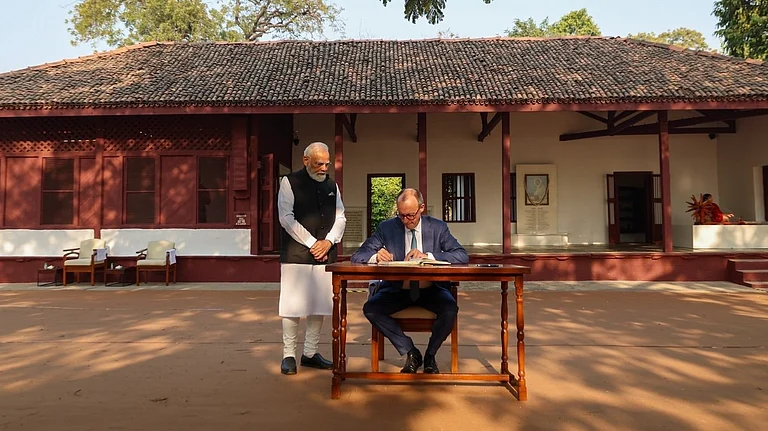
India and Germany on Monday signed 19 agreements and launched a slate of new cooperative initiatives across defence manufacturing, semiconductors, critical minerals, clean energy, skilling and higher education, as German Chancellor Friedrich Merz concluded a two-day official visit to India, Ministry of External Affairs said.
The agreements, signed during bilateral talks and at an India–Germany CEOs Forum attended by 23 German executives, included a Joint Declaration of Intent on a Defence Industrial Cooperation Roadmap, a semiconductor ecosystem partnership, cooperation on critical minerals and a green-ammonia offtake deal between India’s AM Green and Germany’s Uniper Global Commodities. Germany also announced fresh funding of €1.24 billion under the Green and Sustainable Development Partnership (GSDP), taking forward a broader €10 billion concessional financing commitment through 2030.

1 October 2026
Get the latest issue of Outlook Business

Prime Minister Narendra Modi said the defence agreement would provide clear policy support for Indian and German companies to pursue co-innovation and co-production, opening up new opportunities not only in defence manufacturing but also in areas such as space. Officials said the intent was to move beyond traditional buyer-seller ties toward long-term industrial and technology partnerships.




Defence and Technology
On defence and security, the two sides agreed to step up military exchanges, institutionalised staff talks and joint exercises. Germany will send a liaison officer to India’s Information Fusion Centre–Indian Ocean Region and participate in selected Indian naval and air exercises, including MILAN and TARANG SHAKTI. The defence roadmap is expected to focus on co-development, technology transfer and joint production between firms from both countries.
Advertisement
Technology cooperation featured prominently, with agreements to institutionalise dialogue across the semiconductor value chain and deepen collaboration on critical minerals needed for chips, batteries and clean-energy technologies. Officials said the focus would be on joint research, investment facilitation and building resilient supply chains for materials such as silicon, lithium and rare earths.
Climate and Energy
Clean energy and climate finance formed another core pillar. Germany’s additional €1.24 billion under the GSDP will support renewable energy, green hydrogen, electric buses and climate-resilient urban infrastructure in India. The green-ammonia offtake agreement between AM Green and Uniper links Indian production capacity with German demand for low-carbon fuels, particularly for fertilisers and shipping. The two countries also launched a battery storage working group to align financing and technical cooperation in energy storage.
Advertisement
In education and skills, the partners announced a joint roadmap on higher education, the creation of a National Centre of Excellence for Skilling in Renewable Energy at Hyderabad’s National Skill Training Institute, and new youth, sports and mobility initiatives. Germany also agreed to visa-free airport transit for Indian passport holders, aimed at easing travel for students, researchers and business visitors.
German Chancellor’s Visit
Chancellor Merz’s visit, his first to Asia since taking office, was framed as part of a broader strategic alignment as both countries seek to diversify supply chains and cooperate more closely on defence, technology and climate goals. The two sides reiterated support for an India–EU free trade agreement and for a rules-based Indo-Pacific order.
Officials said the focus will now shift to implementation, with sectoral working groups tasked with translating the agreements into concrete projects on co-manufacturing, technology transfer and clean-energy deployment, testing whether the diplomatic momentum delivers tangible economic and strategic outcomes.