


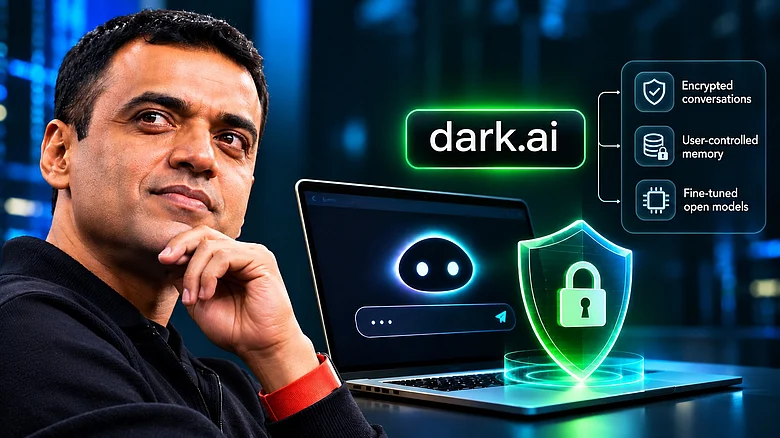

Eternal founder Deepinder Goyal says dark.ai is being built for users who want to discuss sensitive ideas and research without exposing their conversations.
The proposed assistant will use fine-tuned open-weight models, end-to-end encryption and an encrypted memory layer controlled by users.
Experts say privacy could attract businesses and researchers, but independent security assessments and clarity on data access will be essential to building trust.
Eternal founder Deepinder Goyal wants to address a concern that could limit how freely people use artificial intelligence (AI): what happens to the information they share with an AI assistant?
In Eternal’s Q2 FY27 shareholders’ letter, Goyal outlined dark.ai, a privacy-focused AI assistant that the company hopes to launch globally by the end of 2026. The product is intended for people who want to explore sensitive questions, conduct research and discuss confidential ideas without worrying about who might access their conversations.

1 October 2026
Get the latest issue of Outlook Business

According to Goyal, dark.ai will use fine-tuned open-weight models running on Eternal’s own infrastructure, end-to-end encryption and an encrypted memory layer controlled by users. He said the company would not be able to read conversations, even if compelled to do so.
The product is being tested internally, but Eternal has not announced its pricing or a confirmed launch date. Nor has it published independent security assessments. The question, therefore, is whether dark.ai can turn its proposed privacy protections into a competitive advantage in a market where established AI assistants already offer data controls.
What Is Dark.ai?
Goyal’s thinking was partly shaped by an interaction with Anthropic’s Claude. In the shareholders’ letter, he described receiving a response from the assistant that appeared to express resentment after he left conversations unfinished. He acknowledged that this was probably confabulation — a convincing response generated through pattern-matching, rather than evidence of genuine feelings.
Advertisement
For Goyal, the broader concern was what happens to information shared with AI systems after a conversation ends. Turning off model training, he argued, does not necessarily address every question about retention, human review, third-party logging or access under legal demands.
These uncertainties can make users cautious about sharing unpublished research, early-stage business ideas or sensitive work information. Dark.ai is intended to give users a space to explore such subjects with greater confidence in the privacy of their conversations.
Eternal says the product is aimed at founders, researchers, scientists, enterprises and governments. Goyal has also claimed that its models are fine-tuned to prioritise answers they assess to be true rather than simply pleasing users. The company has said it plans to reveal benchmarks, but its performance claims have yet to be independently established.
Advertisement

How Dark.ai Aims To Be Different
The proposed distinction rests on three elements: model hosting, encryption and memory.
First, Eternal says dark.ai will run fine-tuned open-weight models on its own infrastructure. Access to open model weights gives developers greater flexibility over deployment, but it does not automatically make a service private. How the system handles prompts, outputs and stored information remains crucial.
Second, Eternal says end-to-end encryption will prevent the company from reading conversations. Whether that promise holds will depend on the implementation, including how encryption keys are managed and where readable information exists while the AI processes a request.
Third, an encrypted memory layer is intended to carry context across sessions while remaining under the user’s control. This could help users continue research or work without repeatedly explaining the same background. But the security of the feature will also depend on how information is retrieved, decrypted, corrected and deleted.
Shalini Sankarshana, managing director of Planview India, said: “The distinction is between controlling how a service uses your data and designing a system in which the service provider may not be able to access that data in the first place.”
Existing assistants already offer privacy controls, although their scope varies by product and account. OpenAI, for instance, says ChatGPT users can turn off model improvement for new conversations and use Temporary Chat, which is not used to improve its models but may be retained for up to 30 days for safety purposes. Anthropic also provides data-handling and retention policies for Claude, with arrangements varying by service and account type.
The distinction is therefore not that competing assistants have no privacy protections. It is whether dark.ai can demonstrate a stronger technical barrier to provider access than controls based primarily on data-use settings and retention policies.

Can Privacy Become An AI Moat?
For businesses, the potential value goes beyond keeping conversations out of model training. Companies may want to use AI to work with confidential research, product plans or sensitive internal information. Employees who are unsure how their data will be handled may avoid using AI for tasks where it could be most useful.
Vikram Raichura, founder and managing director of Helo.ai by VivaConnect, said businesses must balance the benefits of understanding customers with the responsibility of protecting their information. He also warned that employees using unapproved AI tools could expose sensitive data without their organisations knowing.
Dark.ai’s opportunity is to make confidentiality part of its value proposition. Dr Aditya Narayana K, co-founder of Mirror Security, said: “An assistant that can safely use the real problem can be more valuable than a stronger model restricted to a sanitised version of it.”
That is a potential advantage, not yet a demonstrated one. Users will also judge dark.ai on answer quality, reliability, speed, ease of use and cost. Privacy could help it attract customers, but it will not compensate for weak performance or a lack of useful features.

What Still Needs To Be Proven?
The central test is whether dark.ai’s architecture can deliver the protection Eternal describes. Encryption is only one part of the system. Device security, account authentication, key recovery, software vulnerabilities, logs and third-party integrations can all affect how information is protected. Persistent memory also raises questions about what is stored and how users can review or erase it.
Sankarshana said open-weight models do not automatically guarantee privacy. Independent audits and transparency about encryption, key management, retention, third-party access and legal requests will be important in establishing trust.
Raichura put the challenge directly: “What matters is whether a company can genuinely prevent access to the data it promises to protect, rather than simply asking customers to trust it.”


For a product that is not yet publicly available, those assurances remain to be tested. Eternal will need to explain how the system protects information during processing, not just what it encrypts, and how privacy works when users connect other services or carry information across sessions.
Goyal is betting that privacy can become a reason for people to choose one AI assistant over another. Whether it becomes a lasting competitive advantage will depend on whether Eternal can demonstrate that its promises hold in practice.