All India Distillers' Association opposes draft CAFE-III norms, citing bias towards EVs.
Ethanol industry says flex-fuel vehicles are undervalued in emissions framework.
Calls for higher incentives, tech-neutral policy and alignment with ethanol blending goals.
India's ethanol industry has formally pushed back against the government's draft Corporate Average Fuel Consumption (CAFE-III) norms for the period FY2027-28 to FY2031-32, arguing that the proposed framework unfairly favours battery electric vehicles and plug-in hybrids whilst leaving ethanol-based solutions — particularly Flex-Fuel Vehicles — with inadequate regulatory incentives.
The All India Distillers' Association (AIDA), the apex body representing India's ethanol manufacturers and potable alcohol producers, wrote to Neeraj Mittal, Secretary of the Ministry of Petroleum and Natural Gas, on April 22, setting out its concerns and laying out four specific recommendations for revision.
1 September 2026
Get the latest issue of Outlook Business

AIDA's central objection is that the CAFE-III framework, while sophisticated in its architecture — introducing WLTP-linked metrics, passbook-based credit accounting and a regulated trading framework — is "strategically imbalanced" in how it treats different decarbonisation pathways.
The association's specific concern is the Volume Derogation Factor of 1.1 assigned to standalone Flex-Fuel Vehicles. In AIDA's assessment, this figure significantly understates the contribution FFVs make to emissions reduction, energy security and India's Ethanol Blended Petrol Programme — a programme that has received substantial national investment and policy support.
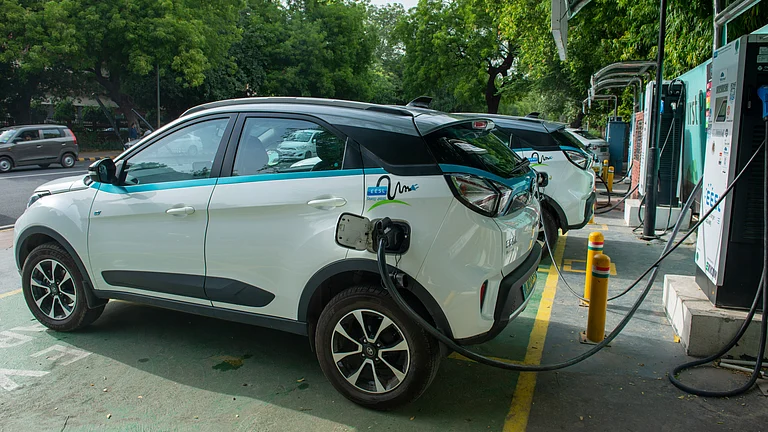
Battery electric vehicles and plug-in hybrids, by contrast, attract considerably more generous derogation factors under the draft norms.
Advertisement
The practical consequence, AIDA argues, is a framework that could inadvertently push automakers towards electrification whilst side-lining an immediately deployable, domestically anchored and cost-effective route to decarbonisation — one that does not require the charging infrastructure or supply chain imports that rapid electrification demands.
Suggested Changes
The association has put four recommendations to the ministry. First, it wants the Volume Derogation Factor for standalone FFVs raised from 1.1 to at least 2.0 to 2.5, to properly reflect their environmental and economic value. Second, it is calling for a technology-neutral, portfolio-based compliance structure that co-incentivises electrification, hybridisation and ethanol-based solutions — rather than creating a regulatory hierarchy that effectively prioritises one pathway over others.
Advertisement
Third, AIDA wants the CAFE-III framework explicitly harmonised with the Ethanol Blending Programme, including its roadmap beyond E20, so that regulatory signals across sectors point in the same direction. Fourth, it is pushing for a more robust recognition of well-to-wheel emissions reductions associated with ethanol, particularly when produced from domestically grown renewable feedstocks such as maize and molasses.