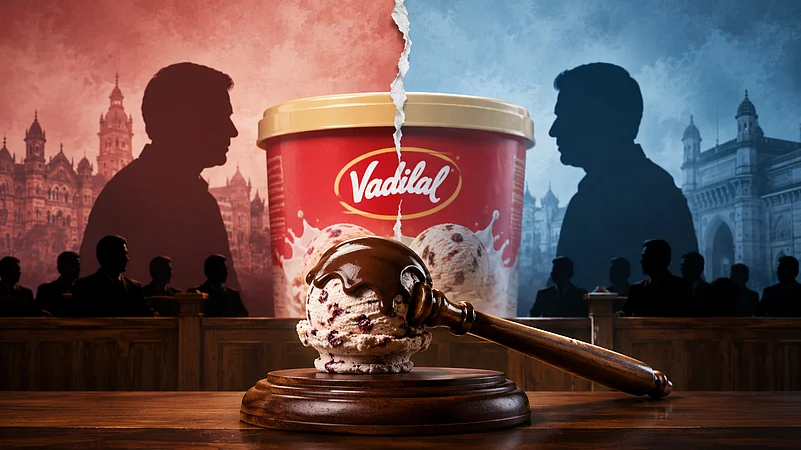

The Gandhi family's dispute traces its roots to business divisions and ownership arrangements made in the 1990s
The Mumbai and Ahmedabad branches are now battling in the Bombay High Court over brand rights, territories and alleged interference in business operations
The case could determine how the Vadilal brand is managed going forward and clarify the rights of both family factions under earlier settlement agreements
Flavourful frozen treats wrapped in colourful packaging! The century-old ice cream brand, Vadilal, has built a loyal customer base across generations in India. But behind the family pack ice cream tubs, cones and refreshing ice candies, lies a three-decade old family dispute.
It has passed through generations. About 30 years ago, a family settlement divided the Vadilal business between two branches — Mumbai and Ahmedabad — of the Gandhi family. The dispute over ice cream has once again reached the courtroom.

1 September 2026
Get the latest issue of Outlook Business

The latest debate has brought the Mumbai and Ahmedabad factions of the family face-to-face in the Bombay High Court. It has reopened questions over brand rights, business territories and the interpretation of a decades-old agreement.

When Vadilal Dispute Started
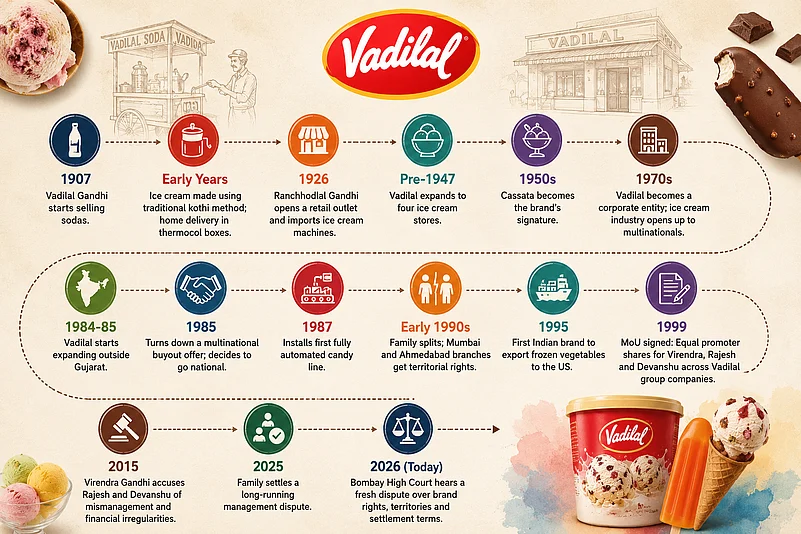
The origins of the Vadilal family dispute can be traced back to the early 1990s, when differences emerged within the fourth generation of the Gandhi family that controlled the ice cream business. The first major split involved brothers Rajesh Gandhi and Shailesh Gandhi, grandsons of Ranchhodlal Gandhi, who had expanded the family enterprise into a national brand.
Advertisement
The disagreement eventually led to a division of territories, with Shailesh retaining rights to use the Vadilal brand in Maharashtra and parts of southern India, while the Ahmedabad branch continued to control the core business.
The family attempted to create a more durable framework for ownership through a memorandum of understanding signed in 1999. Under the agreement, brothers Virendra Gandhi and Rajesh Gandhi, along with their cousin Devanshu Gandhi, were to hold equal shares in the promoter stake across Vadilal group companies. The pact also stipulated that none of the family members could increase their stake in group entities without the consent of the others.
Advertisement
However, fresh tensions surfaced in 2015 when Virendra Gandhi approached the Company Law Board, accusing his brother Rajesh and cousin Devanshu of “mismanagement" and of unlawfully removing him from key positions in group companies. Rajesh and Devanshu denied the allegations and countered with accusations of their own, turning what had been a private family disagreement into a prolonged legal battle.
The dispute dragged on for nearly a decade through various legal forums before the family reached a settlement in 2025. Yet even as that chapter appeared to close, another conflict rooted in the family's earlier territorial arrangements and brand rights has resurfaced, which has brought different branches of the Gandhi family back into court.

Why Dispute Returned Now
The latest round of litigation was triggered by a petition filed by the Mumbai branch, led by Shailesh Gandhi through Vadilal Dairy International.
The Mumbai branch has approached the Bombay High Court seeking interim relief against members of the Ahmedabad branch and related entities.
In short, it wanted the Ahmedabad branch not to interfere with the manufacturing, sale, distribution and marketing of ice-creams and juices that it claims it is entitled to sell under the 1993 family settlement.
The matter is currently before the Bombay High Court, where the parties have argued over both the substance of the dispute and procedural issues, including jurisdiction.
Justice Amit Borkar has reserved orders on the request for interim relief.

What Are Both Sides Arguing
Senior advocate Mustafa Doctor, who represented the Mumbai branch in court, argued that the Ahmedabad faction had at one stage explored acquiring the Mumbai group’s business as part of a broader effort to consolidate the Vadilal businesses.
However, according to the Mumbai side, the proposed transaction was never completed, which triggered a series of disputes across multiple legal forums.
The Mumbai group maintains that the 1993 family settlement granted it permanent rights to manufacture and sell ice creams and juices under the Vadilal brand in Maharashtra, Goa, Karnataka, Kerala and the then undivided Andhra Pradesh.
In return, it gave up its stake in the family's trademark-holding company. The group has further alleged that the Ahmedabad branch attempted to disrupt its operations through trademark disputes in the United States, quality-related complaints, product recall demands and efforts to inspect its manufacturing facilities.
The Ahmedabad branch has rejected these allegations. Appearing for the group, senior counsel Venkatesh Dhond argued that products manufactured by Vadilal Dairy International Ltd (VDIL) had repeatedly failed quality standards due to serious microbiological contamination.
According to the Ahmedabad side, such issues amounted to a violation of the quality-control requirements laid down in agreements signed when the family businesses were divided in the early 1990s.
The legal battle has also resulted in other entities linked to the Vadilal brand. Lawyers representing Vadilal International questioned whether the Bombay High Court was the appropriate forum for the dispute, arguing that earlier agreements between the parties specified Ahmedabad courts as the jurisdiction for resolving such conflicts.
Meanwhile, Vadilal Industries has sought to distance itself from the feud. Representing Vadilal Industries, senior counsel Zal Andhyarujina and Ativ Patel of AVP Partners argued that the company was publicly listed and that retail shareholders hold a 35% stake.
“We have been made a party in the case, whereas we are not a party or signatory in any agreement between family members. We are just a licensee (of Vadilal International) that owns the brand "Vadilal",” argued Andhyarujina.
What’s Next
Currently, the immediate focus is on the Bombay High Court's decision regarding interim relief. For now, the dispute appears headed toward arbitration, which was envisaged under the original family settlement framework.
The eventual outcome could clarify the rights and obligations of both branches under the 1993 agreement and determine how the Vadilal brand is managed going forward.
In a nutshell, the settlement intended to end family disagreements more than 30 years ago has become the centrepiece of a new legal battle. And in a reminder that even the most familiar consumer brands can have complex histories behind them, India's iconic ice cream company finds itself back in court.