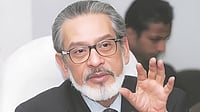
Tata Sons board reappoints N Chandrasekaran for a third term despite Noel Tata’s opposition.
Tata Trusts calls Chandrasekaran’s reappointment “illegal”, citing Tata Sons’ Articles of Association.
The row raises a long-standing governance question at Tata: who calls the shots at the conglomerate?
The differences between the Tata Trusts and the Tata Sons board came out in the open after the board decided to reappoint N Chandrasekaran for a third term. It also initiated steps to comply with the Reserve Bank of India’s requirements for upper-layer non-banking finance companies. This could ultimately put Tata Sons on the path to an initial public offering.
The decisions were taken despite opposition from Noel Tata, chairman of Tata Trusts, the majority shareholder of Tata Sons, on September 17. In a statement later, the Trusts called Chandrasekaran’s reappointment “illegal”, citing provisions in Tata Sons’ Articles of Association.

1 September 2026
Get the latest issue of Outlook Business

The episode has brought a long-standing question about Tata Group’s governance into the open. Where does the authority of the Tata Sons board end? And where do the special rights of the Tata Trusts begin? Experts say the answer will determine how the boardroom battle unfolds from here.


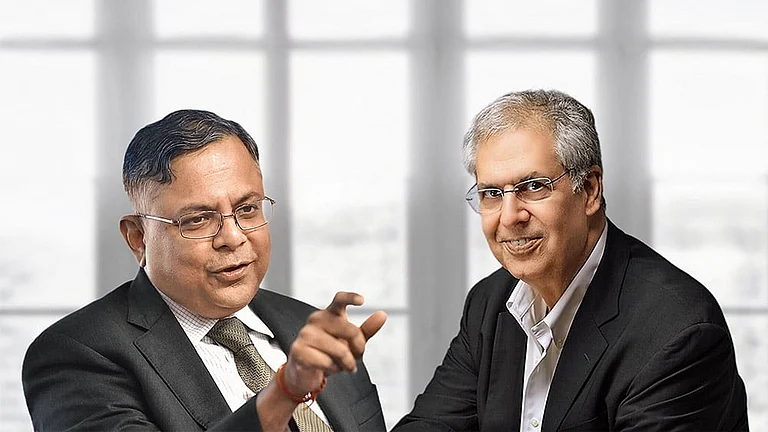

Can the board act against the Trusts?
The answer lies in Tata Sons hybrid governance structure. Tata Trusts owns about 66% of the holding company, giving it decisive power at the shareholder level. At the same time, the company’s Articles of Association (AoA) give Trust-nominated directors special rights over certain decisions. The board, meanwhile, remains responsible for managing the company and its affairs.
Advertisement
“The board is not a mere agent of Tata Trusts, but neither is it free to ignore the governance rights written into Tata Sons’ Articles,” says B Shanker, managing partner at B Shanker Advocates LLP. A 2021 Supreme Court judgment in the cases filed by Cyrus Mistry and minority shareholder of Tata Sons, the Shapoorji Pallonji Group, upheld the affirmative-vote mechanism but stopped short of treating it as inherently oppressive. That tension is now being tested in public.
To be sure, on Thursday, Tata Sons board members, including Trusts’ nominee directors Noel Tata and Venu Srinivasan, independent directors Harish Manwani and Anita Marangoly George, and the group’s Chief Financial Officer Saurabh Agrawal, took part in the vote on N Chandrasekaran’s reappointment resolution.
Advertisement
Barring Tata, every board member voted in favour of the resolution, including Srinivasan. It was reported that the Sir Dorabji Tata Trust (SDTT) had sought to restrain Srinivasan from participating in or voting on the resolution before the meeting. Srinivasan rejected the move, arguing that he was a joint nominee of SDTT and Sir Ratan Tata Trust (SRTT) and that one Trust could not unilaterally prevent him from exercising his rights as a director.
“The Articles carve out a special class of reserved matters — under the Article 121 group of provisions introduced in 2014 — on which no resolution is validly passed unless it carries the affirmative vote of a majority of the directors nominated by the Tata Trusts,” V. P. Singh, Advocate and Former Member of NCLAT, Delhi Bench..
The appointment, reappointment or removal of the Executive Chairman of Tata Sons is one of these protected matters. Article 118 of Tata Sons’ AoA also lays down a selection process in which the Trusts have a built-in majority.
“On these subjects, the board simply cannot, in law, override the Trusts’ nominees. That is not an accident of drafting; it is the whole point of the mechanism. So my answer is a lawyer’s answer: on everyday matters, yes; on the chairmanship, no,” Singh points out.
But there is still some ambiguity. The exact wording of Articles 118 and 121 is not fully in the public domain. The exact legal interpretation of these Articles remains contested.
Alay Razvi, managing partner at Accord Juris, says it cannot yet be stated conclusively that the Articles either permit or prohibit what the board has done.
“The central legal issue is whether the special affirmative voting requirement is an independent safeguard or can be overridden by the general board voting provisions,” he says. That distinction could ultimately determine whether the board’s resolution stands.

What Can the Trusts Do Now?
“The Trusts’ strongest weapon is not litigation at all. It is ownership,” says Singh. With about 66% of Tata Sons, Tata Trusts has a controlling shareholder position. That gives it a route that exists independently of the current boardroom dispute: the shareholder meeting.
Under Section 100 of the Companies Act, shareholders meeting the prescribed threshold can requisition an Extraordinary General Meeting. With its majority stake, the Trusts comfortably cross that threshold. At such a meeting, the Trusts can exercise their shareholder voting rights on matters requiring shareholder approval.
It can also seek changes at the board level, subject to the procedures and legal requirements under the Companies Act. Section 169, for example, provides a mechanism for removal of directors by shareholders through an ordinary resolution, subject to special notice and the concerned director’s right to be heard, the former NCLAT member points out.
This creates an important distinction between boardroom control and shareholder control. But the issue facing the charitable institution right now is its inability to call that AGM or EGM. The one of principal Tata Trust, Sir Ratan Tata Trust (SRTT), has been barred from convening trustee meetings amid proceedings before the Maharashtra Charity Commissioner. The restriction has complicated the Trust’s ability to take certain decisions required for Tata Sons matters, including jointly nominating a representative with the Sir Dorabji Tata Trust.
It also contributed to the adjournment of Tata Sons’ annual general meeting (AGM) after the company could not meet the required quorum in September. Now, Tata Sons has until December 31, 2026, to hold the AGM.
Singh points to other options, like the Article 118 selection-committee process. It can be used to place Tata Trusts’ dissent formally on the record, exercise their right under the Article 104B group to nominate up to one-third of the board and fill nominee vacancies, and withhold their affirmative votes on connected reserved matters until the chairmanship is settled.

Back to Courts?
The Trusts can also challenge the validity of the board resolution before the appropriate legal forum. One possible route, according to the experts, would be to seek a declaration that the resolution is invalid and an injunction preventing the company from acting on it until the dispute is resolved.
“The Trusts may approach the National Company Law Tribunal or a competent court under the Companies Act and the Articles of Association,” says Razvi, Managing Partner, Accord Juris. “Possible grounds could include breach of the affirmative voting requirement, procedural irregularity, violation of the Articles, oppression or prejudice to shareholder rights.”
A petition under Sections 241-242 of the Companies Act is another possible avenue, although its applicability would depend on how the Trusts frame the dispute. Experts caution that the oppression-and-mismanagement provisions should not automatically be treated as a catch-all remedy. The Supreme Court’s judgment in 2021 itself placed limits on how those provisions should be used.
The more fundamental legal argument may therefore be contractual, according to Singh. The Articles of Association bind the company and its members, and if the board acted outside the powers given to it under those Articles, the resolution could be challenged as being contrary to them.
It also means the dispute may eventually move from the boardroom to a courtroom, where the question will not be who has the stronger shareholder position, but what the Articles actually permit.
Tata Sons’ future
The Chandrasekaran reappointment is only one part of the problem. Tata Sons is also dealing with the RBI’s regulatory framework for upper-layer NBFCs. The holding company was classified as an upper-layer NBFC and has been looking at ways to comply with the regulatory requirements, including the listing requirement.
Tata Sons had earlier sought to surrender its Core Investment Company registration after taking steps to reduce its regulatory exposure. It also repaid public loans and separately listed Tata Capital. The RBI subsequently rejected the request to surrender the CIC registration, leaving Tata Sons facing the broader question of how it will deal with its regulatory status and potential listing.
The September 17 board decision to move towards compliance therefore puts the listing issue directly alongside the governance dispute. For the Trusts, this is significant because a Tata Sons listing would fundamentally alter the nature of the holding company.
The Trusts have historically exercised influence through their ownership and the governance architecture of Tata Sons rather than through an openly traded listed holding company. A public listing would introduce another layer of scrutiny, disclosure and market accountability.
That makes the disagreement over who controls the board and who determines strategic direction more consequential than a dispute over one chairman’s term.
On Friday, SP Group Chairman Shapoorji Pallonji Mistry said that the public listing of Tata Sons is not merely a financial or regulatory matter, but “a social and moral imperative.”
It has been reported that Mistry earlier wrote to the Prime Minister’s Office requesting a mandate for Tata Sons’ listing. He cited the group’s over 18% stake, which is still pledged against large private debt. It has been reported that the construction giant risks defaulting on the debt if capital does not come from the Tata Group.
“I wish to place on record my profound admiration for the exemplary leadership of our Hon’ble Prime Minister, Shri Narendra Modiji, particularly his commitment to strengthening institutions and enabling them to discharge their responsibilities with clarity, authority and purpose,” said Mistry, thanking him and the RBI for providing clarity on Tata Sons’ UL-NBFC status.
For now, though, the risk isn’t to the day-to-day operations of the conglomerate, which expands from salt to software, with growing interest in sunrise sectors like semiconductors and battery storage.
“The risk is less day-to-day operational paralysis and more strategic overhang. If the Trusts and Tata Sons board remain divided, major decisions may become slower, more contested and more closely watched by regulators and investors,” says Soumya Singh, Co-Founding Partner, Thistle&Law.
Ultimately, as pointed out by experts, the resolution would be to draw a defining line between where the board’s authority ends and the Trusts’ special rights begin. Until that line is drawn, disputes of this kind will keep recurring.