Warren Buffett has stepped down as Berkshire Hathaway's chairman after six decades, taking on the role of Chairman Emeritus while remaining on the board.
Howard G Buffett has been elected the new Chairman of the Board, with Greg Abel continuing as CEO and Susan L Decker staying on as Lead Independent Director.
The transition caps a succession plan that began when Abel took over as CEO in 2025, with Buffett citing age as a factor in his letter to shareholders.
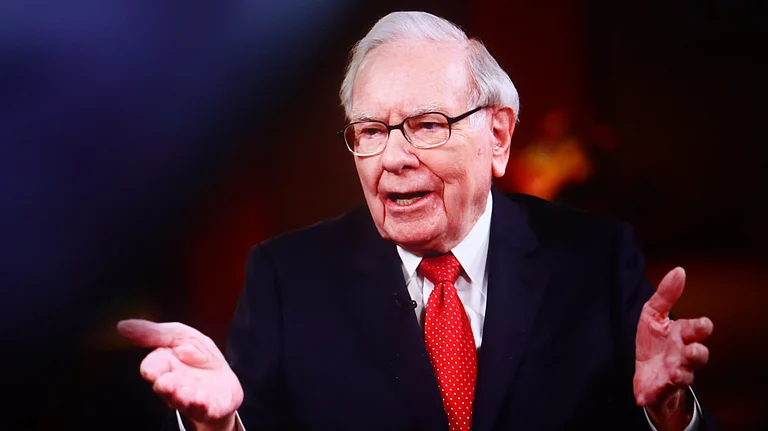
Warren Buffett has given up the chairman's post at Berkshire Hathaway, bringing an end to a six-decade stretch at the top of the $1 trillion conglomerate. The company said on September 18 that the 96-year-old investor will now hold the title of Chairman Emeritus, a position created in recognition of what it called his extraordinary contributions to the firm and its shareholders.
Buffett will continue to sit on Berkshire's board and remains available to offer his views, the company said. The board has elected his son, Howard G Buffett, who has served as a director since 1993, as the new Chairman. Susan L Decker continues in her role as Lead Independent Director.
1 September 2026
Get the latest issue of Outlook Business

The announcement arrives nine months after Greg Abel took charge as chief executive, a move that had already shifted day-to-day control of Berkshire's operations away from Buffett even as he held on to the chairmanship. Buffett had first signalled his intention to hand over the CEO role at the company's annual meeting in May 2025.


Advertisement
In a letter accompanying the announcement, the Oracle of Omaha wrote that time eventually catches up with everyone. "Father Time always wins," he said, adding that he had nonetheless been given the chance to watch Berkshire reach a stage where he feels more confident than ever about its future.
Succession Plan Gets A Sharper Divide
The latest move draws a clearer line between who manages Berkshire's business and who safeguards its institutional character. Abel has already been overseeing operations since becoming CEO, while Buffett stayed involved in major calls and acted as a sounding board. Earlier this year, Abel told CNBC that Buffett still came into the Omaha office daily and was consulted often.
Advertisement
Buffett also continued to weigh in on investment decisions in recent months. In July, he said he had personally driven Berkshire's move into Alphabet, after the company made a roughly $10 billion private purchase of the stock in June, making the Google parent its third-largest holding after Apple and American Express.
Describing the new arrangement, Buffett wrote that Abel would run the company while Howard would protect its culture and values, calling both more valuable than anything on Berkshire's balance sheet. He compared Howard's position to an insurance policy that shareholders own but hope never to need.
Abel, in the company's statement, said the culture the legendary investor built would stay central to Berkshire going forward, with Howard responsible for preserving it. Howard is not expected to take on operational duties, with his role centred instead on maintaining the principles that have guided the company under his father.
The Long Road From Textiles To Trillions
Buffett took control of Berkshire Hathaway in 1965, when it was a textile manufacturer in financial trouble. Under his leadership over the following decades, the company grew into a sprawling conglomerate spanning insurance, railroads, energy and manufacturing, alongside a large investment portfolio.
Berkshire posted $44.5 billion in operating earnings last year and now employs close to 400,000 people. Over Buffett's tenure, the company returned 19.7% annually to shareholders on a compounded basis, roughly double the S&P 500's return across the same stretch.
Buffett had already acknowledged that age was slowing him down in a letter to shareholders last Thanksgiving, ahead of handing the CEO role to Abel, noting that he moved slowly and found reading harder than before, even as he continued going into the office five days a week. In Friday's letter, he took a lighter tone about turning 96, mentioning that he had celebrated his birthday with family, including a great-grandchild who had just turned one and was, in his words, moving faster than he currently does.
The leadership change comes at a time when Berkshire's stock has underperformed the wider market in 2026, rising about 1% against a gain of more than 11% for the S&P 500. That gap adds pressure on Abel to put the company's large cash pile to work. Berkshire held $365.5 billion in cash as of the latest count, while share buybacks rose to $4.5 billion in the second quarter.
Buffett expressed confidence in Abel's leadership, writing that his expectations for him had been extremely high from the outset and that Abel had gone beyond them. He said the company was in good hands and that he looked forward to remaining a shareholder himself.
Abel said Buffett had handed him an extraordinary responsibility, and that he looked forward to continuing to work with Buffett, alongside Howard as Chairman and Decker as Lead Independent Director.