
RBI’s rejection of Tata Sons’ deregistration request has revived its listing prospects.
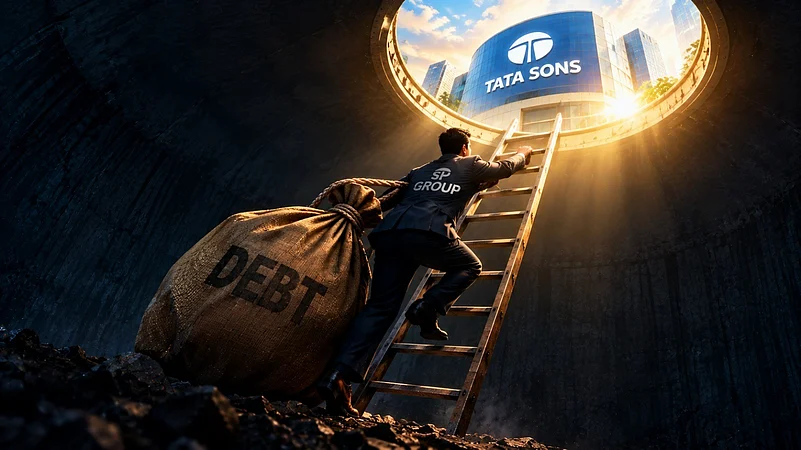
For SP Group, which owns 18.37%, a listing could make its biggest asset easier to value and monetise.
But the estimated ₹2.3 lakh crore stake value isn’t cash; debt relief depends on a sale or refinancing.
The Reserve Bank of India’s rejection of Tata Sons’ request to surrender its registration has revived the prospect of a stock market listing for the group’s holding company. For the Shapoorji Pallonji (SP) Group, which owns an 18.37% stake in Tata Sons, could open a new route to tackle its expensive debt burden.
Currently, SP Group’s Tata Sons stake is one of its most valuable assets and has historically been used to raise funds against promoter-level debt. An Economic Times report has estimated the stake’s look-through value at around ₹2.3 lakh crore. But its value on paper is very different from cash in hand.

1 September 2026
Get the latest issue of Outlook Business

But a Tata Sons listing could change that equation by giving the stake a transparent market value and potentially making it easier to sell, refinance or use as collateral. The key question is whether that greater liquidity can help SP Group unlock enough value to bring down its high-cost borrowings.
The Tata Sons Lifeline
SP Group’s challenge is not a lack of valuable assets. It is the difficulty of converting some of those assets into cash on terms that can reduce its financing costs.
Infomerics Valuation and Rating, in its June 30, 2026 assessment of Shapoorji Pallonji and Company Pvt Ltd (SPCPL), said the group has historically leveraged its 18.37% Tata Sons stake to raise funds at promoter holding entities. The proceeds, it said, have primarily been used to refinance existing promoter-level debt and meet refinancing requirements across group entities.
Advertisement
That financing has become expensive. SP Group completed a ₹21,500-crore refinancing in July, including around ₹15,200 crore of three-year rupee-denominated zero-coupon bonds carrying a 18.95% yield and a $650-million bond at 14.5%. The group is looking to bring borrowing costs down from around 18–19% to about 12%, according to Moneycontrol.
SP Group is also weighing options to meet a ₹3,500-crore repayment due by the end of September, including raising funds or seeking more time from lenders, the ET reported. Lenders have been seeking tangible progress on monetising the Tata Sons stake before considering further refinancing or easing loan-to-value requirements.

Advertisement
The Listing Effect
A listing would change the nature of SP Group’s holding. Instead of owning shares in a privately held company whose value has to be negotiated or estimated, SP would hold shares with an observable market price and potentially a much wider pool of buyers.
Suman Kumar Jha, founder and managing partner of Corp Legex, said a listing “could materially improve the monetisation prospects” of SP Group’s 18.37% stake by widening the buyer universe and establishing an observable market price. Public trading, he said, would provide “a clearer benchmark for negotiated sales, institutional placements or phased disposals.”
That does not mean SP could immediately sell its entire holding at the quoted price. Jha cautioned that “market depth, applicable lock-ins, existing pledges and the size of any disposal would determine the proceeds and timing.”
On the other hand, Shriram Subramanian, founder and managing director of InGovern Research Services, sees liquidity as a major benefit for SP. “Minority shareholders, including Shapoorji Pallonji Group ... will get liquidity,” he said. “At least Shapoorji Pallonji will be a big beneficiary because they could then at least overcome their debt problems.”

The Cash-Conversion Challenge
Not necessarily. The ₹2.3 lakh crore figure should be treated as an indicative value of SP’s 18.37% stake, rather than the amount the group can automatically realise.
Jha said the figure “should be treated as an indicative stake valuation, rather than assured realisable proceeds.” The eventual market value of Tata Sons could be materially different from estimates based on the value of its underlying investments.
Investors would assess Tata Sons’ portfolio, dividend income, liabilities, future capital commitments and governance. A holding-company discount could also affect the valuation because investors can already buy shares of several listed Tata companies directly. Minority ownership, potential tax leakage and selling pressure could further affect the proceeds. Any fresh equity issuance by Tata Sons could also dilute SP Group’s percentage holding.
BusinessLine has separately estimated Tata Sons’ value at around ₹10 lakh crore and highlighted the value embedded in its stakes in seven listed Tata companies. But that remains an estimate of the holding company’s value and is different from an actual IPO valuation, which would ultimately depend on the issue structure and market pricing.
The Debt-Relief Route
The potential benefit is therefore less about a sudden windfall and more about creating a credible route to monetisation.
Greater liquidity and price discovery could also change the conversation with lenders. Jha said a transparent market valuation and a credible exit route could “reduce lenders’ uncertainty about collateral value and recovery prospects.” This could support “lower collateral haircuts, broader lender participation and better refinancing terms”, particularly where financing is secured against the Tata Sons stake.
But a listing itself would not put cash into SP Group’s hands. “A fresh issue raises money for Tata Sons; SP receives proceeds only if it sells shares through an offer for sale or subsequent transactions,” Jha said. Over time, he added, phased monetisation could “meaningfully reduce principal and interest costs.”


The credit-rating agencies underline why that matters. Infomerics described SPCPL’s liquidity as “stretched”, citing delays in tying up enhanced working-capital limits and high debtors. It said timely monetisation of assets and/or promoter-group capital infusion would remain important, while the group’s ability to execute planned refinancing and asset monetisation remained important to its deleveraging strategy.
ICRA’s May 29, 2026 assessment also highlighted pressure from elongated debtors, high working-capital intensity and weak operating cash flows, while noting the need for promoter support. These concerns show why unlocking value from the Tata Sons stake could matter beyond its headline valuation.
For SP Group, the RBI decision therefore does not turn a ₹2.3 lakh crore paper asset into cash overnight. What it potentially does is make the group’s biggest asset more transparent, more liquid and more usable — giving it another route to address a debt burden that has become increasingly expensive to carry.