Apple has entered India’s foldable smartphone market amid slowing iPhone sales.
The ₹2,99,900 iPhone Duo targets India’s premium segment.
Analysts expect the device to add to Apple’s India sales, but not reverse its declining shipment volumes.
Apple's foray into the foldable smartphone market comes at a time when its sales have faced pressure in the June quarter after years of growth. The decline coincided with the overall smartphone market facing a decline due to rising component costs pushing up device prices.
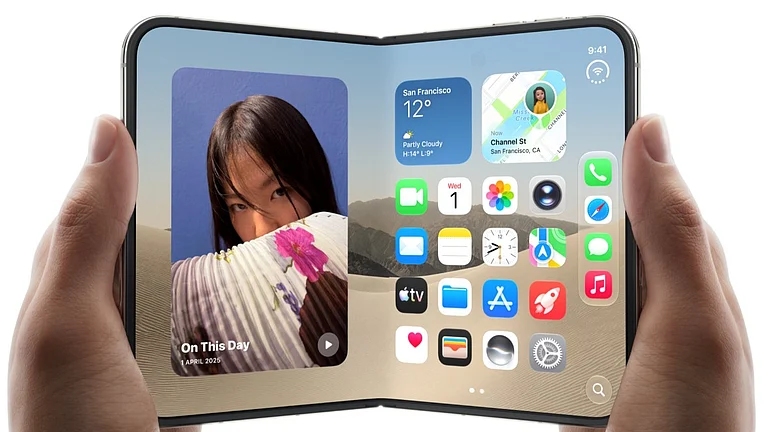
On Thursday, the American giant launched its first foldable smartphone, iPhone Duo, at a staggering price of ₹2,99,900 in India. Globally, the device starts at $1,999 and features a 7.6-inch inner display and a 5.4-inch outer screen.

1 October 2026
Get the latest issue of Outlook Business

Analysts believe that the new device can add to the iPhone maker's sales in India, though they stop short of declaring that it might reverse the company's declining shipment numbers.
Market intelligence firm IDC Research expects Apple’s India shipments to decline in single digits in 2026 compared to a growth of 16% year on year (YoY) in 2025. In 2025, the company sold about 14.3 million units.
Apple’s India Losing Momentum
In the first six months of 2026, Apple sold about 6.4 million units of its iPhones, according to data from Omdia. The agency also found that shipments in volume terms have been on a downward path since January.
Advertisement
Counterpoint Research has also reported a similar decline. Though it claimed that on an annualised basis, the April-June quarter was the first time the iPhone maker saw a quarterly shipment decline in nearly four years.
"There is a short-term hiccup in volume due to ongoing memory price hikes and consumers pushing out their purchases," Tarun Pathak, research director at Counterpoint Research, said. He still sees Apple's growth in India “far from maturity”.
But, as per him, Duo isn't going to help push its volume shipment anytime soon.
Advertisement
Can Duo Make a Dent?
It's quite unlikely, given its current market share in India. India’s entire foldable smartphone market stood at 626,000 units as of December 2025, according to IDC. Even with expected growth of more than 25–30% in 2026, the category is projected to reach only around 800,000–850,000 units, says Upasana Joshi, senior research manager for mobile phones, smart wearables and smart home/IoT at IDC India and SEA.
"Against Apple's own India shipment base, which runs into several million units, even a strong share of that foldable pie adds up to a rounding error on total volumes. So no, the Duo isn't going to reverse the pressure on Apple's overall India shipments...It's additive, not transformative, at least in the near term," said Joshi.
Another layer of the Duo's impact is expected from the side of iPhone enthusiasts, according to Counterpoint Research's senior research analyst Shilpi Jain.
"Adoption will likely come from brand loyalists, early adopters, or those eager to try new Apple hardware- similar to what we saw with the Vision Pro, the original Watch Ultra, or first-generation iPad users," she said. However, Jain added that the ₹3 Lakh price tag "has never been tested against end-consumer budgets for smartphones."
Her colleague Pathak pointed out that there are high chances users will find a way to purchase the iPhone Duo internationally.
So, the Duo's initial customer base is more likely to consist of existing iPhone users and early adopters who want a foldable without leaving Apple’s ecosystem. Faisal Kawoosa, founder of TechARC, described the positioning as “ultra niche” initially.
"The early adopters will be existing iPhone users who have been wanting to own the novel form factor of foldables but within the Apple ecosystem. They were at a cross road, they wanted to have a foldable smartphone but were not keen to leave the Apple experience. Now they get the both," said Kawoosa. He also expects broader adoption to take six to nine months as consumers become more familiar with the form factor.
Apple’s entry could nevertheless give the category a boost by increasing consumer confidence in foldables. Its arrival also gives Apple an opportunity to participate in a segment that rivals have been developing for several years.

Apple's Premium Play
The decline in Apple's iPhone sales in volume terms is not a matter of concern, according to analysts, given its dominance in the value segment. The company has enjoyed India's shift to premium products in its post-Covid-19 sales boom.
Even last year, when the overall India smartphone market saw just 1% YoY growth in volume terms, Apple increased its shipments by 28% YoY, according to Counterpoint Research. In value terms, the company ended the year with a 28% market share last year, the highest in India.
Joshi explains the reason behind this positioning. Apple already has the highest average selling price in India's smartphone market, well above $800-900 against the $300 selling price seen in the overall India market.
"It (Apple) has consistently led the market in value terms since 2023 despite a comparatively modest share of units. The Duo fits that same playbook: a high-priced, low-volume product that reinforces Apple's value leadership and premium-segment dominance rather than expanding its shipment base," she added.
So, given the still smaller size of the super-premium smartphone segment in India, the IDC analyst points out that the Duo looks "more like an ASP and brand-value play than a volume strategy."
Counterpoint's Pathak also expects this value-led growth to continue for Apple. He expects a single-digit decline in Apple’s India volumes after the latest price increases, but in value terms, growth is expected to be around 6–7% YoY in 2026.

What Is Behind Recent Slowdown?
The slowing growth of Apple's India sales is not company specific. In May, IDC reported that India’s smartphone shipments fell 4.1% YoY in the first quarter of 2026, while market value increased by 5.8% and the average selling price reached a record $302.
After holding off for months, Apple also had to raise prices across its India lineup following its latest launch. Reuters reported that prices for some existing iPhone models rose sharply, with the increases linked to higher memory and storage chip costs.
“Rising memory costs are a meaningful headwind,” said Sravan Kundojjala, analyst at SemiAnalysis. He said Apple’s purchasing scale and supply agreements can cushion some of the impact, but higher prices, smaller discounts and margin absorption are still likely.


For India, the bigger concern is affordability. Kundojjala said higher prices could put newer iPhones out of reach for some first-time buyers and delay purchases, even though demand among wealthier consumers is likely to remain more resilient.