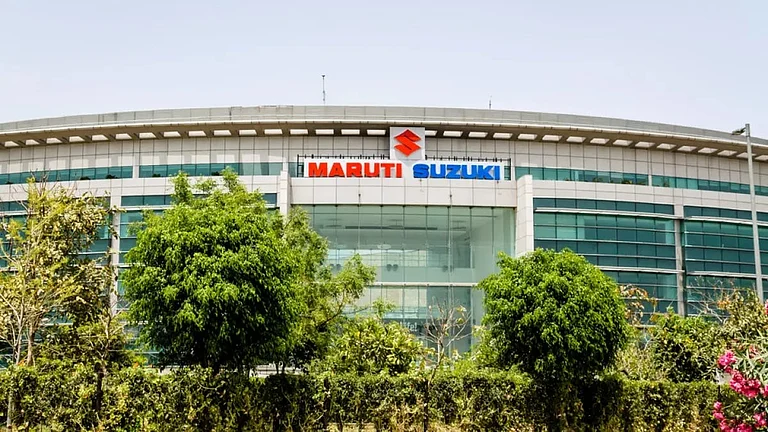
There is a significant opportunity for India to emerge as a trusted manufacturing and supply chain hub in the global automotive ecosystem, as cost is no longer the sole priority — reliability and operational continuity are now just as vital, Maruti Suzuki India MD and CEO Hisashi Takeuchi said on Wednesday.
In a bid to truly strengthen the industry's competitiveness, products made in India must be able to compete with the best in the world and "require quality to become our signature", Takeuchi said, while addressing the annual session of Automotive Component Manufacturers Association of India (ACMA).
"The last decade taught us how to withstand disruption. The next decade must help us become stronger because of disruption," he said.

1 October 2026
Get the latest issue of Outlook Business

To move in that direction, Takeuchi said there are four important enablers for the Indian automotive industry -- deep localisation, people, collective learning, and technology.


"Fortunately, the conditions for deeper localisation have never been more favourable," he said, adding global supply chains are being reconfigured.
"Cost is no longer the only consideration. Reliability and continuity have become equally important. This creates a significant opportunity for India to emerge as a trusted manufacturing and supply chain hub," Takeuchi noted.
The government's policy support to the industry has helped in creating opportunities to build capabilities in critical areas and reduce strategic dependencies, he noted.
Advertisement
Takeuchi said India's export potential also continues to strengthen, thereby creating an opportunity of scale and justifying the need to invest in localisation, including advanced technologies that were previously considered difficult to manufacture competitively in India.
Takeuchi also pointed out that competitiveness is not an individual company phenomenon but "is an ecosystem phenomenon".
"Unless our Tier-2 and Tier-3 suppliers are capable, we can't produce world-class quality. Hence, we need to extend our focus beyond our companies to include our immediate suppliers, as well as Tier-2 and Tier-3 suppliers," he added.
Highlighting the need to focus on cyber security as the industry embraces digitisation more, Takeuchi said, "It is encouraging to see that organisations are continuously strengthening their cybersecurity systems by investing in advanced technologies." He further noted that even hackers are evolving their technology and becoming more sophisticated with each passing day. "So, we have to ensure that we stay one step ahead of them," he said, noting that the chances of a cyber incident cannot be ruled out.
Advertisement
"In view of this, we must be prepared with a robust contingency plan that enables us to resume business operations within the shortest possible time and minimise any potential disruption." He also called on companies to start looking at people differently beyond viewing human resources "primarily through the lens of cost and reflected as an expense in the profit and loss account".
"We should view people as assets on the balance sheet... Organisations that invest in people are also better positioned to attract and retain high-quality talent," he said.
In an increasingly competitive industry, the ability to attract talent may well become a critical differentiator, Takeuchi noted.