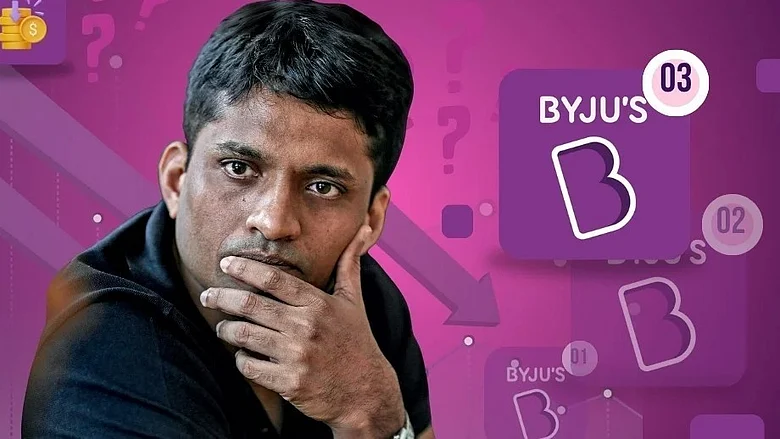

Singapore court sentenced Byju’s founder Byju Raveendran to six months in jail in a contempt case linked to asset disclosures.
The ruling adds to the legal and financial troubles facing the once $22-billion edtech startup.
Delayed audits, debt disputes and global lawsuits pushed Byju’s into crisis.
India’s once-celebrated edtech giant Byju’s is facing another major setback, with founder Byju Raveendran sentenced by a Singapore court to six months in jail for contempt. The order relates to his alleged failure to comply with court directions linked to disclosure of assets and ownership documents.
The latest ruling marks a dramatic turn for a company that once represented the peak of India’s startup boom. At its height in 2022, Byju’s was valued at $22 billion, backed by global investors and known for high-profile cricket sponsorships and aggressive expansion plans.

1 October 2026
Get the latest issue of Outlook Business

But over the past few years, the company has been pulled into a widening financial and legal crisis involving delayed audits, mounting losses, debt disputes, insolvency proceedings and court battles across multiple countries.
New Trouble For Byju’s Founder
The Singapore court found Raveendran guilty of contempt after he allegedly failed to comply with several court orders issued since April 2024, according to media reports. The court has directed him to surrender to authorities and also ordered him to pay legal costs of S$90,000.
The court further asked him to submit documents establishing ownership of Beeaar Investco Pte, a corporate entity linked to the dispute. The matter is tied to legal proceedings involving entities connected to investments and financing arrangements around Aakash Educational Services.
Advertisement
The case adds another international legal challenge for the founder, who is already dealing with insolvency proceedings in India and lender disputes in the United States.
How Byju’s Reached This Point
Founded in 2011 as Think & Learn, Byju’s grew rapidly by tapping into India’s competitive education market and the rise of digital learning. The Covid-19 pandemic accelerated its growth as schools shut and online education demand surged.
The company raised massive funding from global investors and expanded aggressively through acquisitions. It spent nearly $3 billion buying companies such as Aakash Educational Services, Great Learning and Epic while pushing into overseas markets.
Advertisement
The turning point came in 2021 when Byju’s raised a $1.2 billion term loan from overseas lenders. What initially looked like a milestone for India’s startup ecosystem later became the centre of the company’s troubles.

Audits, Debt And Investor Concerns
Concerns started growing after the company delayed filing audited financial statements. When the FY21 numbers were finally released, losses had widened sharply to around ₹4,588 crore, raising questions over spending and governance.
The situation worsened when auditors resigned. Deloitte stepped down as auditor citing delays in financial reporting and communication issues. Later, BDO’s India affiliate also exited. The resignations triggered alarm among investors and lenders.
At the same time, lenders accused the company of breaching loan conditions and failing to provide transparency around the use of funds. Negotiations between the two sides eventually broke down, leading to legal action in multiple jurisdictions.
Global Court Battles And Missing Funds Claims
The company’s lenders later alleged that roughly $533 million linked to the term loan had been moved without proper disclosure. Court filings claimed the money was transferred through different entities, leading to accusations of hidden assets and offshore fund movements.
Legal battles spread across the US, Singapore and India. US lenders sought control of Byju’s US subsidiary, Byju’s Alpha, while Singapore emerged as another key legal battleground tied to investment-related disputes.
Back in India, the National Company Law Tribunal admitted insolvency proceedings against Think & Learn in July 2024 over unpaid dues linked to the Board of Control for Cricket in India. Ironically, the cricket sponsorship that once symbolised Byju’s success became one of the triggers for the insolvency case.
The company also faced a battle over Aakash Educational Services, considered one of its most valuable assets. Byju’s opposed a rights issue by Aakash, arguing it could dilute its stake significantly during insolvency proceedings, but tribunals did not block the move.
Raveendran Denies Wrongdoing
Responding to the Singapore court development, Raveendran said the matter was procedural and not related to fraud or dishonesty.
In a statement posted on X, he said lenders, including GLAS Trust and entities linked to Qatar Investment Authority, had been in advanced settlement discussions with the founders for months. According to him, a settlement had been agreed “in principle” with only minor issues remaining.
“Today’s Singapore court matter is a procedural contempt of court order, arising only from disputes over document disclosure in ongoing proceedings — not a finding of fraud, dishonesty, or any wrongdoing on the merits,” Raveendran said. “I have been directed to appear on 15 June and appeal options are available.”
He also claimed that all parties had broadly agreed not to actively pursue cases against each other during settlement talks and described the latest court action as an unnecessary pressure tactic.