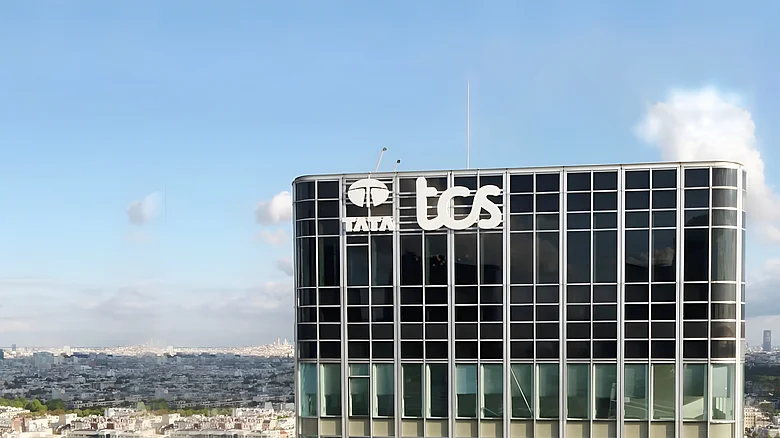
Tata Consultancy Services (TCS) has raised variable payouts for mid to senior-level employees for the second quarter in a row, but how much an employee actually takes home still depends heavily on how often they show up to the office.
The IT giant paid an average quarterly variable of 60-80% in the January-March quarter, according to Moneycontrol. This marks a major improvement from the previous two years, when payouts hovered between 20-50% through the second quarter of FY26.
One employee told the media publication of receiving 60-80% in quarterly variable pay for Q4. However, those with office attendance below the required threshold received considerably less. An employee reportedly said many colleagues received around 50% of their variable pay because their office attendance stood at only about 60%.

1 October 2026
Get the latest issue of Outlook Business

The company's policy, in place since Q1 FY25, directly links mandatory work-from-office compliance to eligibility for the quarterly variable allowance. Employees must maintain at least 85% office attendance to receive the full payout. Those with 75-85% attendance receive 75% of their variable pay, while employees with 60-75% attendance get only 50%. Those falling below 60% attendance are not eligible for the quarterly bonus at all.


Salary Hikes and Concerns
This comes few days after TCS rolled out average salary hikes of around 5% in its latest appraisal cycle, according to a previous report by Moneycontrol. However, several employees alleged cuts in take-home pay, lower variable payouts and changes in compensation structures.
Advertisement
The concerns surfaced months after the company announced annual increments averaging 4.5-7%, with double-digit hikes for top performers and revisions for nearly 80% of employees, effective September 1.
Employees in the top-rated A+ category reportedly received hikes of 9-13%, while those in the A band saw increments largely ranging between 5% and 9%. Staff in the B band reported hikes of around 1-3.5%, while many in the C band said salary revisions were either marginal or negative.

Pushing Out Underperformers
Additionally, the IT giant has also asked managers to formally identify and weed out underperformers.
Advertisement
According to a previous report by Mint, which cited an internal mail, business unit heads had initially identified about 3% of employees — roughly 17,500 people — as underperformers. However, TCS' human resources unit is pushing managers to assign around 5% of its 584,519 employees to Band D, the lowest performance category. That would mean over 29,000 TCS staff could be classified under the band.
The email, sent by a TCS HR executive to a business unit head in April, urged leaders to "critically review and share the list of associates" who could be slotted into Band D in order to meet the "agreed 5% distribution", Mint reported.
While Band D ratings have existed previously, this is reportedly the first time HR has formally pushed for a fixed percentage to be met across teams.