BYD is targeting double-digit growth in India in 2026, said EV business head Rajeev Chauhan.
The company recorded about 84% year-on-year sales growth in 2025, broadly in line with overall EV market expansion.
India’s passenger EV retail sales rose 77% to 176,817 units in 2025 from 99,975 in 2024, according to FADA.
Chinese electric vehicle giant BYD is aiming to achieve at least double-digit growth in India in 2026 after selling about 6,000 cars last year, said Rajeev Chauhan, the firm's head of electric passenger vehicle business. The company logged about 84% year-on-year sales growth in 2025, which was in line with the overall Indian EV market's growth.
Passenger electric vehicle (EV) retail sales in India grew by 77% to 176,817 units in 2025, up from 99,975 in 2024, data from the Federation of Automobile Dealers Associations (FADA) show.

1 September 2026
Get the latest issue of Outlook Business

“Our journey over the last four years has been tremendous. Just to quote a number, in calendar year 2025, we were able to sell 6,000 cars, which was roughly 84% higher than our 2024 numbers. That reflects the kind of growth we are witnessing at BYD... we operate in the premium segment. In that space, we are aiming to achieve at least double-digit growth in 2026 as a baseline expectation. Beyond that, we will see how things evolve,” Chauhan said on Wednesday as it inaugurated BYD's 48th showroom in Moti Nagar.



Advertisement
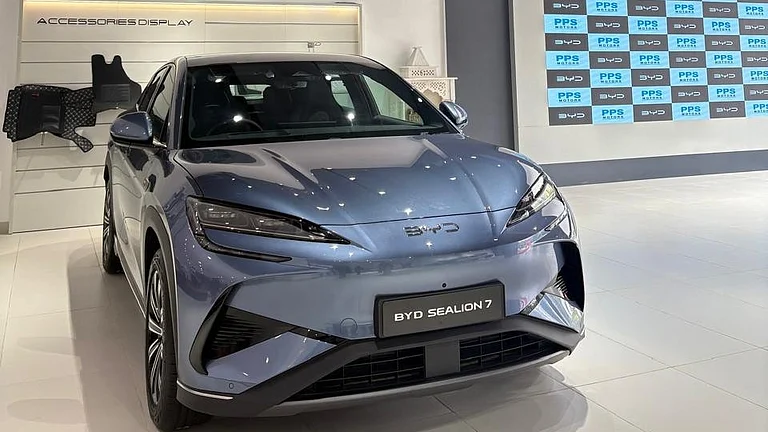
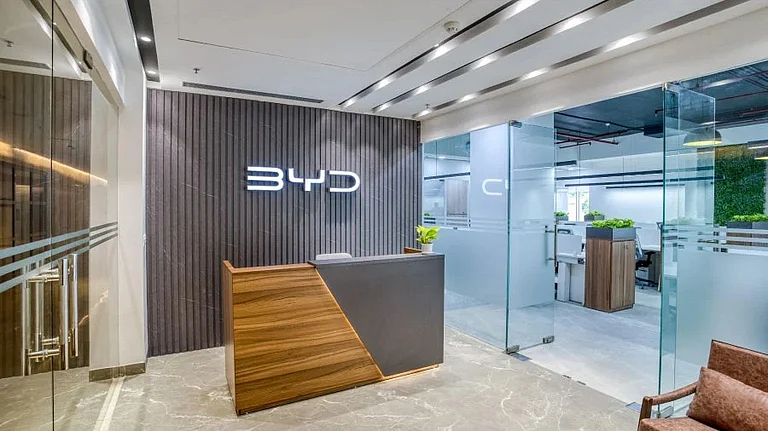
The facility, built in partnership with PPS Motors Pvt. Ltd., is BYD's largest showroom in the country, with a 9,000 square feet space. It is the sixth showroom of the Chinese carmaker in Delhi NCR.
BYD currently sells four main electric vehicle models in India: Atto 3 SUV, Seal sedan, eMAX 7 MPV, and the recently introduced Sealion 7 SUV. Only two of these models are homologated, Atto 3 and eMAX 7.
Homologation refers to the approval process required to certify that vehicles meet Indian government-mandated standards before they can be sold or used on roads, whether manufactured locally or imported. This involves extensive testing by the Automotive Research Association of India (ARAI) to verify compliance with safety, emission and performance norms laid down in the Central Motor Vehicle Rules (CMVR).
Advertisement
For overseas automakers such as BYD, the rules allow the import of up to 2,500 completely built units (CBUs) per year without full local homologation.
BYD India's EV head said that the company is working on certifications of other models, though he noted that they won’t be able to “spell out the timeline” for the same.
On new launches and the potential introduction of hybrid vehicles which combines a petrol or diesel engine with an electric motor, Chauhan said “We are keeping an eye on the market, how it is evolvingand we always have that option.”
As competition intensifies in EV segment with new players like Vietnam’s VinFast scaling up, Chauhan said the company is keeping a close watch on developments in the EV market.
“We have chosen this space (premium segment) for the time being, and we are trying to strengthen our position in this space as much as possible. We are keeping our eyes open,” he said.