
A parliamentary committee has recommended strict guidelines to stop delivery platforms from setting "unrealistic speed targets" through algorithmic dispatch systems, seven months after companies dropped their 10-minute delivery claims from apps and advertisements.
The recommendation is part of the Department-Related Parliamentary Standing Committee on Commerce's 201st report, titled "Doing Business in India: The Way Forward," presented to Parliament on August 7.
The report does not fix a minimum delivery time or ask platforms to slow down. It also does not become binding unless the government or a regulator acts on it. What it does is shift attention from the delivery promise shown to customers to the systems working in the background.

1 September 2026
Get the latest issue of Outlook Business

From Marketing Claim To Backend Systems
Blinkit, Zepto and Swiggy's Instamart removed fixed 10-minute delivery claims in January after the Union Labour Ministry raised concerns over road safety and working conditions for delivery partners.


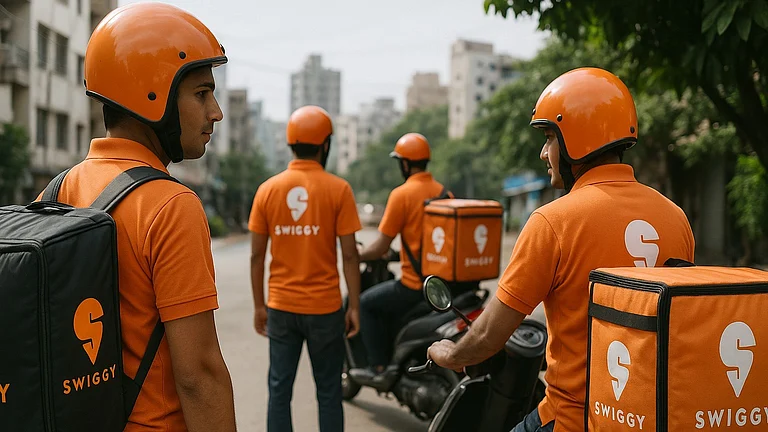

At the time, Eternal, which owns Blinkit, said the change was limited to branding and that its business model remained the same. Platforms continued offering deliveries within minutes depending on location, traffic, inventory and dark-store capacity.
Riders who spoke to Moneycontrol and Business Standard said there was no change in payouts, incentives or how orders were assigned to them. They said they were not shown countdown timers, but earnings were linked to the number of orders completed in a shift, acceptance rates and peak-hour slabs. Missing these targets could cut earnings, while repeated order rejections could lead to temporary restrictions, the riders reportedly said.
Advertisement
How Quick Commerce Builds Speed Into Orders
Speed is built into an order before a rider starts the delivery. Backend systems assign orders to nearby dark stores with the required stock, while digitally mapped shelves and system-generated picking routes cut down search time, according to a report by Moneycontrol. Riders may be assigned to an order even before it has been packed. Platforms also cap delivery distances to a small radius around each dark store.
Defending the model, Eternal founder Deepinder Goyal had earlier said that Blinkit riders were not shown customer-facing timers or penalised for missing the 10-minute mark. In January this year, he had said orders were typically picked and packed within about 2.5 minutes, after which riders covered less than two kilometres in roughly eight minutes, averaging about 15 km/hour.
Advertisement
Moneycontrol's reporting found that riders could still face indirect pressure through incentive slabs and shift-based order targets, though this alone does not establish that the dispatch system is unsafe.
Notably, the committee has not defined what would count as an unrealistic speed target. The report does not specify whether a future framework should examine delivery estimates, time allotted per trip, rider incentives, acceptance rates, route selection or the number of orders assigned per shift. It also does not name a regulator, an audit method or penalties for violations.

Other Recommendations For Gig Workers
The panel has also recommended surprise inspections of dark stores by state governments to check ventilation, hydration facilities and rest intervals for workers.
Point to note: India's quick-commerce market is estimated at around ₹1.08 lakh crore in 2026, growing 40% year-on-year, according to an Equirus report. The combined dark-store network of Blinkit, Instamart and Zepto rose to 5,026 locations in May this year, up from 3,405 in the year-ago period.
It proposed examining an Aadhaar-linked central registry to provide delivery workers portable medical and accident insurance across platforms, and called for enforcement of aggregators' contribution to the social security fund for gig workers, set at 1 to 2% of annual turnover under the Code on Social Security, capped at 5% of payments made to such workers.
On consumer protection, the report recommends tighter action against dark patterns, misleading advertisements and use of a customer's search history, device type or location to alter prices at checkout.