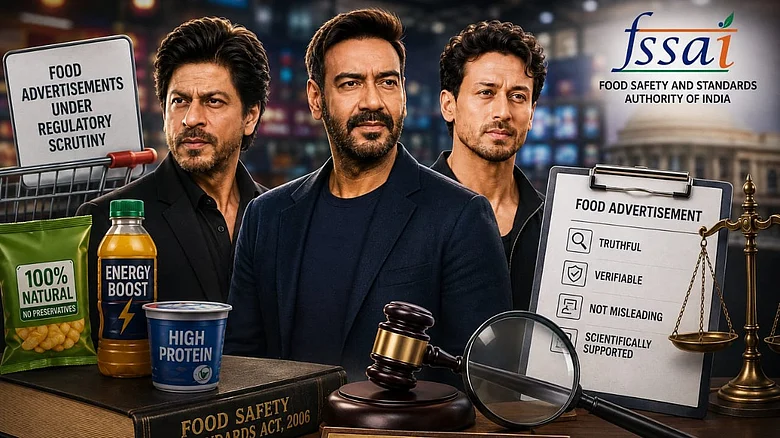

FSSAI has issued more than 150 notices to food companies over misleading advertisements, false claims and labelling violations.
Recent action against Shah Rukh Khan, Ajay Devgn and Tiger Shroff over a Vimal Elaichi advertisement has raised questions about celebrity liability.
The law allows action against endorsers in certain cases, while also providing a due-diligence defence.
Recent regulatory action against food companies and celebrity endorsers has put greater focus on claims made in food advertisements. The Food Safety and Standards Authority of India (FSSAI) has warned celebrities and influencers against promoting food products through misleading or unverified claims.
The issue has gained wider attention after the Maharashtra Food and Drug Administration (FDA) issued show-cause notices to actors Shah Rukh Khan, Ajay Devgn and Tiger Shroff over their appearance in a Vimal Elaichi advertisement. At the same time, FSSAI has stepped up action against food companies over misleading advertisements, false claims and labelling violations.

1 October 2026
Get the latest issue of Outlook Business

The developments raise a basic question: If a celebrity promotes a food product and the advertisement is found to be misleading, can the celebrity also face action?
Why Are Food Ads And Celebrity Endorsements Under Scrutiny Now?
The latest action is part of a broader regulatory drive and is not limited to celebrities. According to The Times of India, FSSAI said that it had issued more than 150 notices to food companies in recent months over misleading advertisements, false claims and non-compliance with labelling regulations. The companies named by the regulator included Nestle India, PepsiCo, Abbott India, Red Bull India, Danone India, Monster Energy India, Mondelez India, Coca-Cola India, Ferrero India and Kenvue.
Advertisement
FSSAI has also taken action against e-commerce companies and food-service establishments. The regulator said several companies had taken corrective action following notices, including withdrawing misleading claims and changing product packaging.
The scrutiny of celebrities adds another layer because endorsements can give advertising claims greater visibility and influence consumer choices, particularly when products make health or nutritional claims.

What Did FSSAI Warn Celebrities About?
FSSAI has warned celebrities and influencers that claims made while promoting food products should be truthful, verifiable and compliant with the law.
The warning means endorsers need to exercise reasonable care over what they are promoting rather than simply relying on a brand's advertising material.
Advertisement
However, this does not mean celebrities are automatically responsible for every regulatory violation committed by a company. Their role, conduct and whether they exercised due diligence before making the endorsement can matter.
Can Celebrities Be Held Responsible For Misleading Food Ads?
Yes, but celebrity liability is not automatic. Alay Razvi, Managing Partner, Accord Juris, said an endorser's liability can depend on their role, conduct and knowledge, along with whether they exercised due diligence before making the endorsement.
“Liability is not automatic merely because a celebrity appears in an advertisement,” Razvi said.
Section 24 of the Food Safety and Standards Act, 2006 prohibits misleading food advertisements, including false claims relating to a product's quality, safety, composition, standard or usefulness. Section 53 provides for a penalty of up to ₹10 lakh for a misleading food advertisement.
The Consumer Protection Act, 2019 provides another route for action. Section 21 gives the Central Consumer Protection Authority (CCPA) powers to act against false or misleading advertisements and impose penalties on manufacturers and endorsers.
The law also provides a due-diligence defence. An endorser may avoid the statutory penalty if they can establish that they exercised due diligence to verify the claims made in the advertisement.

What Does The Law Say About Food Advertising?
The Food Safety and Standards (Advertising and Claims) Regulations, 2018 require food claims to be truthful, unambiguous, meaningful and not misleading. The regulations also restrict claims about the efficacy of food products where there is no adequate or scientific justification.
This means the responsibility does not stop with checking whether a product exists or is legally sold. Claims made about its quality, usefulness or benefits must also have an adequate basis.
Razvi said celebrities and influencers should check the product's FSSAI licence or registration, ingredients, nutritional information, manufacturing details, warnings and the evidence supporting advertised claims. They should also review the script, captions, packaging and visuals for potentially misleading implications.
“Blind reliance on the brand may not amount to legally sufficient due diligence,” Razvi said.
Under Section 53 of the FSS Act, a person who advertises, or is a party to the publication of, a misleading food advertisement can face a penalty of up to ₹10 lakh.
Separately, the CCPA can impose a penalty of up to ₹10 lakh on a manufacturer or endorser for a false or misleading advertisement. For a subsequent contravention, the penalty can go up to ₹50 lakh. It can also prohibit an endorser from making endorsements for up to one year, extending to three years for a subsequent contravention.
What Is Surrogate Advertising? The Vimal Elaichi Case Explained
The Vimal Elaichi case brings another concept into focus: surrogate advertising.
Surrogate advertising generally involves promoting a restricted or prohibited product indirectly through another product using the same or closely associated brand name, logo, visual identity or other branding elements.
Mathuvanthy Mathavan, Partner, Poovayya & Co, said such advertising can indirectly promote a restricted product by using an ostensibly permissible product with closely associated branding. “Whether a particular advertisement falls within this prohibition would depend on whether the regulator can establish that the advertisement is false, misleading or deceptive in relation to the food product being advertised,” she said.
In the Vimal Elaichi case, the Maharashtra FDA alleged that the advertisement creates an association with the Vimal Pan Masala brand, which is prohibited in the state. The regulator questioned whether the advertisement could amount to indirect or surrogate promotion of a prohibited tobacco-related product.
The FDA issued show-cause notices to Shah Rukh Khan, Ajay Devgn and Tiger Shroff and asked them to explain their role in the advertisement.
Importantly, these are regulatory allegations being examined through show-cause proceedings, not a final finding that the actors violated the law.
What Can FSSAI And CCPA Do?
FSSAI and the CCPA can both act against misleading advertisements, but their mandates are different.
FSSAI regulates food specifically, including food safety, standards and food-related advertising and claims. Mathavan said the distinction lies in the regulators' areas of focus. “FSSAI regulates food specifically under the Food Safety and Standards Act, 2006, while the CCPA has a broader consumer-protection mandate covering goods and services generally.”
The CCPA can direct a manufacturer, advertiser, endorser or publisher to discontinue or modify a misleading advertisement. It can also impose penalties and prohibit endorsers from making advertisements for specified periods.

Is FSSAI's Crackdown Only About Celebrities?
No. The action against celebrities is only one part of a wider enforcement drive.
FSSAI's recent enforcement updates show that the crackdown covers food companies across categories, including major packaged-food, beverage and energy-drink brands. The regulator has also issued notices to e-commerce companies and food-service establishments.
The action has also resulted in corrective measures. Amway India, for instance, removed the term “Energy Drink” from its XS product range and withdrew a “100%” claim from its coconut oil product. FSSAI also said Juza Foods agreed to remove several claims from its baby-food products, while Mondelez India withdrew certain health and nutrient-comparison claims and advertisements.
The broader message is that scrutiny is not simply about celebrity endorsements. The underlying product claim, how it is presented and whether it can be substantiated are all coming under greater regulatory focus.

Why Are Celebrities Becoming More Cautious About Food Endorsements?
The regulatory pressure is also beginning to affect the endorsement market.
The Economic Times (ET) reported that at least a dozen celebrities and influencers had halted new endorsements for several food and beverage brands amid the regulatory crackdown. The report said some celebrities were becoming more cautious about the brands they associate with and were stepping up due diligence in endorsement contracts.
The concern is not limited to financial penalties. ET reported that reputational risk and the possibility of stricter action were also becoming important considerations.


For celebrities and influencers, the takeaway is straightforward: they are not automatically liable for every problem involving a brand, but they cannot necessarily rely blindly on the brand either. What an endorser knew, what they were asked to claim and what checks they carried out can matter when an advertisement comes under regulatory scrutiny.