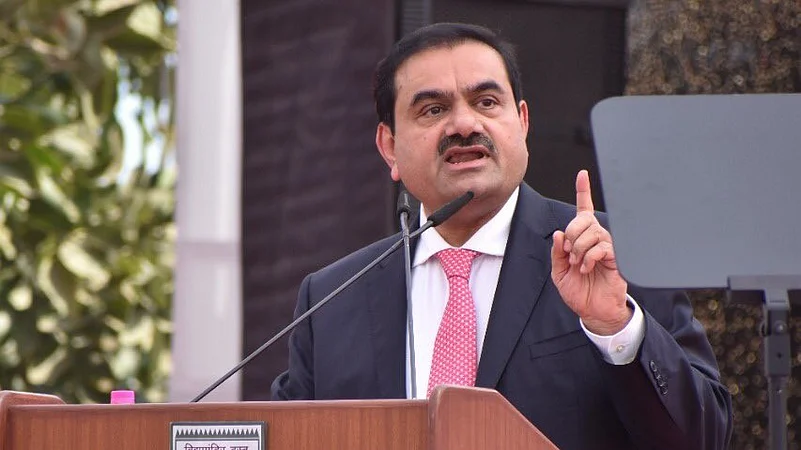

Gautam Adani told shareholders that infrastructure and artificial intelligence are the twin engines of India’s rise as a global power.
At the Adani Group’s 34th AGM, he detailed massive investments in roads, ports, power and data centres.
He argued that technological dominance depends on robust physical infrastructure and integrated digital systems.
Gautam Adani, Chairman of Adani Group, positioned infrastructure and artificial intelligence as inseparable forces in India's rise as a global power, framing the two as the central theme of the group's strategy going forward, at the group's 34th annual general meeting (AGM).
"They are the twin global engines that must shape India's strength, secure India's sovereignty and accelerate India's journey to becoming one of the defining powers of this century," he said.

1 September 2026
Get the latest issue of Outlook Business

Adani defined the first engine, infrastructure, as roads, ports, airports, transmission lines, power plants, renewable parks, gas networks, logistics platforms, cement capacity, water systems and industrial ecosystems.
The second engine, intelligence, he described as data centres, AI, automation, predictive systems, digital platforms, real-time analytics and machine-led decision support.

The Foresight Argument
Adani said the group had anticipated this convergence long before it became the prevailing view. “We recognised early that the world was entering a new era, one in which geopolitical divisions would intensify, supply chains would splinter, and energy security would once again become a core strategic priority,” he told shareholders.
Advertisement
The company concluded that the race for technological dominance and autonomy would be limited not by ambition, but by the strength of underlying infrastructure.
He presented the group as one of the few global players at the forefront of this shift and supported this claim with specifics on capital deployment.
The conglomerate invested a record sum of more than ₹1.5 lakh crore in physical infrastructure in FY 2025-26, which he said represented over 30% of India’s total new private-sector capital expenditure for that year.
The Build-Out
Adani pointed to the group's integrated infrastructure stack as the practical expression of the twin-engine thesis.
Advertisement
"Our strength lies in the way our infrastructure pieces connect, from mining and power generation to transmission and distribution, to ports and logistics, to data centres and fulfilment centres," he said.
He further stated that the company is capable of integrating all the critical layers of infrastructure needed to power the age of intelligence.
On the intelligence side, he cited a binding MoU for a gigawatt-scale data centre with Google in Visakhapatnam and a target of building a 3 GW data centre platform by 2030, adding that global technology leaders, including Google, Microsoft, Uber and Flipkart, had placed their confidence in the group.


He concluded with a strong message that resonated across both engines, stating that the company kept building when it was most difficult to do so. "We kept believing when it was hardest to have faith. And we demonstrated that resilience is not just a trait, but a way of life for us".