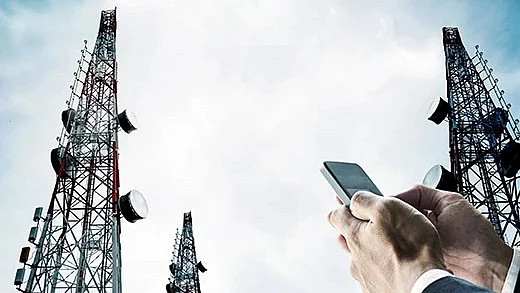

The Economic Survey 2025–26 shows India’s telecom sector has expanded rapidly over the last decade with rural connections growing faster than urban ones.
Massive policy push through nationwide 5G rollout, BharatNet, PLI-led manufacturing and 6G research has strengthened self-reliance in the sector.
Affordable data prices, expanded network coverage and strong cyber-security measures have boosted digital adoption.
Ahead of the Union Budget 2026, Finance Minister Nirmala Sitharaman on Thursday tabled the Economic Survey 2025-26, providing a detailed outlook on India’s telecom sector in the upcoming fiscal year. India’s telecom vision focuses on making connectivity ubiquitous (Samaveshit), development-oriented (Viksit), fast and efficient (Tvarit), and safe and secure (Surakshit), reflecting the broader goal of a digitally inclusive nation.
According to the survey, India’s telecom sector has seen remarkable growth, with tele-density rising from 75.23% to 86.76%. Growth in rural telephone connections has outpaced urban expansion, indicating a narrowing of the digital divide.

1 September 2026
Get the latest issue of Outlook Business

Internet and broadband subscriptions have also multiplied over the past decade, demonstrating a shift from basic connectivity toward data-intensive digital usage across households and businesses. Falling wireless data prices have further driven adoption, leading to a sharp increase in average monthly data consumption, while network infrastructure has been strengthened with 31.87 lakh Mobile Base Transceiver Stations (BTS) and 8.48 lakh mobile towers as of December 2025.



Advertisement
Rural connectivity has also seen a boost, with 13,415 towers made functional under the 4G saturation project, covering nearly 20,000 villages, while the BharatNet project has delivered broadband access to 2.14 lakh Gram Panchayats through optical fibre and satellite connectivity.

The survey highlights the nationwide rollout of 5G networks, now covering 99.9% of districts and supported by 5.18 lakh 5G BTS. This expansion has been made possible through spectrum reforms, rationalisation of financial liabilities and removal of spectrum usage charges for acquisitions from 2022 onwards.
Additionally streamlining Right of Way (RoW) approvals, and platforms like the GatiShakti Sanchar portal have been drivers of this expansion. India has also set up 100 5G Use Case Labs to promote research, skill development, and start-up collaboration, alongside the Bharat 6G Vision and Bharat 6G Alliance, positioning the country on a path toward global 6G leadership.
Advertisement
Domestic manufacturing has been strengthened through the PLI Scheme, which has attracted investments of over ₹4,700 crore, generated more than ₹1 lakh crore in sales including ₹21,000 crore in exports, and created roughly 30,000 jobs. Support for research and development has been extended via the Telecom Technology Development Fund (TTDF) and Digital Bharat Nidhi, funding 136 projects in 6G, AI-in-Telecom, SatCom, Open RAN, and security with ₹542.23 crore.

The survey also underscores India’s focus on citizen-centric security, with initiatives like Sanchar Saathi, Device Setu, and AI-driven fraud detection systems preventing financial losses of approximately ₹660 crore and disconnecting around 3.3 crore fraudulent connections.
Infrastructure efficiency has been improved through the centralized RoW portal, which reduced approval times for tower and optical fibre installations from 451 days in 2019 to just 40 days in 2025. Spectrum reforms and the National Frequency Allocation Plan 2025 ensure optimal allocation for current and future services, including 6G.
The Survey has portrayed a telecom sector that is inclusive, rapidly modernising, and poised for global leadership in next-generation digital technologies.