

Commits $0.4 million to support the development of India’s Health Foundation AI model
Announces $8 million in funding for AI Centres of Excellence across health, agriculture, education, and sustainable cities in India
Provides $0.05 million each to Gnani.ai, CoRover.ai, and BharatGen to build AI models for Indic language applications
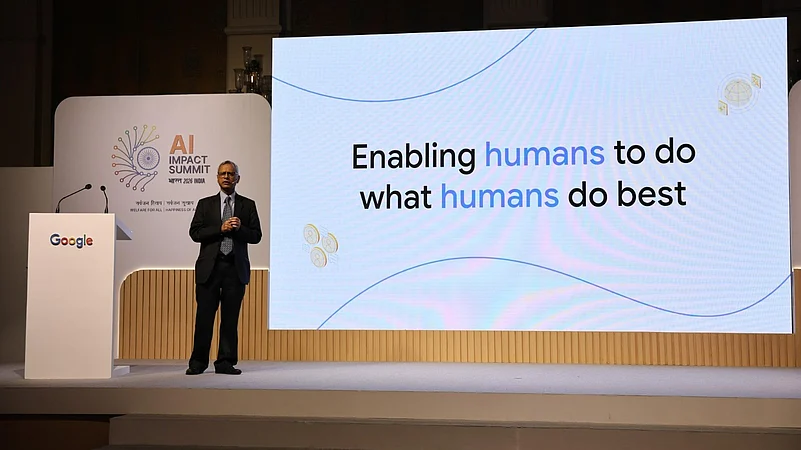
In a major push to advance inclusive AI in India, tech giant Google has announced a series of funding initiatives. Through its philanthropic arm, Google.org, the company will commit $8 million to support four Centres of Excellence focused on health, agriculture, sustainable cities, and education. It is also making a $2 million founding contribution to establish an Indian language technologies research hub at IIT Bombay.
Complementing these efforts, Google announced grants of $0.05 million each to Gnani.ai, CoRover.ai, and IIT Bombay, in collaboration with the IndiaAI Mission.

1 April 2026
Get the latest issue of Outlook Business

CoRover.ai, the creator of the sovereign language model BharatGPT, will use Gemma, Google’s open-source AI model framework, to build pre-trained language models in English, Hindi, and other Indian languages for e-governance use cases. Gnani.ai will adapt Gemma for voice-based AI applications, while IIT Bombay will use it to process Indian-language health, governance, and policy documents.



“India cannot be built on borrowed ideas alone. It must rest on indigenous knowledge, strong institutions, and the ability to solve problems at scale. Our linguistic, cultural, and socio-economic diversity is often viewed as a challenge, but in the context of AI, it is a strength. If AI systems can work for India, they can work for the world,” said Dharmendra Pradhan, Union Minister for Education.
Separately, Google announced a $0.4 million grant to support new collaborations using MedGemma, a healthcare-focused AI model developed by Google and trained on medical data, to strengthen India’s healthcare ecosystem. The model is designed to improve diagnostics, streamline clinical workflows, and expand access to quality healthcare globally.

As an initial step, Google’s technology partner Ajna Lens will work with experts from AIIMS to develop AI models aimed at improving healthcare efficiency and patient outcomes across India. The collaboration will begin with two India-specific models focused on dermatology and OPD triage, both critical pressure points in the country’s healthcare system. According to Google executives, the outcomes of these models will be contributed to India’s digital public infrastructure and made available to the broader ecosystem in an open manner.
Google.org is also supporting Wadhwani AI with a $2.5 million grant to pilot HealthVaani, a conversational AI assistant developed in partnership with the Ministry of Health and Family Welfare. The tool is designed to assist ASHA and frontline health workers by improving access to accurate and timely health information.
HealthVaani is a multilingual solution built using Gemini 2.5 Flash for translation, response generation, and moderation. It also uses advanced Gemini embedding models to improve response relevance. Currently available in Hindi, English, and Odia, the platform will soon expand to other major Indian languages. Google said it expects its Gemini models to play a key role in strengthening the delivery of public health services across the country.
The announcement comes amid a broader push by global tech companies to deepen their presence in India. Recently, Microsoft unveiled its largest investment in Asia, committing $17.5 billion over four years from CY 2026 to 2029 to strengthen India’s cloud and AI infrastructure, skilling, and operations. Amazon has also said it plans to invest $35 billion in India by 2030, with a focus on AI, exports, and job creation. Microsoft CEO Satya Nadella noted in a post on X that the investment aims to build the “infrastructure, skills, and sovereign capabilities needed for India’s AI-first future”.
“AI is opening new pathways in cancer therapy through large-scale foundation models and accelerating the discovery of new materials for next-generation technologies,” said Manish Gupta, senior director at Google DeepMind.
AI, he added, is now augmenting human capabilities in powerful ways, moving beyond predictive and generative systems into an era of multimodal understanding, advanced reasoning, and agentic action. Multimodal AI can process text, code, images, and video together, mirroring how humans use multiple senses to understand the world.
“India has a unique opportunity to shape the global AI future. We invite institutions and innovators to collaborate so that AI solutions developed in India can benefit billions worldwide,” he added.