




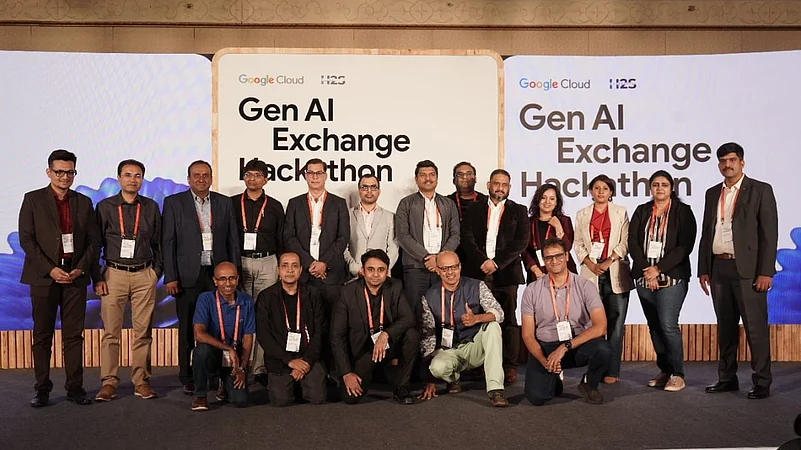

The Google Cloud Gen AI Exchange Hackathon drew 270,000 developers for a five-month program focused on real-world AI solutions
Winning projects demonstrated a shift toward production-ready agentic systems for industrial optimization
Problem statements were supplied by partners like the Maharashtra government, JK Cement, and EaseMyTrip
The Finale of the Google Cloud Gen AI Exchange Hackathon 2025, powered by Hack2skill, wrapped up in Bengaluru on November 29 after a five-month programme that drew more than 270,000 developers.
Framed as one of India’s largest collaborative generative-AI initiatives, the challenge asked participants to build scalable, production-oriented solutions for briefs supplied by partners including the Maharashtra government, the NASSCOM Centre of Excellence (IoT & AI), JK Cement, EaseMyTrip and LVX.
1 August 2026
Get the latest issue of Outlook Business

Organisers said the focus was on practical, real-world impact. Problem statements mapped to government and industry priorities, from industrial optimisation and artisan market access to misinformation, legal enablement and citizen service delivery.



The top 100 teams pitched to a 30-member jury of industry leaders, with the winning projects reflecting a shift away from prototype-style demos towards agentic systems and explainable models built for enterprise integration.

Winners & Notable Themes
Among the highest-scoring entries were projects focused on youth mental-wellness using conversational AI to generate dynamic behavioural insights, AI-assisted marketplaces for artisans, retrieval-augmented legal-document intelligence, and explainable multimodal models for deepfake and misinformation detection.
Advertisement
Other notable winners applied agentic AI to create automated test-case generation and industrial optimisation tools, while a separate entry combined predictive analytics with policy-support agents to produce AI-driven governance dashboards.

What the Results Signal for 2026?
Judges and observers noted a trend toward domain-specific, production-ready tooling: solutions that can plug into existing enterprise pipelines, provide auditability, and scale for public-sector use.
The hackathon’s outcomes underscore growing appetite among state departments and large companies to move past pilots and evaluate generative AI as workflow augmentation rather than novelty.
Advertisement
Beyond the winners, the programme surfaced numerous practicable use-cases across travel planning, startup evaluation and career advisory, indicating that generative AI is maturing across both consumer and B2B segments. For Indian enterprises and public systems preparing for broader AI adoption in 2026, the hackathon served as a snapshot of emerging talent, toolkits and partner collaborations that could accelerate deployment at scale.








