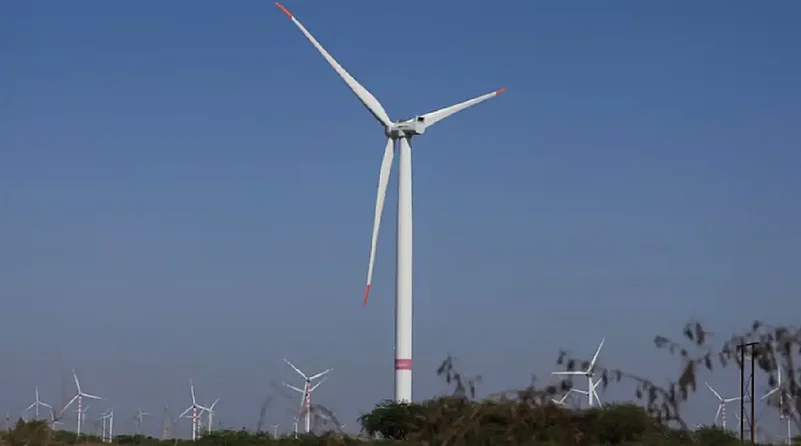

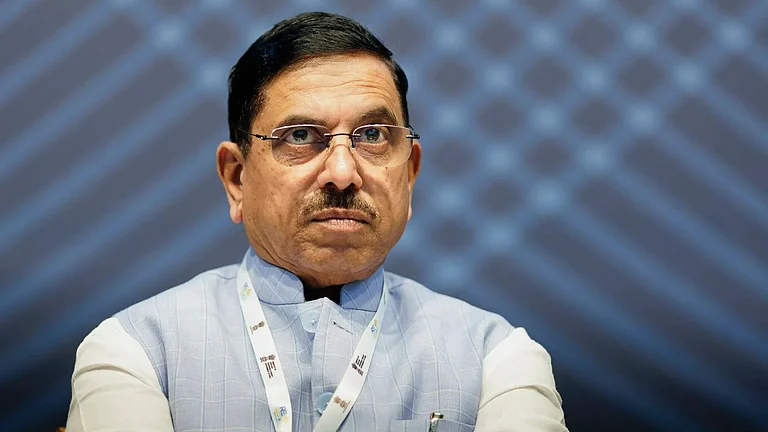
Union New & Renewable Energy Minister Pralhad Joshi on Wednesday said India has over 272 GW non-fossil fuel-based electricity generation capacity, including 141 solar and 55 GW wind energy, at the launch of 'India-UK Offshore Wind Taskforce'.
This assumes significance in view of India's ambitious target of 500 GW of renewable energy by 2030 and net-zero emission target by 2070.
UK Deputy Prime Minister David Lammy and British High Commissioner to India Lindy Cameron were present on the occasion.

3 February 2026
Get the latest issue of Outlook Business

Addressing the official launch of the India-UK Offshore Wind Taskforce, Joshi said in the ongoing financial year, India added more than 35 GW of solar and 4.61 GW of wind capacity.

Also, he said last year India achieved 50 per cent of its cumulative installed power capacity from non-fossil sources, five years ahead of our Nationally Determined Contribution commitment.
"Today, India's installed non-fossil capacity stands at over 272 GW, with solar at more than 141 GW and wind at 55 GW... to give you an idea of our scale, almost 3 million households have benefitted from rooftop solar under PMSGMBY in less than 2 years. We have solarised 2.1 million pumps under another single scheme, called PM-KUSUM," he added.
The minister pointed out that these numbers reflect a clear policy direction, institutional coordination and the confidence of investors and industry.
But the next phase of our transition must strengthen reliability, grid stability, industrial depth and energy security, he opined.


He stated that offshore wind has a strategic role in the next phase and promising zones have been identified off the coasts of Gujarat and Tamil Nadu.
Transmission planning for an initial 10 GW offshore evacuation capacity, 5 GW each off Gujarat and Tamil Nadu, has been completed.
A Viability Gap Funding scheme has also been introduced to support early projects, with a total outlay of Rs 7,453 crore, which is approximately 710 million pounds, he added.
"As we all know, offshore wind is among the most complex segments of the global energy transition. It demands specialised port infrastructure, marine logistics, robust seabed leasing frameworks, clear risk allocation and bankable commercial structures," Joshi said.
That is why this taskforce matters, he pointed out.
As agreed under the India-UK Vision 2035 and the Fourth Energy Dialogue, the taskforce has been constituted to provide strategic leadership and coordination for India's offshore wind ecosystem.
The minister stated that the UK has demonstrated global leadership in scaling offshore wind, from early-stage deployment to large commercial markets with mature supply chains.
"India brings scale, long-term demand and a rapidly growing clean energy ecosystem. Together, we can focus on three practical pillars," he said.
First, ecosystem planning and market design. Refining seabed leasing frameworks, aligning bidding trajectories with grid readiness and ensuring revenue certainty mechanisms that are credible and transparent.
Second, infrastructure and supply chains. Port modernisation, local manufacturing of foundations, towers, blades and cables, specialised vessels and skilling for marine operations.
Third, financing and risk mitigation. Blended finance structures, early stage de-risking instruments and mobilisation of long term institutional capital.
Offshore wind must also be integrated with transmission planning, storage solutions and emerging coastal green hydrogen clusters, he said.
"We have also set a new benchmark in green hydrogen, with prices falling to a historic low of Rs 279 per kg under the National Green Hydrogen Mission," he said.
This task force is actually a trust force, he said, adding that it reflects confidence that India and the United Kingdom can work together in solving real execution challenges.