
Asian steelmakers plan massive capacity growth dominated by carbon-intensive blast furnace technologies.
Limited scrap, infrastructure gaps and weak carbon pricing favour high-emissions steelmaking routes.
State support and green finance are critical to avoid long-term industrial carbon lock-ins.
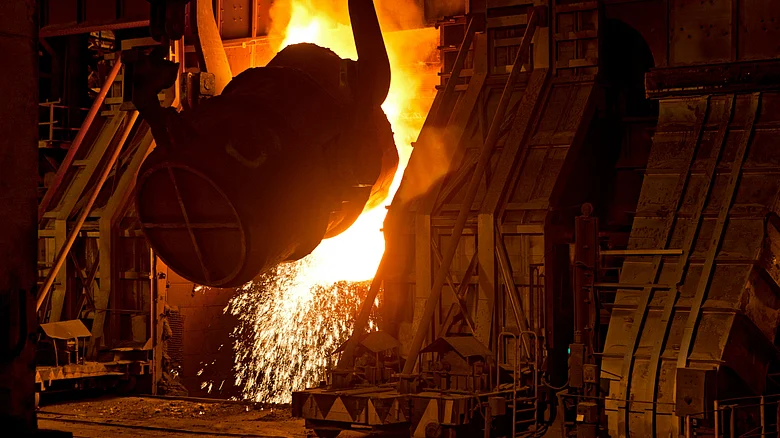
The biggest steel producers in emerging markets have made strong commitments to expand their capacity over the next decades. Most of this expansion will take the form of carbon-intensive routes. Once operational, Asian steel units will have locked in high-emissions industrial capacities for decades, severely undermining global efforts to reach net zero.
India's steel giants are planning to nearly triple their capacity, with Vietnam, Indonesia and Malaysia charting similar trajectories. These four countries alone plan to add 466 million tonnes per annum (mtpa) of new steel capacity. However, only 60mtpa (12.8%) of the total output would be through using the cleaner electric arc furnace (EAF) technology. Over 400 mtpa will still come from traditional, high-carbon-emitting blast furnace-basic oxygen furnaces (BF-BOF).

1 October 2026
Get the latest issue of Outlook Business

With surging domestic demand, these emerging markets in South Asia and Asean are rightfully expanding the basic materials industry to satiate their growing economies. However, the choice of conventional high-carbon technologies with asset lives of 40–50 years will create lock-ins of emissions for the coming decades.

Infrastructure and Cost Gaps
Steel production accounts for approximately 7–9% of global greenhouse gas (GHG) emissions. EAFs, powered by renewable energy (RE), can reduce emissions by up to 75% compared to traditional blast furnaces. But here the local availability of scrap steel is vital as most emerging markets are dependent on its imports from their developed peers.
Therefore, south and southeast Asian countries favour carbon-intensive furnaces in their expansion plans—42.5% of Indonesia’s current capacity is through EAF, yet only 5.4% of its expansion plans employ this technology. Similarly, Malaysia holds 60.8% of its current capacity through EAF, the highest share in the region, but only 2.2% of its expansion maintains its low-carbon competitive advantage. Except for Vietnam, all four countries are significantly lowering their EAF share out of total steel capacity.
Advertisement
Capital costs play a big role in these investments. Although BOF and EAF plants typically require similar amounts of upfront capital, at about $300–400 per tonne of capacity, hydrogen-based direct reduction iron (DRI) plants are more expensive at about $700–900 per tonne in cost. In the absence of effective carbon pricing, taking these costs at face value might prove challenging.
A lack of sufficiently high domestic carbon pricing in these Asian countries means there are missing price signals for investment in EAFs. Infrastructure gaps create additional barriers with production requiring a reliable electricity supply, typically around 500kWh per tonne of steel, and access to scrap steel feedstock. Many developing economies lack either stable grid supply with high RE penetration or a mature scrap collection and processing infrastructure, compared to developed markets that have been producing steel for centuries. Hydrogen-based DRI routes require hydrogen production and distribution infrastructure that is scarce outside a few pilot projects. BOF routes, by contrast, use well-established supply chains built around domestic iron ore resources.
Advertisement
Crucial Role of State Support
A recent report from the Grantham Research Institute at the London School of Economics found that Europe, Japan and other developed markets have committed more than €14bn in direct capex support for low-carbon steel projects. This is one among many forms of state subsidies that have been made available for steel decarbonisation. In comparison, India has a ₹455-crore pilot scheme, an upcoming ₹5,000-crore subsidy scheme and a Green Steel Mission at a cost of ₹15,000 crore under works for steel decarbonisation.
Immediate priority for emerging markets should be making green steel financially competitive. Development finance institutions (DFIs) could play an important role in conditioning steel project financing on carbon intensity thresholds. This would not prohibit BOF entirely but would require developers to demonstrate that lower-carbon alternatives are genuinely infeasible before receiving concessional financing.
Financial support through government carbon contracts for difference, like the German model, could also help lower market risk when making the jump to greener steel. Large steel producers would then have a higher incentive to adopt new technologies and have a market be formed for the necessary energy infrastructure.
Investment decisions being made today in India, Indonesia, Malaysia and Vietnam will shape global emissions trajectories for the next half-century.



Governments and multilateral organisations can play a key role in ensuring green steel production options are financially viable and achievable in these economies. DFIs can make carbon intensity thresholds a condition for project financing, and governments can implement carbon contracts that eliminate first-mover disadvantage and make green steel financially viable.
It also falls on the developed economies like the EU and Japan to help their emerging market peers tackle the decarbonisation challenge and enable them to build steel capacity in ways that remain economically viable in a carbon-constrained world.
(The author is Policy Fellow (India and ASEAN) at the Grantham Research Institute at London School of Economics. The views expressed are personal.)