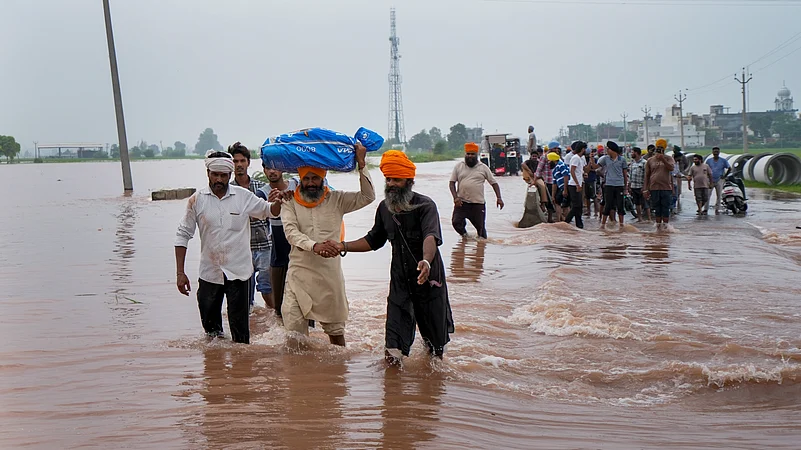

Extreme weather remains world’s most severe long-term risk despite short-term ranking decline.
Environmental risks dominate 2036 outlook, driven by climate impacts and ecosystem collapse.
Rising insured catastrophe losses underline economic costs of escalating climate risks globally.
Extreme weather events have slipped to fourth place for the upcoming two years from first or second most significant risk over a two-year period for four years in a row, according to the World Economic Forum’s Global Risks Report 2026.
While they are no longer at top the list of immediate global concerns, they remain the greatest long-term threat to humanity — especially for poor and developing countries with the least capacity to cope.

1 September 2026
Get the latest issue of Outlook Business

The report, which assesses global risks across three time horizons — immediate (2026), short-to-medium term (to 2028) and long term (to 2036) — reveals a reprioritisation of threats in the near future.
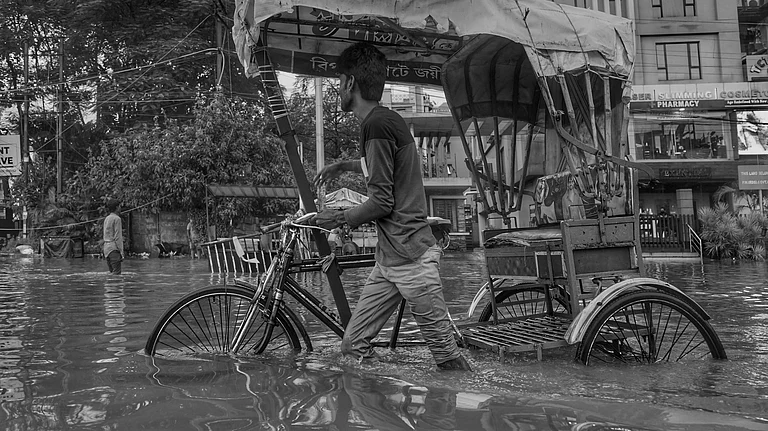
In addition, pollution has moved down in the list, going from sixth place to ninth, while biodiversity loss and critical changes to Earth systems have slid further down into the lower half of the list.
According to the report, this change indicates how short-term environmental concerns are being eclipsed by geopolitical tensions and economic instability. It is anticipated that during the next two years, non-environmental risks will take precedence over four major environmental threats in terms of policy attention: extreme weather, pollution, declining biodiversity and significant alterations to Earth's systems.
Advertisement

Environmental Risks Dominate in Long Term
Environmental threats are expected to dominate the global risk outlook for the next ten years, with extreme weather events continuing to rank highest until 2036. Critical changes to earth systems come in second, followed by ecosystem collapse and biodiversity loss.
According to the WEF report, environmental risks account for five of the top ten long-term global risks, underscoring what the World Economic Forum refers to as their "existential" nature—impacts that are anticipated to be felt most keenly in developing nations.
As was the case last year, extreme weather events continue to rank highest in the 10-year outlook, while ecosystem collapse and biodiversity loss exhibit the greatest increase in severity when compared to the two-year outlook. Pollution is still one of the top ten risks, and shortages of natural resources rank sixth.
Advertisement
These long-term risk projections are already being realised in actual economic terms. Insured losses from natural catastrophes crossed the $100bn mark again in 2025 for the sixth consecutive year, driven largely by record wildfire losses in Los Angeles during the first quarter and severe convective storms, which remain a persistent global loss driver. Swiss Re Institute estimates total insured losses at $107bn in 2025, down 24% from $141bn in 2024.