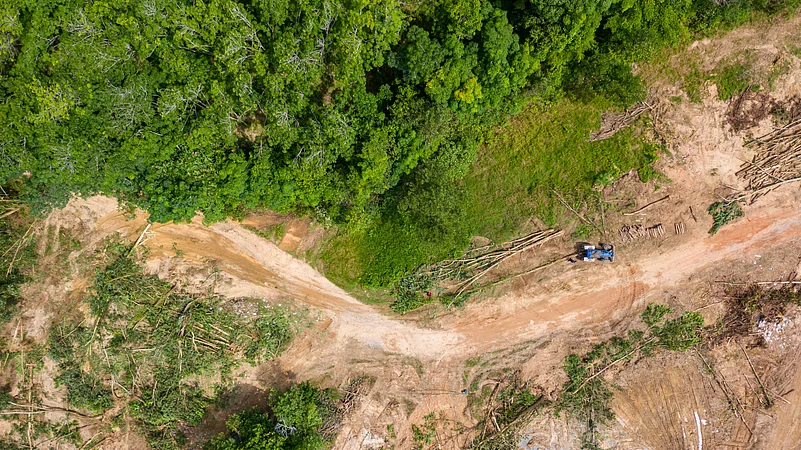

Biodiversity loss disrupts nitrogen, carbon and water cycles, worsening climate change.
Amazon and Southeast Asia forests under stress, reducing carbon sink capacity.
Global security and sustainable development threatened by ecological degradation, UN warns.
Human-caused land degradation and biodiversity loss are increasingly upsetting the climate system, causing atmospheric changes that hasten additional ecological harm, according to the Global Environment Outlook-7 (GEO-7), published on December 9, 2025 by the UN Environment Programme (UNEP).
The report further stated that biodiversity loss affects the climate system primarily through its influence on nitrogen, carbon and water cycles. For example, research shows that the fertilising effect of elevated atmospheric carbon dioxide resulting from deforestation has enhanced the water-use efficiency in boreal forests.

1 September 2026
Get the latest issue of Outlook Business

However, ecosystems respond unevenly to environmental stress, adopting different adaptive strategies with varying outcomes, the report stated.

Amazon's Decline & Regional Climate Risks
Although global carbon emissions from deforestation and land degradation have remained relatively stable over the last two decades, the report underscored that the Amazon—the world’s largest tropical forest and vital carbon sink—driven by deforestation, rising temperatures and growing moisture stress.
This is particularly the case in eastern Amazonia during the dry season. “An estimated 10 to 47% of the Amazon’s forests are exposed to a combination of warming temperatures, extreme droughts, deforestation and wildfires,” the report stated. “Which could result in an irreversible ecosystem transition if certain critical thresholds or tipping points are crossed, potentially exacerbating regional climate change,” it added.
Advertisement
In addition, in south-east Asia, both bottom-up and top-down models reported that a net carbon sink that approaches zero between October and December. The report added that extreme global heat in 2023 would cause a gross carbon loss of 1.73 gigatonnes across terrestrial ecosystems globally, signalling a substantial weakening of land systems as carbon sinks.
Biodiversity loss and land degradation also affect the climate by changing the reflectivity or albedo of the Earth’s surface. For instance, darker forest cover can increase heat absorption, creating positive radiative forcing that reduces the cooling benefits of carbon sequestration. As a result, the report noted, reducing deforestation in high-latitude regions could potentially increase warming.
Advertisement
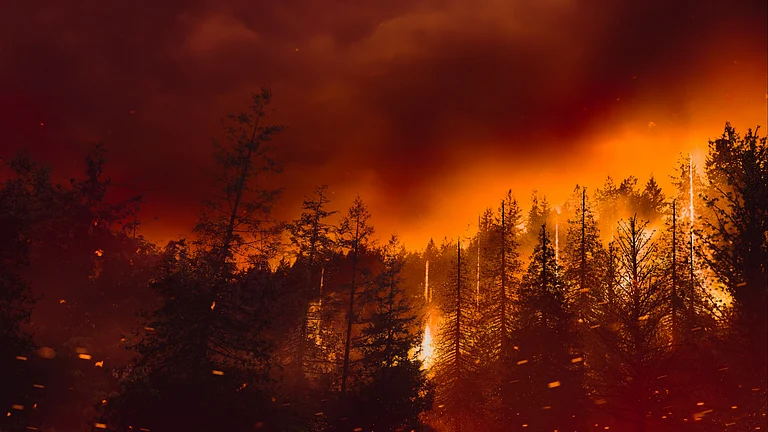
Biodiversity Loss & Climate
In addition to regional impacts, biodiversity loss and climate change present global security challenges
According to reports published by Intergovernmental Panel on Climate Change in 2018 and the Security Council Report in 2021, climate change and biodiversity loss are global security issues, as their negative impacts undermine many sustainable development goals (SDGs), challenging the stability of states and societies.
For achieving sustainable development—in particular by eradicating poverty and hunger, providing safe water, reducing inequality, and maintaining healthy ecosystems—it is critical to consider the interlinkages between climate, biodiversity and society.