Global trade grows despite tariffs, tensions and supply-chain realignments, report finds.
Climate shocks, currency volatility, financial concentration heighten risks for vulnerable economies.
The UNCTAD report urges public trade-finance support to protect resilient trade networks.
Global trade looks stable on the surface despite tariffs, geopolitical tensions and supply-chain realignments. Goods trade rose by an estimated 4% in early 2025, defying predictions of slowdown. This growth was driven in parts by firms accelerating imports ahead of tariff changes, but also by structural shifts including expansion of services, growth in digital economy and artificial intelligence, and South-South trade growing above average, revealed a report published by the UN Trade and Development (UNCTAD) on December 2, titled “Trade and Development Report 2025 On the Brink—Trade, Finance and the Reshaping of the Global Economy”.
The report further warned that this resilience masks a deeper vulnerability. According to the report, the world’s trading system increasingly depends on a highly concentrated financial architecture in addition to logistics, and is now being destabilised by climate shocks, currency volatility and tightening capital flows.

1 September 2026
Get the latest issue of Outlook Business

“Trade is not just the chain of suppliers,” said Rebeca Grynspan, Secretary-General of UNCTAD in a news release, adding that it is also the chain of credit lines, payment systems, currency markets and capital flows, and climate change adds to the financial pressures.
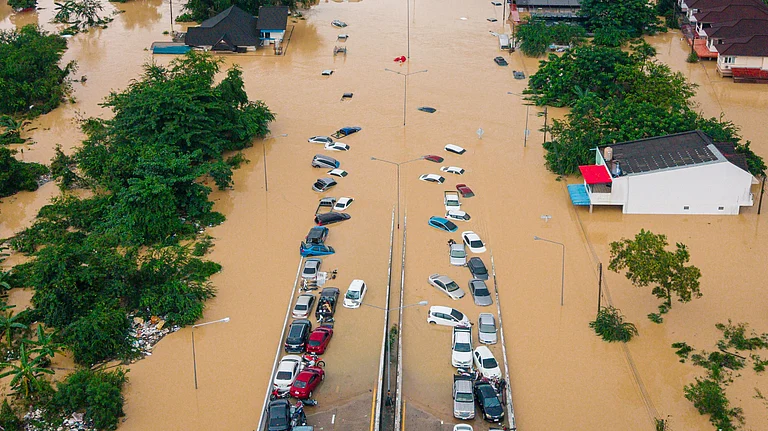
The report stated that countries repeatedly hit by extreme weather now pay an estimated $20bn more each year in interest, as lenders see them as riskier. It also revealed that these additional premiums have cost climate-vulnerable economies about $212bn since 2006 – funds that could have supported social investment or climate adaptation.
Advertisement
Trade Depends on Finance
Over 90% of global trade now depends on bank finance — letters of credit, supply-chain financing, guarantees, digital clearing platforms and derivatives that allow exporters and importers to transact across borders, according to Down To Earth. Dollar liquidity and cross-border payment systems are also crucial for international trading activities. This reliance on financial channels makes trade closely linked to global financial and monetary conditions, the UN report stated.
Every supply chain depends on correspondent banks, every shipment depends on credit, and every container depends on exchange rates. Developing economies are most affected by this financial backbone's increasing volatility. Banks supporting trade in Africa, South Asia, and Latin America have decreased due to dollar shortages, currency fluctuations, sanctions, and stricter capital regulations—a situation that is now made worse by climate change.
Advertisement

Currency & Climate Risk
According to a different report published in April 2025 by the International Institute for Environment and Development (IIED), exchange rate volatility and climate shocks worsen the debt and trade finance burdens of vulnerable economies, particularly small island and least-developed states. These pressures raise borrowing costs and reduce access to credit—making trade far less reliable when extreme weather strikes.
The latest UN Trade and Development Report 2025 calls for expanded public trade-finance guarantees, stronger regional payment platforms and healthier domestic capital markets to shield vulnerable economies from climate-induced credit squeezes and avoid future where trade grinds to a halt.