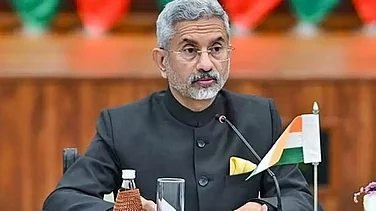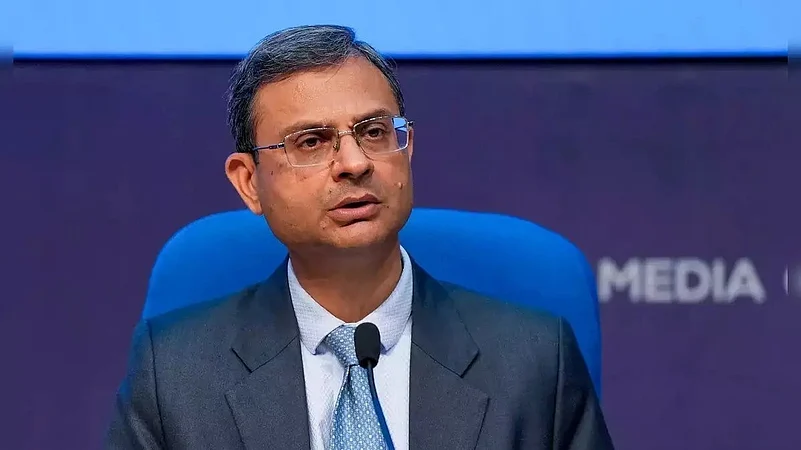

Malhotra said rules-based fraud detection cannot keep pace with criminals and urged banks to use AI and machine learning for real-time anomaly detection.
AI could reshape risk assessment, credit delivery, customer service and operational costs while expanding financial inclusion.
Aadhaar, UPI and DigiLocker give India a strong public digital infrastructure on which banks can build AI-powered financial services.
Only artificial intelligence can combat the rising tide of AI-driven financial crimes, Reserve Bank of India Governor Sanjay Malhotra said on Tuesday. Delivering the inaugural address at the FIBAC 2026 conference, Malhotra highlighted the limits of traditional security.
"It is AI and AI alone that can help limit AI frauds," Malhotra said.

1 September 2026
Get the latest issue of Outlook Business

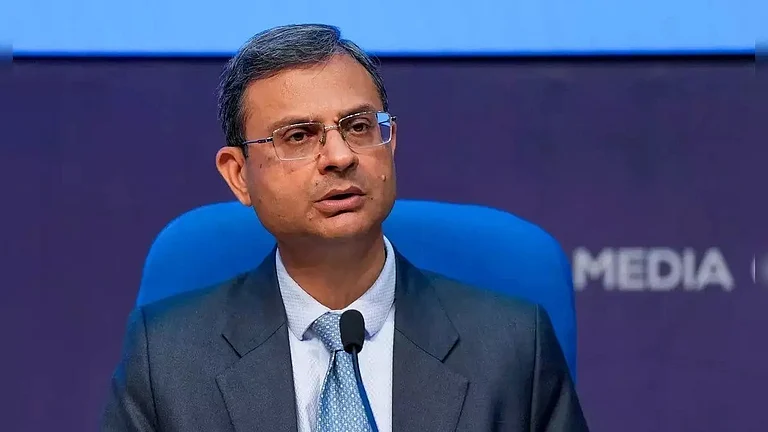
He warned that traditional rules-based engines are failing to keep pace with tech-savvy criminals. "Fraud today moves at a speed of an API call. Rules-based fraud engines, however well-designed, are perpetually one step behind the fraudsters, who adapt more frequently. It is only AI and machine learning models, which continuously learn from these transaction patterns, that can identify anomalies in real time, rather than after the loss has occurred," Malhotra said.


.jpeg?auto=format%2Ccompress&fit=max&format=webp&w=768&dpr=1.0)
Malhotra compared the rise of AI to previous economic milestones. "AI holds for this decade what liberalisation held for the 1990s, what digitalisation held for the 2010s," he said.
Advertisement
"Certainly, in all these areas, AI has a big role to play. AI multiplies intelligence. I had never thought one can actually do that way back, when I joined college. I did computer science; they said coding is the most difficult of the subjects that humans can actually do. But now coding has become so mundane and easy and routine, because people have now moved on from there to intelligence," he said, adding that while AI holds promise, it also carries risks.
Reshaping Modern Banking
Adopting AI will require financial institutions to change how they assess risk, serve customers, price capital and organise operations. "AI is a shift to how we evaluate risk, serve customers, price capital, organise institutions," Malhotra said. "Many of the banks are already doing it, some of them are considering doing it. The important question is: whether you share the AI journey or you let AI shape you," he said.
Advertisement
The technology could also accelerate financial inclusion, though it poses stability risks if deployed carelessly. "AI, well-deployed, can close existing gaps in financial inclusion faster than any preceding technological innovation. Deployed carelessly, it can, at the same time, entrench new forms of exclusion and instability at a pace that regulators and banks may struggle to keep up with," Malhotra said.
To address these concerns, the RBI established a committee on the responsible use of AI. The panel submitted its report last year, proposing a framework for ethical enablement.
"We at Reserve Bank have set up a committee for responsible use of AI and it has come up with a framework for responsible and ethical enablement of AI. It submitted its report last year. It very clearly puts forth the distinction," Malhotra said.
AI could also help banks reduce operational costs, which currently consume 47 to 49 per cent of their income.
"It can also help to reduce operational costs from 47 to 49 per cent vis-a-vis income that needs to be reduced and AI can certainly help us in this regard," Malhotra said.
The technology will also transform credit delivery by using alternative data to evaluate unserved populations. "AI changes the economics of credit deliverability fundamentally.
Data that is absent for unserved sections of society, AI models on alternative data, which we have a lot now, they can extend the frontier of bankable India considerably," Malhotra said, adding that AI can democratise banking systems.
Leveraging Digital Infrastructure
India is well-positioned to leverage AI due to its robust public digital infrastructure, including Aadhaar, UPI, DigiLocker and a developing unified lending system aggregator.
"We, in India, stand at a vantage point to leverage AI. We have the most advanced public digital infrastructure, whether it is Aadhaar, UPI, DigiLocker — we are trying to build an improved, unified lending system aggregator," Malhotra said.
"These are all public goods, on top of which the private sector can build AI, because it has the potential to do for financial judgement what UPI did for financial transactions, that is, make it instant, granular and available to the last mile," Malhotra said.
The central bank has already automated more than 203 application types and delivered 99.9 per cent of services within prescribed timelines. "All the applications from the regulatory entities and customers, about most of them are automated," Malhotra said.
To improve the ease of doing business, the RBI reduced the regulatory burden on bank boards, rationalised working capital norms, reviewed bulk deposit pricing and delegated certain foreign exchange approvals to authorised dealers.
"On ease of doing business, we have taken a number of steps. The regulatory burden on the boards has reduced, made it more principle- and policy-based. We let the operational details be handled by the management and consolidated regulatory and supervisory instructions, streamlined the form of business," Malhotra said.
"We rationalised the current account and working capital norms," Malhotra said. "We also reviewed norms relating to pricing of bulk deposits. This was an ask from the industry." He added that the central bank has delegated certain foreign exchange-related approvals to authorised dealers.