
Telangana and Maharashtra landfills listed among top global methane emitters.
Satellite study identifies 25 landfill super-polluters across 18 countries worldwide.
Methane emissions linked to severe climate and public health risks globally.
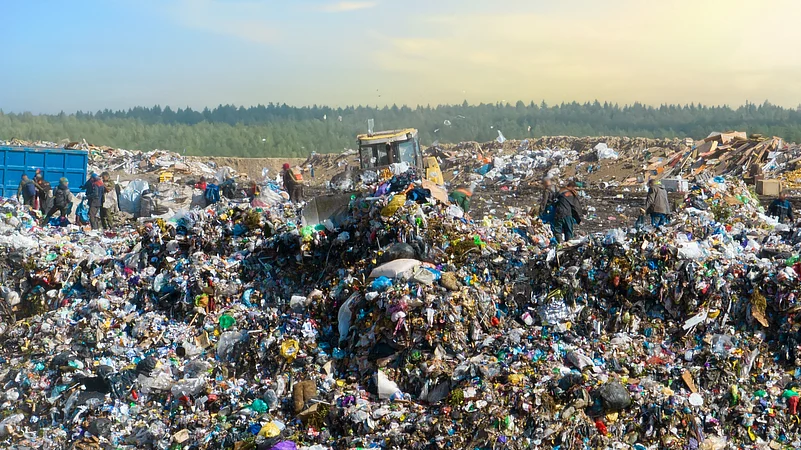
Two landfills located in Telangana and Maharashtra have been identified as among the world’s top 25 "super-polluting" methane emitters, according to the report, ‘Spotlight on the Top 25 Methane Plumes in 2025: Landfills’, published by UCLA’s STOP Methane Project.
These Indian facilities are part of a global group of 25 sites across 18 countries responsible for the highest methane emission rates detected from space in 2025. The study analysed public data from the non-profit Carbon Mapper, which used satellite instruments to observe nearly 3,000 plumes from over 700 waste sites worldwide.

1 September 2026
Get the latest issue of Outlook Business

The 25 facilities on the list produced emission rates ranging from 3.6 to 7.5 tonnes of methane per hour. To illustrate the environmental impact, the report notes that a single source emitting 5 tonnes of methane per hour contributes as much to global warming as one million SUVs. The highest-emitting site globally is a landfill near Buenos Aires, Argentina, which has a rate of 7.6 tonnes per hour.
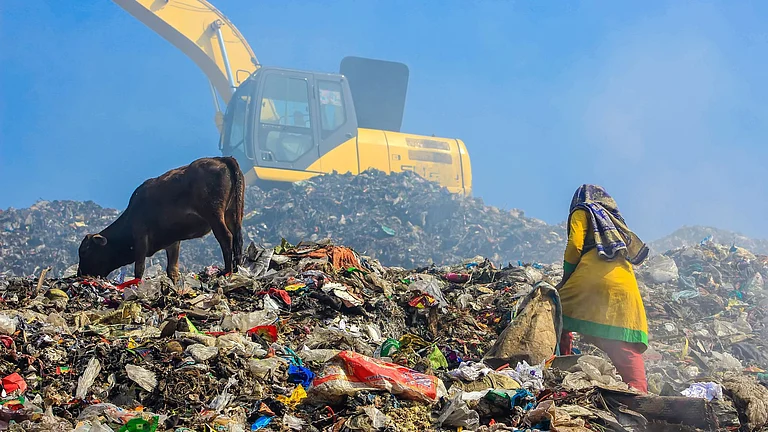
India is one of several nations with multiple sites on the list, alongside Brazil and Chile, which each have three sites, and Saudi Arabia and Turkey, which each have two. The report also highlights Turkey as the host of the upcoming COP31 climate conference, noting that three of the largest methane plumes are located there.
Advertisement
Researchers emphasise that these high-emission events often occur near urban areas, posing direct risks to public health. Because methane is a potent heat-trapping gas, identifying these "super-polluters" is considered a critical step for mitigation. The report aims to prompt action from landfill operators and national governments by making this data visible. Already, two operators in Chile have reported taking steps to address emissions after being featured in an earlier version of this list. Cara Horowitz, Executive Director of the UCLA Emmett Institute, stated that the findings indicate significant work is required across a wide variety of countries to manage these emissions.
Advertisement

Landfill Mitigation Health Benefits
According to 2021 report by the United Nations Environment Programme, the waste sector accounts for 20% of global anthropogenic methane emissions and India holds the world’s largest potential for mitigation within this specific sector.
Implementing targeted measures, such as organic waste separation and gas-to-energy recovery, is highly cost-effective, with most options available for less than $600 per tonne.
These actions significantly improve public health by reducing ground-level ozone formation. This is vital for India, which currently experiences the highest total number of premature ozone-related deaths globally.