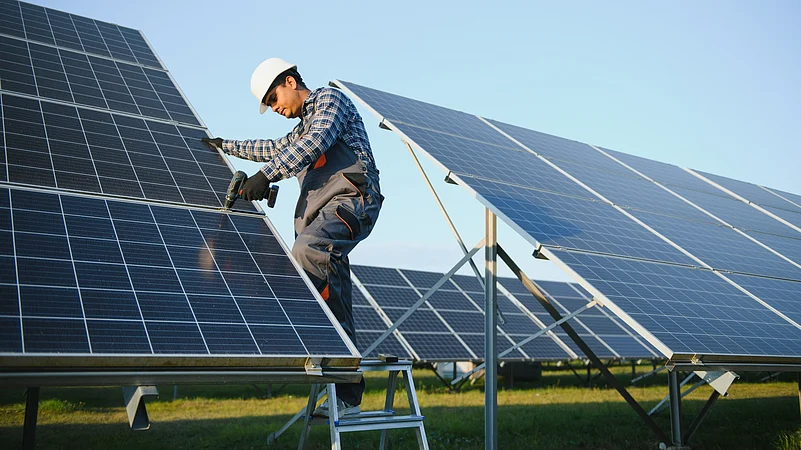
A parliamentary panel has called for a close coordination between states and project developers for identifying and resolving issues related to slow progress of solar-related schemes under Ministry of New and Renewable Energy.
The committee also noted that in respect of bids issued by the four Renewable Energy Implementing Agencies (SECI, NHPC, SJVN and NTPC Ltd/NGEL), power purchase agreement has not been signed for around 44 GW (as on June 30, 2025).
According to a report of Parliamentary Standing Committee on Energy tabled in Parliament on Monday, there has been slow progress under most of the schemes /programmes viz. Pradhan Mantri Surya Ghar: Muft Bijli Yojana (PMSG:MBY), PM-KUSUM and the scheme related to the development of solar parks.

1 September 2026
Get the latest issue of Outlook Business

The Muft Bijli Yojana aims to establish rooftop solar for one crore households by 2026-27. However, the committee noted that as per information furnished by the ministry, till June 2025, around 16 lakh installations have been made.




This means that around 84 lakh installations i.e. 84% of the installations are yet to be made in just two years of 2025-2027. The panel has identified lack of awareness as the major cause for slow adoption of the scheme.
Though the Ministry has been undertaking awareness and outreach programmes through print, radio, television as well as social media, the committee said they are of the view that unless states and their DISCOMs come fully onboard, the widespread progress would be difficult to come by.
Advertisement
The committee therefore, desires that the ministry engage closely with states/DISCOMs to design awareness campaigns that suit the distinctive features of the state concerned, the report said.
This may build trust among states and their consumers, thereby paving way for capital investment and providing space for installation of solar panels at the anticipated scale, it suggested.

The committee noted that PM-KUSUM, which is aimed at solarization of the agriculture sector through its three components, has seen extensive delays.
In particular, under Component-A and Component-C, the progress has been 6.4% and 16.9% respectively, (as on June 30, 2025). Under Component-B, the progress has been comparatively better at 60%.
Advertisement
The panel noted that the scheme is set to expire in March 2026.
"Till then, the committee expects the Ministry to closely monitor its implementation in states and make timely interventions, where needed, to ensure that at least the projects which can be completed within the given timeline is not unnecessarily delayed," the report said.
The committee noted that almost the entire capacity of 40 GW has been sanctioned through 55 solar parks in 13 states.

However, it pointed out that the commissioned capacity is only around 12.2 GW (till March, 2025), which means that around 27.8 GW i.e. 70% capacity is still to be developed in one year of 2025-26.
Therefore, the committee would like to highlight the need to accelerate the completion of the sanctioned capacity, it stated.
Noting regional imbalance in the development of solar power in the country, the committee desires that the ministry and other central agencies promote the development of solar energy in areas having low solar capacity vis-à-vis potential, by handholding such states/Union Territories (UTs).
This should be done through supportive policies, timely Central Financial Assistance (CFA) release, regular monitoring of projects and constant engagement for early detection and timely resolution of the various issues being faced by such states/UTs.
Noting land acquisition as one of the major issues affecting the timely development of utility-scale solar projects, the committee has recommended creating a 'single window clearance mechanism', bringing all stakeholders of Centre and state level at one place for easy identification of land-related issues and their time bound resolution.
Highlighting delays in laying of transmission lines due to issues related to Right of Way (RoW) compensation and the limitation associated with land being a state subject, the panel has asked the ministry take up the matter with each state to understand the prevailing issues in detail and also encourage states to adopt its recent guidelines on RoW compensation at market rate, for effective transmission of non-fossil power, particularly the solar power.
It suggested a dedicated portal, exclusively for all transmission related matters, onboarding all the authorities involved in forest and wildlife related clearances, would be more helpful in timely resolution of the issues facing the transmission sector.
The panel also suggested that a dedicated scheme/programme for polysilicon, ingots & wafers and solar glass may be formulated to encourage the domestic manufacturers to take up their production.