

Rajasthan becomes India’s first state to present a dedicated Green Budget.
₹27,854 crore allocated to sustainability, renewable energy, water and green infrastructure.
Experts highlight capital flow, circularity, MSME inclusion and climate-resilient development strategies.
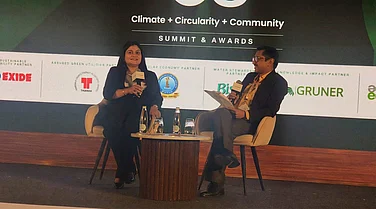
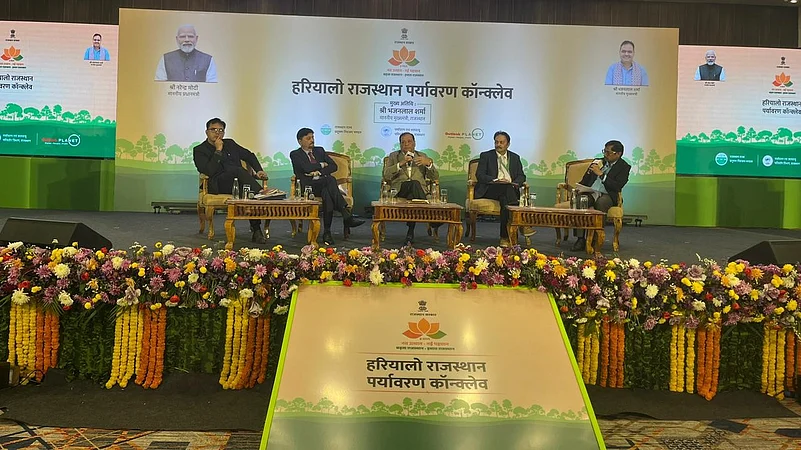
Rajasthan’s ambitious Green Budget 2025–26 took centre stage at a high-level panel discussion held in Jaipur on December 18, where policymakers, industry leaders and sustainability experts deliberated on the state’s roadmap for a green transition.
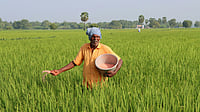
As India’s first state to present a dedicated Green Budget, Rajasthan has announced projects worth ₹27,854 crore, focusing on sustainability, renewable energy, water conservation and the creation of green infrastructure. Notably, 11.34% of the state’s total expenditure has been earmarked for sustainability-led initiatives, aligning climate goals with long-term development priorities.

1 April 2026
Get the latest issue of Outlook Business

The session was opened by Sudipto Dey, Editor of Outlook Planet, who reflected on his experiences in Delhi, highlighting the everyday awareness of air quality and environmental challenges in the capital. Earlier, Neeraj Thakur, Editor of Outlook Business discussed the critical trade-off between economic growth and sustainability, questioning whether India can continue to grow at 7–8% annually while meeting environmental and climate goals.

During the session, a panel of experts from government, industry, and research institutions shared insights on the implementation strategy envisioned in Rajasthan’s Green Budget 2025–26, highlighting pathways to strengthen climate resilience and accelerate sustainable growth across sectors. The discussions underscored Rajasthan’s ambition to position itself as a frontrunner in India’s climate action and green economy transition.
Bhuvenesh Mathur, Additional Chief Environment Engineer, RSPCB, said the country can grow economically while remaining sustainable, noting that the focus has shifted from mere compliance to circularity since 1992. He highlighted achievements in industries such as textiles and cement, where recycling and waste management practices have become mainstream.
Mahendra Singhi, Director & Strategic Advisor to Dalmia Cement (Bharat) Limited and Distinguished Fellow at TERI, emphasised that sustainability is profitable, citing the company’s low-carbon cement production, energy-efficient operations and innovative approaches such as converting waste and capturing flue gases for power generation. He noted that leveraging solar power and green technologies contributes to both cost reduction and environmental benefits.
Yogesh Narayan Mathur, Executive Director, Rajasthan Chamber of Commerce & Industry, stressed the need to raise awareness among micro, small and medium enterprises (MSMEs) about green energy, carbon credits and sustainability schemes, as most large industries are already informed but smaller players lag behind.
_1641838128.jpg?auto=format%2Ccompress&fit=max&format=webp&w=768&dpr=1.0)
Abhishek Kumar, Founder-Partner of Indicc Associates, discussed the “possible trinity” of economic growth, sustainability and capital allocation. Talking about ways to manage the trade-off between growth and sustainability, he said, “One way is to recalibrate the system to quantify the benefits of climate action.” He highlighted the importance of enabling capital to flow seamlessly across green projects, adding that “trade-offs can also be addressed by enabling capital to move seamlessly across projects and structures. A Green Budget can help leverage investor interest, but additional work is still needed.” He further emphasised the need to localise national climate commitments at the state level and reverse-engineer sectoral policies to assess how state incentives contribute to meeting national goals.
The panel also discussed the role of climate-resilient infrastructure, carbon capture and utilisation, financing mechanisms for risky green projects, and leveraging carbon credits to support start-ups and industrial transition. The creation of a state-level Climate Change Centre of Excellence, adaptation measures for vulnerable regions, and the integration of civil society, academic institutions, and industry stakeholders were highlighted as key enablers of a just and effective green transition.
Key themes of the discussion included building climate-resilient infrastructure, harnessing renewable energy to establish global capabilities, closing the circularity loop in manufacturing, fostering climate-tech start-ups and creating a robust financial and policy ecosystem to support Rajasthan’s sustainable development goals.