
Mamata Banerjee declares total assets of ₹15.4 lakh, with no house, car, or immovable property
Income stood at ₹23.21 lakh in FY25; majority of assets held in bank deposits, with minimal gold holdings
Among India’s least wealthy CMs as per ADR data; net worth has declined from around ₹30 lakh in 2016
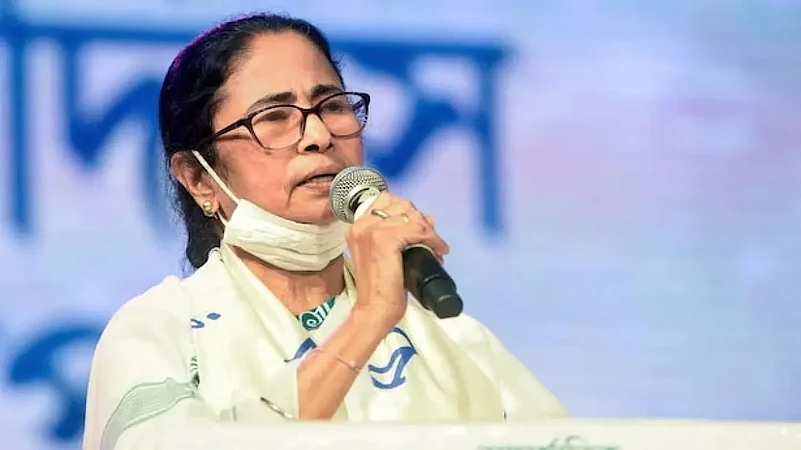
West Bengal Chief Minister Mamata Banerjee has declared total assets worth ₹15.4 lakh, placing her among the least wealthy chief ministers in the country, according to her latest election affidavit.
Her annual income stood at ₹23.21 lakh in FY25, up from ₹20.72 lakh in FY24. Her earnings were highest in FY22 at ₹38.14 lakh.

1 September 2026
Get the latest issue of Outlook Business

Banerjee, 71, is known for her austere lifestyle. As per her affidavit, she does not own a house, car, or any immovable property despite a long political career. She has also declared a tax deducted at source (TDS) refund of ₹40,600 for FY26.
Bank Balance, Gold Holdings
The bulk of her assets are held in bank deposits. She has ₹75,700 in cash, while her primary savings account with Indian Bank holds ₹12.36 lakh. A separate account for election-related expenses has a balance of ₹40,000, taking her total bank deposits to ₹12.76 lakh.
Banerjee owns 9.75 grams of gold, valued at around ₹1.45 lakh. Her total movable assets amount to ₹15.37 lakh.
Advertisement
She has declared no ownership of agricultural or non-agricultural land, residential property, or vehicles.
Lowest Among Peers
During the 2021 elections, Banerjee had a declared net worth of around ₹15 lakh, the lowest among 31 chief ministers at the time, according to data from the Association for Democratic Reforms (ADR). In contrast, Andhra Pradesh Chief Minister N. Chandrababu Naidu was the richest, with assets of about ₹930 crore.
Her net worth has declined from roughly ₹30 lakh in 2016.
Political Journey
Banerjee began her political career with the Congress in the 1970s before founding the All India Trinamool Congress (TMC) in 1998. She first entered Parliament in 1984, defeating veteran Communist leader Somnath Chatterjee, and went on to represent Kolkata South multiple times.
Advertisement
She served as Union Minister in various portfolios, including Railways, before becoming West Bengal’s Chief Minister in 2011—a position she has held since.

Bengal’s Economic Backdrop
Under Banerjee’s leadership, West Bengal’s gross state domestic product (GSDP) has grown from around ₹4.61 lakh crore in 2010–11 to an estimated ₹21.48 lakh crore in 2026–27. Growth has been largely driven by the services sector and welfare-led rural demand, supported by schemes such as Lakshmir Bhandar and Kanyashree.
At the same time, the state’s debt has risen sharply—from ₹1.9 lakh crore to nearly ₹7 lakh crore—amid increasing expenditure on welfare programmes. West Bengal’s industrial share, at 21.6%, remains among the lowest compared to other major states heading into elections.