
Lowering launch costs through high-payload capabilities, indigenous production of critical space-grade components, and unlocking the downstream satellite data economy will be crucial for India to emerge as the world's third-largest space economy, a senior DoT official said on Wednesday.
Department of Telecom, Member (Services), Deb Kumar Chakrabarti emphasised the need for structural reforms, policy changes and greater innovation in the space segment as India moves ahead on its global ambitions in the sector.
Citing a slew of government initiatives that have made the space sector attractive for companies, he said a proposed PLI with a corpus of around ₹600 crores "is coming up very soon".

1 September 2026
Get the latest issue of Outlook Business

On the policy front, the official urged comprehensive regulatory reforms, including strengthening the Indian National Space Promotion and Authorisation Centre (IN-SPACe) into a full-fledged regulator with enforcement powers.
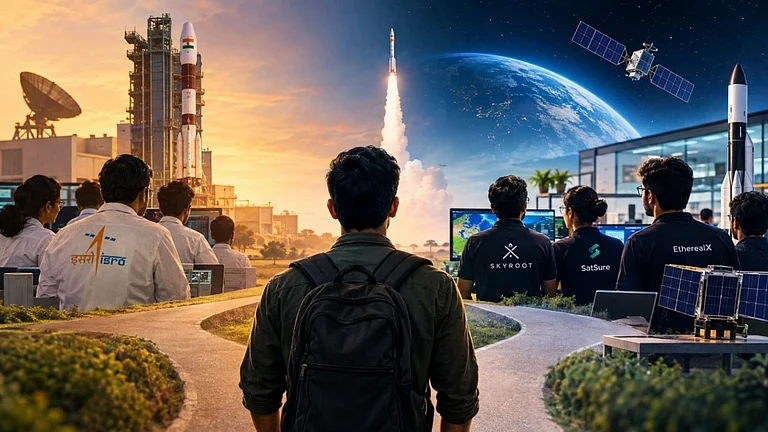


India is currently among leading spacefaring nations, placed at sixth position in space segment economy behind established players such as the US, China, UK, and France, and is aiming to become the world's third-largest space economy in the coming years, he said, addressing IAFI's Space Policy Conference 2026.
"...becoming the number three country in the space economy in the world... requires many structural changes and adjustments in different policies and regulations," he said.
Advertisement
The total space economy in India is $8.4 billion, with a goal of reaching $44 billion by 2033.
"...and the rank of the country will rise from number six to number three. I think it's a huge jump that we have planned in future," Chakrabarti added.
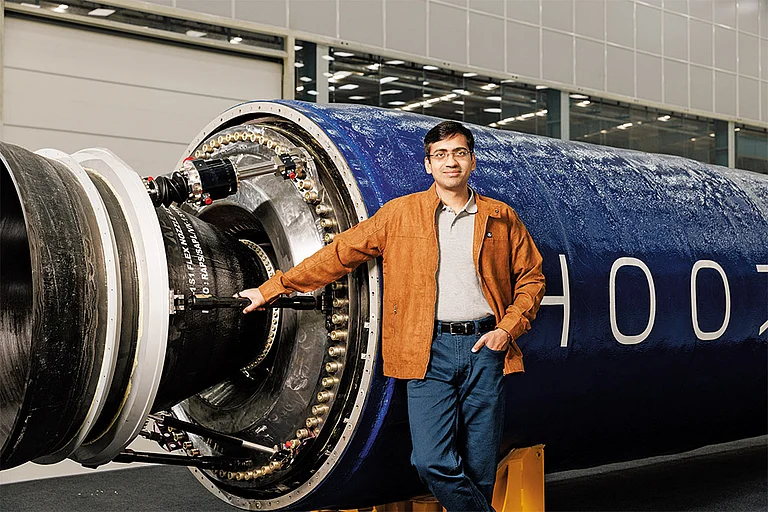
It is pertinent to mention here that Skyroot Aerospace's Vikram-1 became India's first privately developed rocket to successfully reach orbit, marking a historic milestone for the country's private space sector and commercial launch capabilities.
Outlining key priorities for the country, the DoT official noted that India has built a strong reputation in cost-efficiency and reliability in space tech, where startups like Skyroot and Agnikul are setting new benchmarks in lowering costs per kilogram in payloads.
Advertisement
Chakrabarti further said that the country must now move beyond small-payload launches and develop capabilities for high-payload launches to reduce costs further and remain globally competitive.
Citing SpaceX's Falcon as an example, he said higher payload capacity dramatically lowers per-kilogram launch costs.
"One of the sectors where India must concentrate and look into is the high payload sector and the per kg cost of launch to be reduced. The number two point is the material dependencies," he said, identifying import of space-grade materials as another major challenge that needs to be looked at.
India still relies on imports for critical inputs such as space-grade carbon fibre, radiation-hardened semiconductors and minerals including lithium, cobalt and titanium, making the sector vulnerable to supply chain disruptions and mission delays, he pointed out.
"For example, the space-grade carbon fibre...We do not make the semiconductors and the cosmic radiation-proof semiconductors. We do not make the critical minerals which are dependent on lithium, cobalt, and titanium...mostly we depend on China. As you depend on another country, there is a risk in the supply chain," he said.
The DoT official also drew attention to the monetisation structure.
Chakrabarti called for greater focus on the downstream space economy, noting that nearly 70% of global space revenues come from applications such as satellite data, geospatial analytics and earth observation, compared to about 30% from upstream activities like launch vehicles and satellite manufacturing.
"Upstream is important, but India's contribution, or what we are generating... the revenue is much below the 70% segment. So, it is important that we now concentrate on the 70% portion as well," he said.
Innovation, he said, is going to be an important factor here.
"Unless you actually come into the D2D mode, I don't think you are going to derive the best of the satellite broadband facility. And going into the device-to-device, a direct satellite signal catching into a mobile phone and talking and utilising it, is going to take some time," he said.
Chakrabarti also advocated reforms in intellectual property rights, third-party liability provisions and faster multi-ministry clearances to create a more investment-friendly ecosystem.
He also pushed for making IN-SPACe a "full-fledged regulator".
"If there is a non-licensed operation of the satellite services, as of today, there is no penalty for that. I think it's time to make that regulator a full-fledged regulator. Give them all the powers to put a penalty for...non-licensed operation and allow them to decide on the IPR and make the sector much more friendly for the users," he said.
He further called for stronger international coordination on orbital resource allocation and improved space debris management, saying these measures would be essential as India's role in the global space sector continues to expand.