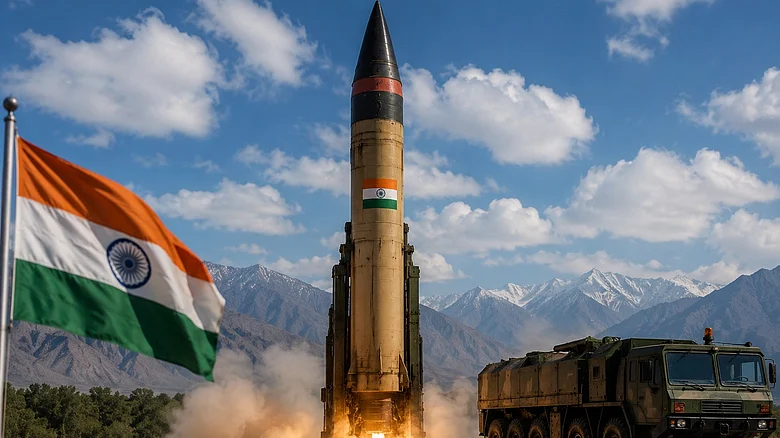

SIPRI estimates India had about 190 nuclear warheads as of January 2026, up from 180 a year earlier.
The report says India has deployed 12 warheads, marking the first time they have been classified as operationally deployed.
New Delhi continues to modernise its nuclear forces, with a focus on longer-range systems and sea-based deterrence capabilities.
India has deployed 12 nuclear warheads for the first time, according to the latest annual assessment by the Stockholm International Peace Research Institute (SIPRI), suggesting a possible shift in the country's long-standing practice of keeping warheads and delivery systems separate during peacetime.
The SIPRI Yearbook 2026, released on Monday, estimates that India possessed about 190 nuclear warheads as of January 2026, compared with 180 a year earlier. Of these, 12 were classified as deployed, while 178 remained in storage.

1 October 2026
Get the latest issue of Outlook Business

The report said India continued to modernise and expand its nuclear arsenal in 2025, alongside other nuclear-armed states, amid rising geopolitical tensions and a weakening global arms-control environment.
According to the report, India's deployment of a small number of warheads may be linked to the increasing use of canisterised missiles and deterrence patrols by nuclear-powered ballistic missile submarines.
The institute noted that India's nuclear triad—comprising aircraft, land-based missiles and submarine-launched systems—continues to mature, giving the country a wider range of nuclear delivery options.
Advertisement

Focus on China, Pakistan Remains Key Factor
SIPRI said India's modernisation programme is increasingly focused on developing longer-range weapons capable of reaching targets across China, while strategic planning continues to be influenced by its long-standing rivalry with Pakistan.
The report also noted that Pakistan continued to develop new delivery systems and accumulate fissile material in 2025, indicating that its nuclear arsenal could expand in the coming years.
Referring to the brief cross-border skirmish between India and Pakistan in May 2025, as per SIPRI, India targeted Pakistani bases linked to its nuclear arsenal but both sides took steps to avoid escalation.




Advertisement
The institute warned that growing reliance on nuclear weapons, combined with technological advances and geopolitical tensions, is increasing global nuclear risks.