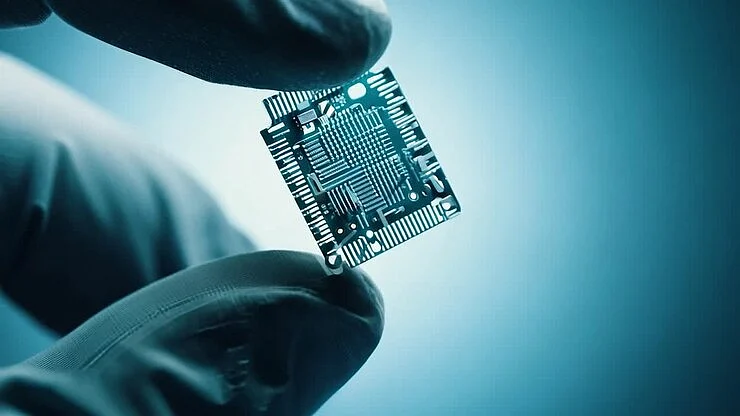

Researchers from the Chinese Academy of Sciences and Peking University designed the specialized neuromorphic chip
The processor achieved speeds between 50 and 478 times faster than Nvidia's A100 GPU in specific brain-mapping tests
By integrating an artificial neural network with a 40-nanometre memory component, the chip utilizes in-memory computing to eliminate data transfer lag
Chinese scientists have designed a brain-inspired microchip that can simulate intricate neural architectures in real time. The hardware executes specific tasks at speeds up to 478 times greater than Nvidia's A100 graphics processing unit, according to a peer-reviewed study in the journal Science.
Researchers from the Chinese Academy of Sciences and Peking University developed the novel processor.

1 October 2026
Get the latest issue of Outlook Business

This development introduces a specialised tool for mapping neural pathways rapidly, potentially altering how researchers simulate the human mind.

Innovative Memory Architecture
The processor merges an artificial neural network with a 40-nanometre memory component, utilising a technique known as in-memory computing.
Traditional computers experience lag because information continuously transfers between the processor and memory. The new architecture circumvents this by conducting both computation and storage within the identical memory array.
This unified approach significantly lowers energy usage and latency while speeding up intricate calculations.
Unprecedented Mapping Speed
The device can recreate the heavily convoluted exterior of a human brain in less than half a second.
Advertisement
Depending on the specific assignment, the chip yielded performance levels ranging from 50 to 478 times greater than the A100, a GPU extensively utilised for scientific computing and artificial intelligence.
The research group stated that their invention also beat current specialised brain-modelling accelerators by a significant margin, setting a new benchmark for this specific workload.
Medical and Interface Applications
Quicker neural simulations could enhance research into ailments such as Alzheimer's disease by enabling scientists to model structural brain changes with greater speed and precision.
Furthermore, the innovation might bolster brain-computer interface development, facilitating direct data exchange between external devices and the human mind.
Advertisement
Medical professionals could additionally benefit during surgeries, as the technology can produce comprehensive brain reconstructions in real time.
Specialised Workload Limitations
However, the scientists stated that the performance contrast with Nvidia's equipment is limited strictly to this particular, highly specialised task.
While the A100 serves as a versatile AI processor for diverse applications, the newly developed chip was engineered exclusively for mapping brain surfaces. Its effectiveness in alternative computing tasks and overall commercial viability are yet to be proven.
This breakthrough arrives as nations globally pour substantial investments into specialised chips and next-generation AI hardware.
Should upcoming evaluations validate its potential, the architecture could represent a major milestone in neuromorphic computing, a discipline focused on creating machines that process data similarly to the human brain.