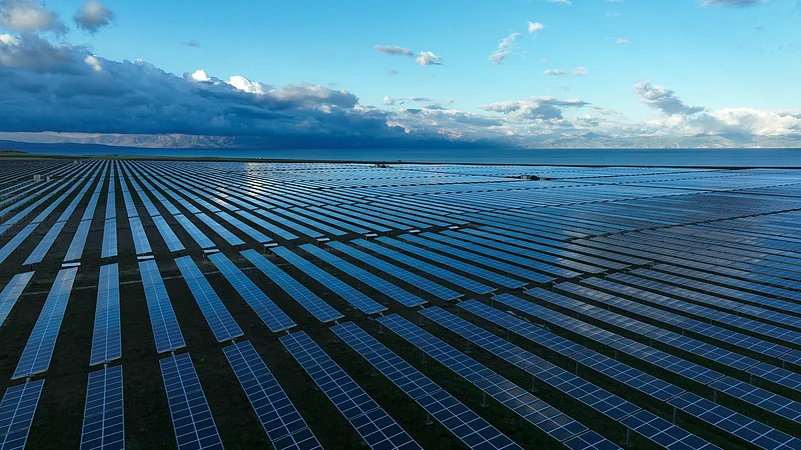

The Union Cabinet has approved a ₹5,070 crore scheme to develop 5 GW of floating solar capacity.
The programme will include energy storage systems with a combined capacity of 10,000 MWh.
The government expects the scheme to reduce carbon emissions and boost domestic clean energy manufacturing.
The Union Cabinet, chaired by Prime Minister Narendra Modi, has approved the Pradhan Mantri Surya Sarovar Yojana (PM-SSY), a ₹5,070 crore scheme aimed at expanding floating solar power projects across India.
The scheme will support the development of 5,000 MW of floating solar photovoltaic (FSPV) capacity along with energy storage systems. The government said the initiative will help increase renewable energy generation without requiring additional land.

1 September 2026
Get the latest issue of Outlook Business

India currently has around 700 MW of floating solar capacity. The new scheme will be implemented between FY2026-27 and FY2030-31, with financial assistance continuing until FY2032-33.
Floating Solar Capacity Gets Major Push
Under PM-SSY, floating solar projects will be developed with co-located energy storage systems capable of storing electricity for at least two hours. The programme aims to create a combined storage capacity of 10,000 megawatt-hours (MWh).
The scheme follows an assessment by the National Institute of Solar Energy (NISE), which estimated that India’s reservoirs and inland water bodies have floating solar potential of around 102.18 gigawatt-peak (GWp).
Eligible projects that are successfully commissioned will receive Central Financial Assistance (CFA) of ₹1 crore per MW. Developers can also receive up to ₹50 lakh per project for preliminary studies, including technical surveys, environmental assessments and other risk evaluation activities.
Advertisement
The government said the scheme will be available across all states and Union Territories, helping expand clean energy generation while reducing pressure on land resources.
Scheme to Cut Emissions, Boost Manufacturing
According to the government, PM-SSY is expected to reduce around 10 million tonnes of carbon dioxide emissions annually. The initiative is also expected to create 16,000-17,000 full-time equivalent jobs across the floating solar project value chain.
The scheme is aimed at strengthening domestic manufacturing of floating platforms, solar cells, modules and battery storage systems. The government said it will support the Aatmanirbhar Bharat initiative by encouraging local production in the renewable energy sector.
Advertisement
The Cabinet approval comes as India continues to rapidly expand its solar power capacity. According to the Ministry of New & Renewable Energy, India became the world’s second-largest market for annual solar capacity additions in 2025, behind China.
India’s Solar Capacity Expansion Accelerates
India’s installed solar capacity has grown sharply in recent years. After crossing 50 GW in 2022, the country added another 50 GW within three years and reached 154 GW of installed solar capacity by April 2026.
The country added 44.61 GW of new solar capacity in FY26, surpassing the government’s target of 34 GW. The addition was nearly double the previous annual record of 23.83 GW achieved in FY25.
India has set a target of achieving 500 GW of renewable energy capacity by 2030. As of April 2026, nearly half of the country’s 288 GW installed power capacity came from non-fossil fuel sources, including solar, wind, hydropower, nuclear and bioenergy.