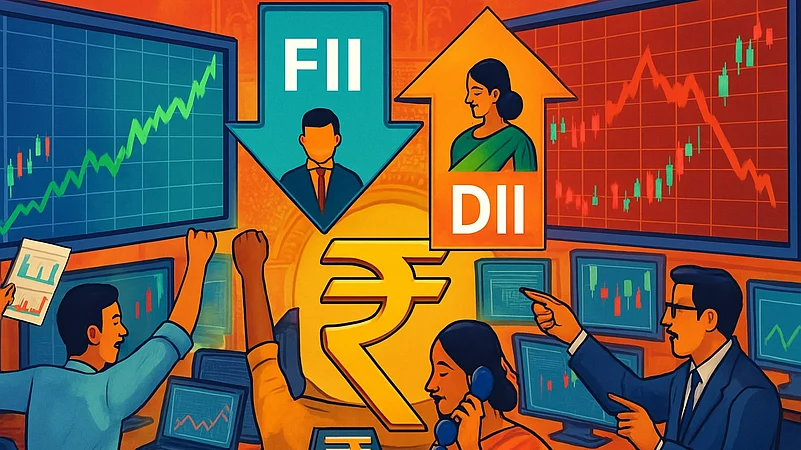

FIIs sell ₹49,000 crore in April despite 8.5% market rally
Global cues, US yields, valuation premium drive continued FII outflows
DIIs offset selling with ₹29,000 crore inflows, supporting market resilience
Even as Indian equity markets staged a strong recovery in April, foreign institutional investors (FIIs) continued to exit in large numbers, creating a striking divergence between market performance and foreign capital flows.
Benchmark indices such as the Nifty 50 and BSE Sensex have gained around 8.5% each in the first half of April, while broader markets have outperformed even further. The BSE Midcap 150 has risen 11%, and the BSE Smallcap 250 has surged 13%, reflecting strong domestic participation and improving sentiment following easing geopolitical concerns.

1 September 2026
Get the latest issue of Outlook Business

Yet, despite this rally, FIIs have continued their selling spree. After offloading nearly ₹60,000 crore in March, foreign investors pulled out another ₹49,481 crore from Indian equities in the first half of the month.




Selling in Both Phases Signals Deeper Concern
What makes the current phase unusual is that FIIs have been selling not just during market corrections but also during recoveries. According to Kotak Institutional Equities, foreign investors sold $14.2 billion during the February–March correction and continued to offload an additional $3 billion even as markets rebounded. This has taken total outflows in calendar year 2026 to nearly $19 billion.
Advertisement
Such behaviour indicates that the selling is not merely tactical or short-term. Instead, it reflects a broader lack of conviction among global investors regarding India’s near-term outlook relative to other markets.
"Indian equity markets witnessed relentless FPI outflows in the past 45 days," the brokerage noted, highlighting the persistence of the trend across different market phases.

Global Factors: US Yields, Dollar Strength, And Risk-off Sentiment
The key reasons behind this FII exodus are global macroeconomic factors that have made emerging markets, including India, less attractive in the short term.
Elevated US bond yields and a strong dollar have drawn capital back into developed markets, particularly the United States. The ongoing artificial intelligence-driven rally in US technology stocks has further intensified this shift, pulling global liquidity away from emerging economies.
Advertisement
Geopolitical tensions, especially the US–Iran conflict and broader instability in West Asia, have added to the risk-off sentiment. During March, this led to a spike in crude oil prices and heightened inflation concerns, prompting investors to reduce exposure to riskier assets.
"The drivers for FII outflows are familiar—elevated US yields, a strong dollar, India's valuation premium and the AI trade pulling capital back into US tech," said Ankush Jain, Director and Fund Manager at Steptrade Capital. "When geopolitical risk flared, risk-off simply accelerated what was already happening."
Sectoral Impact: Financials Lead the Outflows
The selling has been broad-based, but certain sectors have borne the brunt more than others.
Financial services, which carry significant weight in benchmark indices, have seen the largest outflows. FIIs sold ₹19,150 crore worth of financial stocks in the first half of April alone, accounting for nearly 40% of total outflows. This follows heavy selling of over ₹60,000 crore in the sector in March.
Consumer services and healthcare also witnessed significant selling, with outflows of ₹5,336 crore and ₹4,481 crore, respectively. Auto and oil & gas sectors saw withdrawals of ₹3,704 crore and ₹3,352 crore.
Even defensive and consumption-linked sectors such as FMCG, telecom and realty were not spared, indicating that the selling is not limited to specific themes but reflects a broader reduction in exposure.
Analysts note that the heavy selling in financials is partly structural. Given the sector's large weight in indices, any broad-based FII selling tends to disproportionately impact banking and financial stocks.

Domestic Investors Offset the Outflows
Despite persistent FII selling, Indian markets have shown resilience backed by Domestic institutional investors (DIIs).
DIIs have emerged as consistent buyers throughout 2026, providing a strong counterbalance to foreign outflows. In April alone, they have invested ₹29,696 crore, following massive inflows of ₹1.42 lakh crore in March and ₹38,423 crore in February.
On Monday, while FIIs recorded a net outflow of ₹1,059 crore, DIIs stepped in with net purchases of ₹2,966 crore, helping stabilise the markets.
"The structural story has changed. DIIs absorbed every FII exit without the market breaking," Jain said, pointing to strong SIP inflows of over ₹25,000 crore per month as a key support factor.
Hrishikesh Palve, Director at Anand Rathi Wealth also emphasised the growing maturity of domestic investors, noting that steady retail participation and institutional flows have created a more stable market structure.
Valuation Premium and Relative Underperformance
Another critical factor behind the continued outflows is India's valuation premium compared to other emerging markets.
Indian equities continue to trade at higher multiples, even as earnings growth remains uneven in the near term. This has made global investors more cautious, particularly when alternative markets offer better relative value.
Kotak Institutional Equities pointed out that markets such as South Korea and Taiwan have outperformed India in recent months, attracting stronger passive inflows. As a result, India's weight in global portfolios has declined.
This shift in allocation reflects a broader trend that global capital is moving towards markets that offer better near-term performance and valuation comfort.
FII Holdings Recover, But Not Fully
Interestingly, while FIIs have been net sellers, the value of their holdings has rebounded due to the recent market rally.
Assets under custody (AUC) of FIIs rose to $805 billion as of April 15, marking a 9.5% increase from the end-March low of $735 billion. However, this is still 2.5% lower than the $826 billion recorded at the end of December 2025.
This suggests that while market gains have improved portfolio values, they have not been sufficient to offset earlier losses or restore full confidence among foreign investors.
While April has seen significant outflows of ₹41,350 crore so far, this is lower than the sharp ₹1.17 lakh crore exit recorded in March. Additionally, February had seen net inflows of ₹22,615 crore, indicating that FII flows can turn positive when conditions improve.
"FIIs are not structurally negative on India, but are reacting to global cues," said Palve. "As global conditions stabilise, we can expect them to return."
Disconnect May Not Last Forever
The current disconnect between market performance and FII flows highlights a transition phase in India's equity markets.
On one hand, strong domestic participation has reduced reliance on foreign capital, making markets more resilient. On the other, global factors continue to influence FII behaviour, leading to short-term volatility.
Looking ahead, analysts believe that India's strong macro fundamentals, expected 12% earnings growth in FY27, and improving trade dynamics with the US and EU could eventually bring foreign investors back.
For now, though, it's clear that the market's strength is being driven more by domestic investors than foreign money.