
Gold prices up 58% YoY near ₹1.55 lakh ahead of Akshaya Tritiya
Silver outperforms with 170% gains, driven by strong industrial demand
Experts see gold at ₹1.7–1.85 lakh, digital assets gain traction
Gold prices are entering Akshaya Tritiya 2026 on a volatile yet strong footing, with the yellow metal gaining nearly 2% so far this month after a sharp correction in March, as geopolitical tensions and shifting rate expectations weighed on global markets.
In March 2026, gold across purity levels—24K, 22K and 18K—fell around 14% amid escalating US–Israel–Iran tensions and broader risk-off sentiment. However, prices have stabilised since, with 24K gold currently trading around ₹1.57 lakh per 10 grams in early April.

1 September 2026
Get the latest issue of Outlook Business

Despite recent volatility, the longer-term trend remains firmly positive. Since last year's Akshaya Tritiya (April 30, 2025), when gold was priced at ₹97,910 per 10 grams, prices have surged nearly 58.7%, underlining strong investor demand and its role as a hedge against uncertainty.
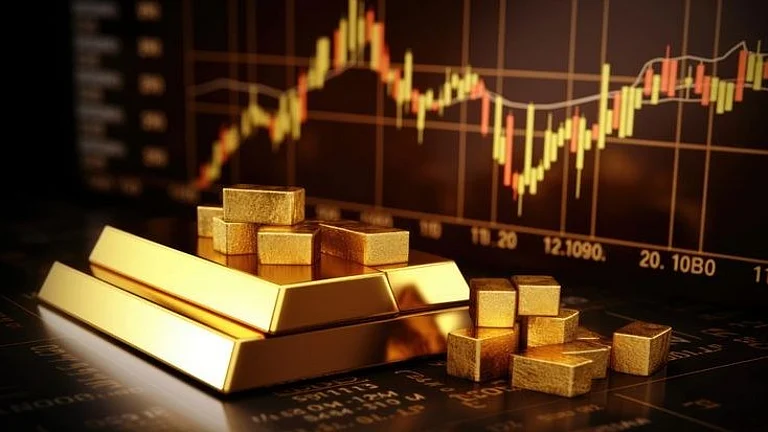
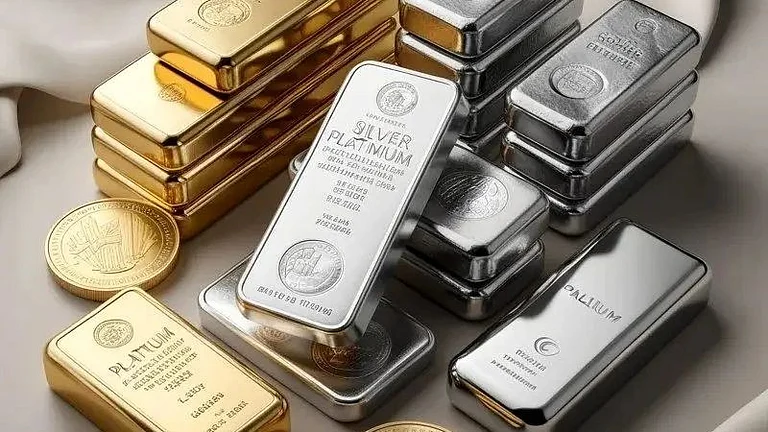



Strong Long-term Performance Keeps Gold Attractive
Gold's consistent performance around the festival has strengthened its appeal among investors. Since 2018, the metal has delivered positive returns each year during Akshaya Tritiya, with an average annual gain exceeding 25%. Over the past nine years, gold prices have risen nearly 435%, reinforcing its status as a long-term wealth compounder.
Advertisement
"Gold has delivered a strong performance over the past five years, consistently yielding positive returns year-over-year around Akshaya Tritiya. The momentum has been particularly striking in the last two years," said Deveya Gaglani, Senior research analyst- commodities of Axis Securities.
Globally, gold saw sharp swings this year, with Comex gold hitting a record $5,598 in January before correcting to $4,098 in March due to profit booking and ETF outflows. The correction coincided with a spike in crude oil prices—from $60 to $115 per barrel—fuelled by geopolitical tensions, which altered inflation expectations and reduced gold’s immediate safe-haven appeal.
However, easing tensions and falling crude prices have helped gold stabilise again, restoring investor confidence ahead of the festive buying season.
Advertisement
Silver Outshines Gold, Driven by Industrial Demand
While gold remains the traditional choice, silver has significantly outperformed over the past year. Prices have jumped from around ₹1 lakh per kg last Akshaya Tritiya to nearly ₹2.70 lakh per kg and delivering gains of about 170%, almost three times that of gold.
In April 2026 alone, silver has gained nearly 6%, even after a sharp 15–16% correction in March.
This divergence is largely due to silver's dual role as both an industrial and investment metal. Demand from sectors such as solar energy, electronics and green technology has supported long-term consumption, even as short-term industrial slowdown impacted sentiment earlier.
"Silver is also outperforming on industrial demand,' said Ajay Lakhotia, Founder and CEO of StockGro, adding that the broader structural story for precious metals remains intact despite short-term corrections.

Outlook Remains Positive
Experts remain optimistic about gold's trajectory over the next year, supported by macroeconomic uncertainty, central bank buying, and potential shifts in interest rates.
"We expect gold prices to maintain a positive bias in 2026. Prices may retest the $5,300–$5,500 range globally, implying a 10–15% upside. Domestically, prices could reach ₹1.7 lakh to ₹1.85 lakh," Gaglani said.
Echoing this view, Renisha Chainani, Head of Research at Augmont. noted that gold could move towards ₹1.8–1.9 lakh by Akshaya Tritiya 2027, driven by geopolitical tensions and sustained central bank demand.
However, near-term movements will depend on global factors such as interest rates, inflation trends and currency movements.
Changing Buying Behaviour: Digital Gains Ground
High gold prices are also reshaping consumer behaviour. Buyers are increasingly shifting towards low-carat jewellery, lightweight designs, and digital investment options.
"Indian buying behaviour has fundamentally changed. High prices have pushed consumers toward minimalist jewellery and digital investment tools like ETFs and digital gold," said Chainani.
Ajay Lakhotia added that exchange-traded funds (ETFs) are gaining traction as they help investors avoid making charges, which can erode returns by 15–20% in physical purchases.
Prashant Pimple of Baroda BNP Paribas MF also highlighted that digital gold formats offer advantages in terms of liquidity, cost efficiency and ease of monitoring, making them increasingly attractive for modern investors.
Festive Demand and Portfolio Role Remain Intact
Despite price volatility, Akshaya Tritiya continues to be a key driver of gold demand in India, with estimates suggesting 20–25 tonnes of domestic demand during the festive week.
"Gold is consolidating around ₹1.5 lakh levels, offering a compelling entry point for jewellery buyers ahead of Akshaya Tritiya," said Ghanshyam Dholakia of Founder and Managing Director, Hari Krishna Group.
Beyond jewellery, gold continues to play a crucial role in portfolio allocation.
"Gold remains a haven against economic uncertainty, a hedge against inflation, and an important tool for diversification," said Pimple, adding that allocation to gold in any form remains essential.
Bitcoin Emerges as A New-age Alternative
Interestingly, alongside traditional gold buying, digital assets like Bitcoin are also gaining traction among younger investors.
"Bitcoin is being quietly embraced as a new addition to family wealth portfolios," said Nischal Shetty, Founder of WazirX, noting that the asset has delivered 17% gains year-to-date and 11.8% year-on-year.
While gold remains the primary choice for auspicious occasions, Bitcoin is increasingly seen as a complementary asset offering liquidity and global accessibility.
As Akshaya Tritiya approaches, gold presents a mix of short-term volatility and long-term strength. While recent corrections highlight sensitivity to global macro factors, the broader structural drivers like central bank demand, inflation hedging and geopolitical uncertainty are remain intact.