Tata Power targets 3 lakh rooftop solar installations across Uttar Pradesh.
Battery storage and financing schemes aim to boost affordable adoption.
Rural outreach and subsidies expand clean energy access across regions.
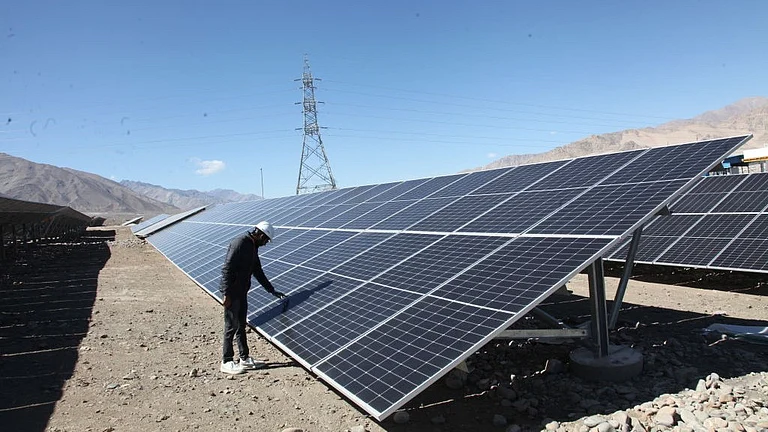
Tata Power has launched the 'Ghar Ghar Solar' campaign in Lucknow, aiming to transform Uttar Pradesh into a major clean energy hub. The initiative seeks to install 3 lakh rooftop solar systems over the next three years, supported by a mix of state and national subsidies that make adoption more affordable for residents.
To ensure round-the-clock power reliability, the company has also introduced Battery Energy Storage Systems tailored for both homes and businesses. Flexible financial schemes featuring zero down payments and easy monthly instalments have been established to lower the barrier to entry for consumers.

1 October 2026
Get the latest issue of Outlook Business

Furthermore, the 'Mera Gaon, Mera Solar' project extends these efforts to rural areas through strategic banking partnerships and community incentives. Ultimately, this comprehensive strategy aims to foster energy independence and significantly reduce carbon emissions across the region.
Praveer Sinha, CEO & MD of Tata Power, stated in the news release, “Uttar Pradesh has emerged as one of India’s fastest-growing rooftop solar regions, supported by strong policy momentum and rising consumer demand for clean energy.” Sinha further added that the company aims to make rooftop solar more accessible and affordable by combining battery storage with easy financing under one integrated platform through ‘Ghar Ghar Solar’ campaign.
Advertisement
"With plans to undertake 3 lakh rooftop solar installations across the state over the next three years, we remain committed to supporting sate’s journey towards becoming a leading solar energy hub while empowering consumers with sustainable energy solutions," he asserted.
Storage Powers Transition Growth
The International Energy Agency (IEA) report published on May 29, 2026 highlighted that battery storage is becoming central to modern power systems, stating that it is “taking on a larger system role” as renewable energy deployment expands.
The IEA report underscored that falling battery costs and rapid scaling are enabling solar-rich grids to manage variability more effectively, improving reliability for consumers and utilities alike.
Advertisement
This shift is particularly relevant for rooftop solar models, where storage can bridge daytime generation with evening demand. In India, policy momentum under schemes such as PM Surya Ghar is further accelerating distributed renewable adoption, with storage integration emerging as a key enabler for residential and commercial systems seeking round-the-clock clean energy access and greater grid independence.