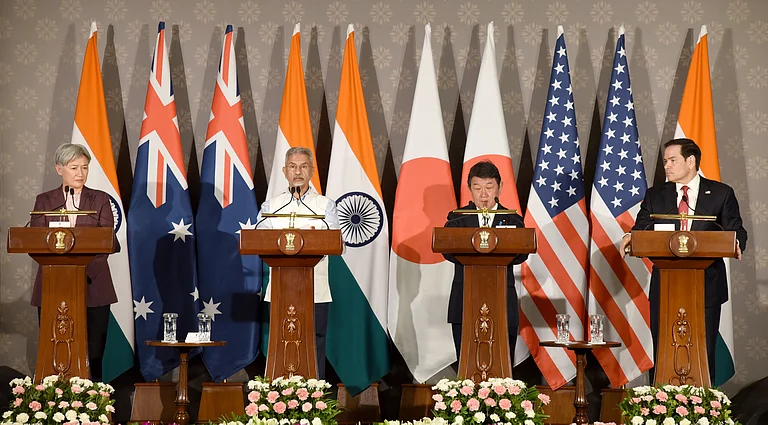
The four Quad partners including India, Japan, Australia and the United States have geared up to mobilise up to $20bn investment to strengthen critical mineral supply chains, as a key step to reduce import dependence and support local industries, reported The Economic Times.
The Quad Critical Minerals Initiative Framework released on May 26 states the intent to mobilise up to $20bn in government and private sector support through new and existing efforts to strengthen critical minerals supply chains, including in mining, processing and recycling through various actions.

1 October 2026
Get the latest issue of Outlook Business

The framework identified key areas for cooperation on critical minerals supply chains among Quad partners while duly considering each partner’s domestic policies and priorities. The countries will collaborate to develop secure critical mineral supply chains that support advanced technologies, economic growth, and resilience of their industrial bases.
The nations will work together to speed the development of diversified and equitable critical mineral markets and support the supply of critical minerals needed for the region’s economic growth and security through the use of economic policy tools and aligned investment.
The four countries will now work to identify projects with a Quad nexus, such as projects located in partner countries, projects operated by companies headquartered in the four countries or projects supplying the four countries, that address gaps in the critical mineral supply chain.

Advertisement
Supply Chain Push
According to The Economic Times, critical minerals such as lithium, cobalt, nickel and rare earth elements have become increasingly important for sectors including electric vehicles, battery manufacturing, renewable energy systems and electronics production. Several countries are now looking to diversify supply chains and reduce import dependencies as demand for these minerals rises globally alongside the clean energy transition.
A 2025 report by the International Energy Agency stated that critical minerals such as lithium, cobalt, nickel, copper and rare earth elements are vital for fast-growing energy technologies like electric vehicles, wind turbines, electricity networks and battery storage systems. These minerals are deemed “critical” because any supply disruption can have a major impact on clean energy transitions, industrial production and economic security globally.