India is poised to become a global textile recycling hub, with circularity turning waste into economic value.
The textile sector is shifting to reuse and recycling, supported by digital tools and global sustainability norms.
Industry players are scaling circular practices, with digital infrastructure aiding sustainability efforts.
Circularity in the textile sector refers to a regenerative, closed-loop approach that reduces waste and pollution by extending the lifecycle of products and materials. Instead of the traditional “take-make-dispose” model, it emphasizes designing for durability, repair, reuse, and recycling of materials.
Speaking at Outlook Planet C3 in a Panel Discussion on ‘Making Circularity Work In the Textile Sector – Digital Passport To Plastic Circularity’, Chandrima Chatterjee, SG, CITI said, “India is well-positioned to emerge as a global hub for textile recycling. What was once seen as waste is now clearly an economic opportunity and a critical enabler in the sector’s growth journey.”

1 October 2026
Get the latest issue of Outlook Business

"Today, most spinning mills have already developed in-house capacity to recycle their own waste, recognising it as a source of value rather than a cost.”
On the role of digital infrastructure in advancing sustainability in the textile sector, Surojit Bose, Sustainability and ESG leader, Intueri Consulting said that India’s rapid progress on digital infrastructure is set to play a critical role in advancing sustainability in the textile sector.
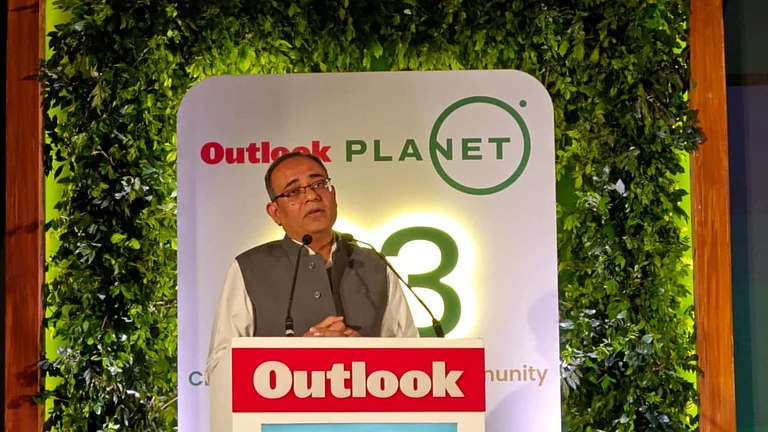
"This will be particularly important in meeting emerging global requirements such as digital product passports, which are expected to become mandatory in the European Union."
Advertisement
Naresh Tyagi, CSO, Aditya Birla Fashion & Retail said, “We launched our ‘Re-Earth’ programme with a clear vision to give back more to the ecosystem than we take from it.”
“Under the Re-Earth mission, we identified ten key focus areas, including energy, carbon, product, packaging, water, social impact, and safety. We assessed our entire business landscape to determine what was most critical, with the understanding that internal alignment must come first—before extending efforts outward.”

Bharat B Mehta, VP, Reliance Industries emphasized that sustainability remains a paradox, consumers demand greener products, but at low cost, which has historically constrained adoption.
Advertisement
However, recent geopolitical disruptions, particularly around the Strait of Hormuz, have begun to shift this dynamic by driving up fossil fuel-linked input costs.